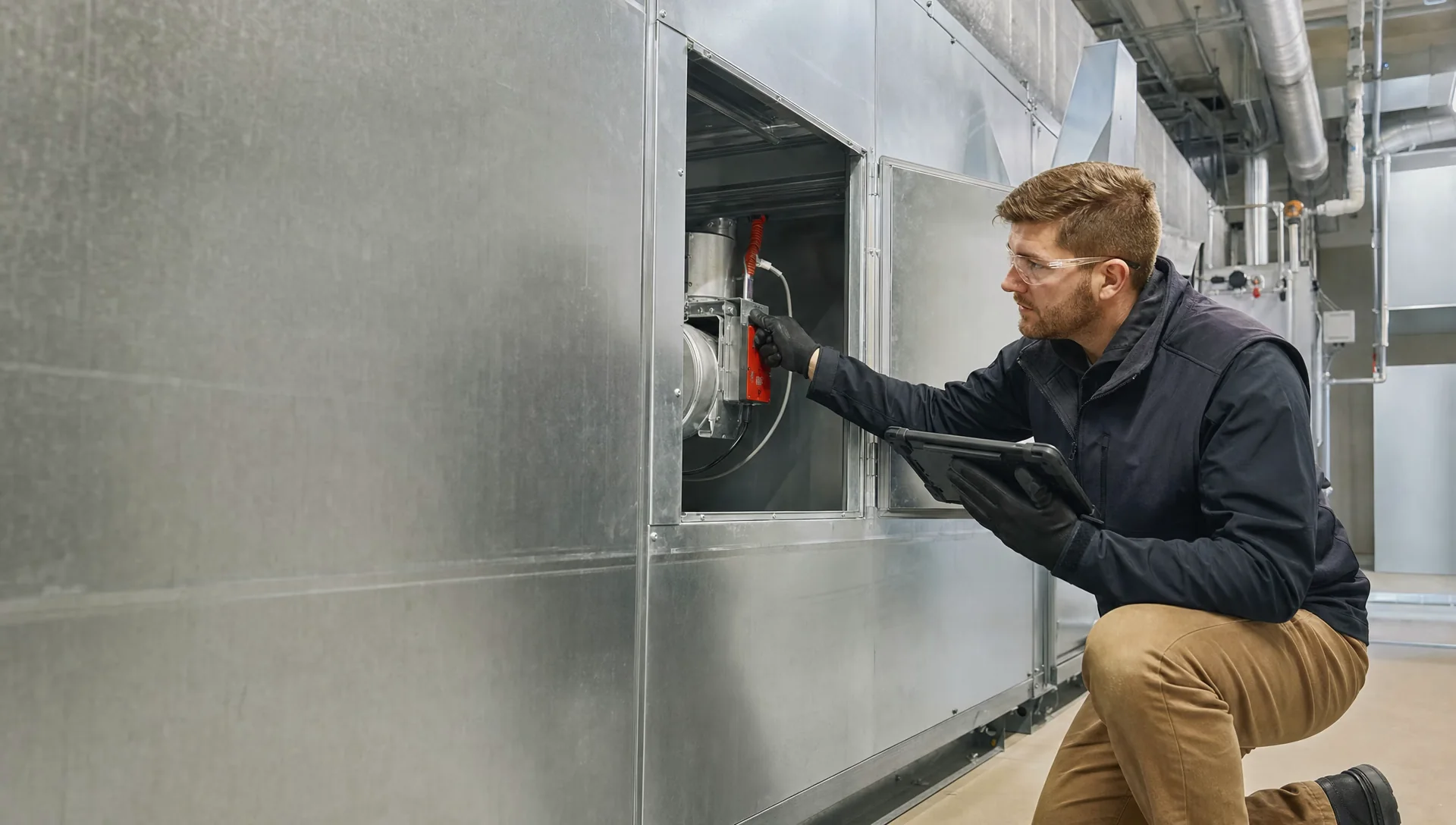
Fire Damper Inspections Documented to NFPA 80 and NFPA 105
A damper that won't close is a hole in your fire barrier — and you won't know until it's tested. Service-Tech locates, tests, and documents fire and smoke dampers with per-damper photo evidence your AHJ and accreditation surveyors will accept.
- NADCAMember since 1990
- 100,000+Facilities serviced since 1960
- 4.9Rated across 187 Google reviews
- Veteran-ownedUS Army veteran ownership since 2019
What a Fire Damper Inspection Covers
Fire dampers and smoke dampers are the moving parts of your building's passive fire protection: they sit where ductwork penetrates rated walls and floors, and they must close when heat or smoke arrives. A code-required inspection verifies each damper can actually do that. The scope covers locating every damper (many buildings have no accurate damper inventory), gaining access, operating the damper — including the drop test that confirms full, unobstructed closure — and documenting condition, deficiencies, and corrective needs damper by damper.
This service lives within our Commercial Air Duct & HVAC Cleaning practice for a practical reason: dampers live inside ductwork, and the access discipline duct work requires is exactly what damper inspection needs.

Why Dampers Fail Silently — and Why Auditors Ask First
A fire damper can sit failed for decades without a single symptom. Air flows straight through an open damper whether or not the fusible link is intact, so nothing in daily operation reveals that the blades are seized, the link is painted over, or a retrofit cable tray is blocking the closure path. The only way a damper announces failure is during a fire — or during a test.
That is why fire marshals, AHJs, and healthcare accreditation surveyors ask for damper documentation early in any life-safety review: it is the record most likely to be missing or expired. For hospitals, campuses, and government buildings, an out-of-date damper file is a finding even if every damper happens to work.
Your Inspection Calendar Under NFPA 80 and 105
NFPA 80 (fire dampers) and NFPA 105 (smoke dampers) set the operational testing rhythm, and it is simpler than most facility teams expect:
| Milestone | Requirement |
|---|---|
| 1 year after installation | Operational test of each damper |
| Every 4 years thereafter | Periodic operational test — most commercial occupancies |
| Every 6 years | Hospitals, under the extended interval recognized by applicable authorities |
| After any barrier or duct work | Re-verify affected dampers |
Two practical notes. First, confirm the governing edition and interval with your AHJ — adopted code editions vary by jurisdiction, and your surveyor's expectations control. Second, the interval is only half the requirement: the standard expects documentation of each test, each deficiency, and each correction. An inspection that produces a one-line "all good" summary will not survive an audit. We help clients build the damper inventory and calendar once, then keep it current cycle over cycle.
Damper Inspection Bundled With Duct Cleaning: One Mobilization
National damper-inspection firms and duct cleaning firms usually arrive separately, each opening the same ceilings and cutting the same access. Service-Tech does both. When damper inspection rides along with duct cleaning — or with heavier scopes like industrial air duct cleaning — the access doors our cleaning crews install per code become permanent inspection access, the system downtime is shared, and dampers hidden behind decades of duct dust are actually found. The pairing consistently reduces combined cost and, more importantly, produces a damper inventory grounded in a crew that has physically traveled the entire duct system rather than sampled it.

What Inspectors Actually Find in Older Buildings
Sixty-plus years of working inside the region's building stock has taught us where damper programs go wrong. In older Ohio industrial and institutional buildings, the recurring findings are consistent: fusible links coated in process dust or paint so they cannot release; blades seized by corrosion in humid or unconditioned spaces; dampers walled in behind renovations with no access panel at all; and closure paths blocked by conduit, cable, or flex duct added long after the original installation. None of these show up in airflow or comfort. Every one of them means the fire barrier is compromised. This is also why an inspection by a firm that understands ductwork matters — recognizing that dust loading around a damper is both a life-safety and a housekeeping problem lets you correct the cause, not just the symptom.

Documentation That Survives an Audit
The deliverable is the product. Our damper reporting is built damper by damper: location, identification, test result, photo evidence of the tested condition, deficiency description where found, and a corrective recommendation. The package gives a surveyor what they ask for in the order they ask for it — inventory, test dates, results, corrections — so your compliance conversation is a document handoff, not a scramble. Keep it with your fire barrier and life-safety records; when the next cycle comes due, the prior report becomes the baseline and the inspection gets faster and cheaper.
How Service-Tech Inspects and Tests Dampers
- 01
Inventory and locate
We survey the duct system against available drawings and build or reconcile the damper inventory — including dampers no drawing shows.
- 02
Access
Existing panels are used where adequate; code-compliant access doors are installed where they are missing.
- 03
Test
Each damper is operated and drop-tested to confirm full closure without binding, with fusible links and closure paths checked.
- 04
Document
Per-damper photo record, result, and deficiency list.
- 05
Report and correct
You receive the audit-ready package plus quotes for corrective work, prioritized by severity.
What Damper Inspections Cost
Pricing follows damper count, accessibility, and building type, so every project is quoted after a site assessment — free of charge. Travel is factored into the quote across our 150-mile service radius from each office. Bundling with duct cleaning or with HVAC coil cleaning and Aeroseal duct sealing scopes shares mobilization cost across the program. Hospitals, universities, and government facilities are our most frequent damper clients; see more sectors on our industries page.
What Happens If Dampers Go Untested
Two failure modes, both expensive. The compliance failure arrives first: a fire marshal visit or accreditation survey finds no current damper documentation, and you inherit a finding with a deadline, performed at emergency speed and premium cost. The catastrophic failure is the one the code exists to prevent: a fire reaches a rated barrier and passes straight through an open damper into the next compartment. Every damper that has never been drop-tested is an unknown in that chain. Testing converts unknowns into either documented protection or a fixable deficiency list — and both outcomes are wins.

Get a damper inventory, test cycle, and audit-ready documentation — before the surveyor asks for it.
The Interval Is Set by Code, Not by Preference
- First inspection 1 year after installation. NFPA 80 requires each damper tested and inspected one year after it goes in.
- Then every 4 years. That is the standard interval for most occupancies.
- Hospitals every 6 years. NFPA 80 permits the longer interval in hospitals, and CMS has issued the corresponding waiver.
- Smoke dampers separately. NFPA 105 governs those, and the two sets are often mixed in one building.
- The AHJ can shorten it. A local fire marshal may require more frequent testing after a failure or for a given occupancy — the code figure is a floor, not a ceiling.
- Access is the practical constraint. A damper that cannot be reached cannot be tested, and NFPA 96-style access provisions apply to the duct it sits in. Where a unit is inaccessible, the fix is an access door, not a note in the file.
The deliverable is a dated record per damper: identifier, location, condition, whether it closed fully under test, and what was repaired — the document a life-safety survey asks for by damper, not by building.
Getting to the Damper Is Most of the Job
- Borescope first where access is poor. A camera through an existing opening confirms whether a unit is present, its type, and whether the blade is obstructed — before anyone cuts anything.
- Open the plenum and the run. Dampers sit at wall and floor penetrations, frequently above hard ceilings and behind duct insulation. The panel has to be opened properly and reinstated greasetight or airtight to its original rating.
- Clear what is blocking it. Debris and accumulated dust are extracted with HEPA capture rather than pushed further into the run — a damper that will not close is more often obstructed than broken.
- Prove full closure. The blade is released and observed closing fully, then reset and verified. A partial closure is a failure, not a pass with a note.
- Reinstate and record. Access panels reinstated to rating, and a dated record per damper: identifier, location, type, condition, whether it closed fully, and what was repaired.
Frequently Asked Questions
How often do fire dampers need to be inspected?
Under NFPA 80 and NFPA 105, dampers require an operational test one year after installation and then every 4 years in most occupancies, with a 6-year interval recognized for hospitals under applicable authorities. Confirm the governing edition with your AHJ — and remember the requirement includes documentation of each test, not just the test itself.
What is a fire damper drop test?
A drop test confirms the damper actually closes: the technician removes or releases the hold-open mechanism (such as the fusible link) and verifies the blades travel fully closed without binding or obstruction. It is the only way to know a damper will perform in a fire, because a failed damper passes air normally and shows no symptoms in daily operation.
What documentation will we receive?
A per-damper package: location and identification, test result, photo evidence, deficiency descriptions where found, and corrective recommendations. The format is built to answer AHJ and accreditation surveyor requests directly, and it becomes the baseline inventory for your next inspection cycle.
Can damper inspection be combined with duct cleaning?
Yes — and it should be. Dampers live inside ductwork, so the access, downtime, and ceiling work are shared when both happen in one mobilization. The access doors installed for cleaning become permanent inspection access, and a crew that travels the full duct system finds dampers a sampling-based inspection misses.
What happens if the inspection finds failed dampers?
Each deficiency is documented with photos and a corrective recommendation, prioritized by severity. Common repairs include freeing seized blades, replacing fusible links, clearing blocked closure paths, and adding access where a damper cannot be reached. You receive quotes for the corrective work, and the corrected dampers are retested and documented to close the finding.