
Industrial & Commercial Cleaning Services in Tampa, FL
On the Gulf coast, the cooling season never ends — and neither does the fouling inside your towers, coils, and ductwork. Service-Tech has cleaned Tampa Bay's building systems since 1980, from hotel kitchen exhaust to hospital air handlers to port-side industrial facilities.
- NADCAMember since 1990
- 100,000+Facilities serviced since 1960
- 4.9Rated across 111 Google reviews
- Veteran-ownedUS Army veteran ownership since 2019
Service-Tech Corporation provides industrial and commercial cleaning services across Tampa Bay from our staffed office at 14240 60th St N Suite B in Clearwater. We've served this market since 1980, and we hold Florida license CAC1819231. Unlike the janitorial franchises that dominate Tampa's commercial cleaning listings, we work inside your building's engineered systems — the air ducts, air handlers, cooling towers, and kitchen exhaust runs where Florida's climate does its real damage — and we document every project for the health inspectors, fire marshals, and insurers who ask.
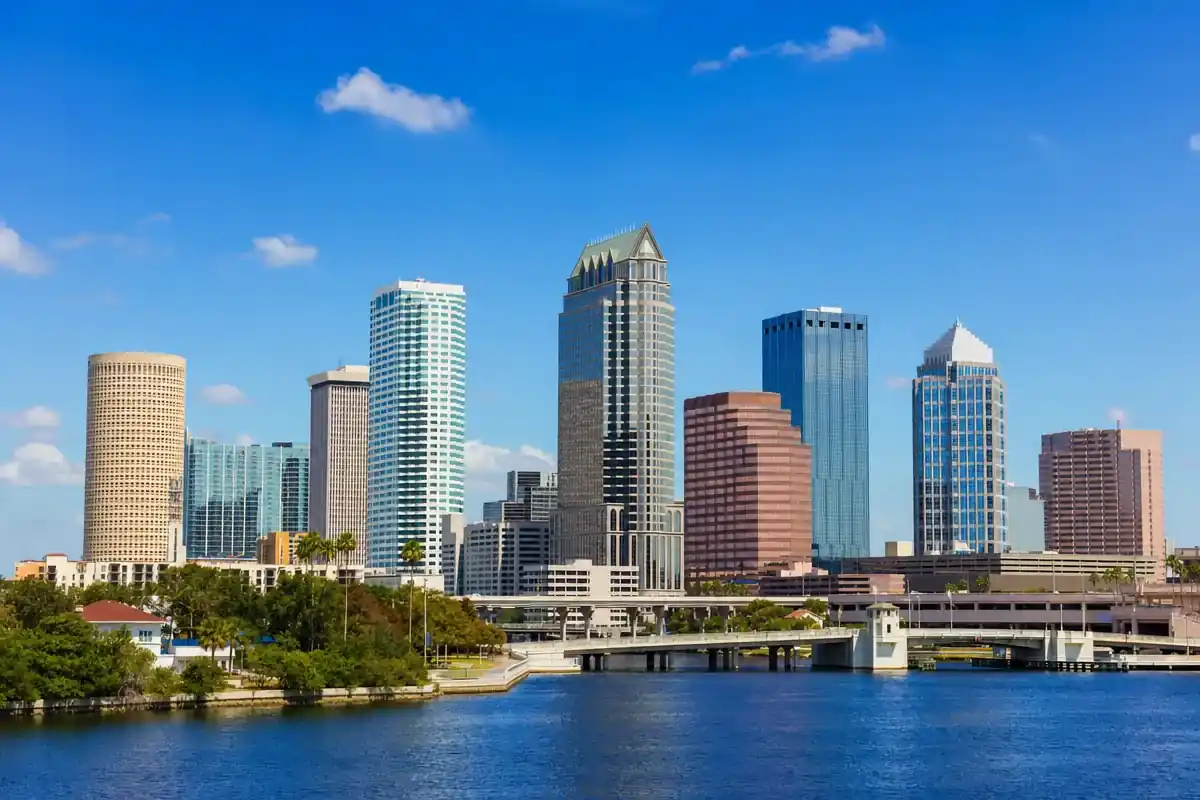
Humidity Is Tampa's Building-System Enemy
Every janitorial page ranking in Tampa talks about offices and floors. None of them mention the one force that actually governs facility maintenance on the Gulf coast: moisture.
Microbial growth in air systems. Tampa's dew points sit high for most of the year. Every air handler wrings that moisture out across its coils, and the combination of condensation, organic dust, and dark, warm plenums is a growth medium. The result shows up as musty odor complaints, dirtied coils running inefficiently, and contamination spreading through supply ductwork. Source-removal cleaning to the NADCA ACR standard — coils, plenums, and duct runs, not just a vacuum at the register — is the remediation that actually resets the system.
Cooling towers that never rest. In Ohio, towers get an off-season. In Tampa they run essentially year-round, which means fill fouling, basin sediment, and biofilm accumulate faster and the stakes are higher: fouled, poorly maintained towers are precisely the conditions ASHRAE 188 water-management programs exist to control. Regular mechanical cleaning of fill, basins, and distribution systems is what keeps your water-treatment chemistry working as designed.
Grease plus heat at hospitality scale. Tampa Bay's hotels, resorts, and waterfront restaurant economy run high-volume kitchens where grease loads exhaust systems fast. NFPA 96 requires cleaning of the entire exhaust path — hood, duct, and fan — on a schedule set by cooking volume, and the fire marshal and your insurer both check for the documentation.
Port and industrial Tampa. Port Tampa Bay's terminals, food-grade processing plants, and the distribution corridor along I-4 need industrial vacuuming, process-exhaust cleaning, and high-structure work that no office-cleaning franchise carries insurance or equipment for.
Storm season. After a hurricane or tropical system, wind-driven rain and prolonged power loss leave commercial buildings with moisture intrusion in spaces conditioned air passes through. Post-storm duct and air-system cleaning — assessed on site, scoped honestly — is part of getting a building back online.

Specialty Cleaning Services for Tampa Bay Facilities
All five service lines dispatch from our Clearwater office with Service-Tech's own trained technicians — part of a 50+ technician field team.
- Industrial cleaning — Industrial vacuuming, process-equipment and overhead cleaning for port terminals, food processors, and distribution facilities. Dry ice blasting at a $2,000 minimum engagement.
- Commercial air duct cleaning — NADCA ACR-standard source removal for humid-climate air systems: ducts, plenums, and air handlers in offices, hotels, healthcare, and schools. From $1,375.
- Cooling tower cleaning — Mechanical cleaning of fill, basins, and distribution systems for Tampa's year-round cooling loads. $1,375 minimum engagement.
- Kitchen exhaust hood cleaning — NFPA 96 hood-to-fan cleaning from $599 per cleaning for hotels, resorts, restaurants, and institutional kitchens, by an IKECA member company.
- Rope access services — Redundant two-rope systems and a documented fall-protection training program for high-rise, stack, and waterfront structure access without scaffolding.
Hospitality and healthcare portfolios often bundle towers, ducts, and hoods under one vendor and one compliance file. The complete service catalog is on our services page.
A Tampa Building-System Maintenance Calendar
Because the cooling season is continuous, Tampa maintenance runs on load and code cycles rather than seasons. A defensible cadence for a Tampa Bay facility looks like this:
| System | Cadence Driver | Practical Tampa Rhythm |
|---|---|---|
| Cooling tower | Year-round operation; water-management program | Mechanical cleaning aligned to your ASHRAE 188 plan, plus after any fouling event |
| Kitchen exhaust | NFPA 96 frequency by cooking volume | High-volume hotel/restaurant kitchens: verify your required interval and calendar it; we track it with you |
| Air handlers & coils | Humidity and condensate load | Inspection-driven; clean when coil fouling or microbial growth is documented |
| Ductwork | NADCA ACR assessment | Assess on a regular cycle; clean on evidence, not on the calendar alone |
| Storm readiness | Hurricane season (June–November) | Pre-season system check; post-storm moisture and contamination assessment |
We'll build this calendar for your specific building during a free site assessment — it's the difference between budgeted maintenance and emergency spend.
What Each Discipline Actually Involves
Tampa Bay's humidity drives the work: condensate, biological growth, and grease. Here is the physical process behind each service.
- Duct cleaning is source removal, and in this climate it is also moisture management. NADCA's ACR standard requires contaminants to be mechanically dislodged and extracted at once — brushes and air whips agitate the interior while the system stays under continuous negative pressure through HEPA filtration. Gulf-coast humidity turns condensate in an air handler into biological growth, and a shedding fibreglass liner is either encapsulated with an antimicrobial coating or replaced. ACR's gravimetric acceptance test is 0.75 mg per 100 cm².
- Cooling towers run harder here, so the cleaning sequence matters more. Cells are isolated and drained, basin deposits brushed out, and the loop dosed to 5–10 ppm free chlorine and circulated for at least an hour before mechanical cleaning (AWT and ASHRAE 188 guidance, which sets a twice-yearly minimum — at startup and shutdown of the cooling season). A year-round Florida cooling load and warm make-up water is exactly the condition ASHRAE 188 was written for. Mineral scale must be descaled; biofilm must be physically stripped.
- Hood cleaning is gauged, then cleaned to bare metal. NFPA 96 triggers a full exhaust-system cleaning at a comb-gauge reading of 0.002 in (50 µm) of grease depth, and immediate cleaning at 0.078 in (2,000 µm). Electrical is locked out first, flammable solvents are prohibited, and crews scrape and degrease the whole path from hood plenum to rooftop fan. Tampa's hospitality and stadium kitchens generate grease loads that put them at the frequent end of NFPA 96's Table 11.4 schedule.
- Combustible dust has a published action level. NFPA 660 sets it at a dust layer of 1/32 in (0.8 mm) across 5% of floor area, and prohibits compressed-air blowdown. Work is done with conductive vacuums bonded and grounded to the equipment, and confined spaces are purged, permitted, and monitored before entry.
- Rope access is a rigging discipline. Crews descend on two independently anchored lines — working plus backup — and use a rebelay (an anchor below the main one that takes the rope off the fall line) and deviations to hold the rope clear of an edge, reaching facades, stacks, and roof centres with no scaffold.
- Dry ice blasting leaves no secondary waste. Pellets at −109 °F embrittle the deposit and sublimate on impact, expanding up to 800 times in milliseconds; at Mohs 1.5–2 the medium is softer than the substrate, so equipment cleans in place without grit or water to collect afterwards (figures per Cold Jet). Because CO₂ gas is heavier than air, enclosed spaces are ventilated and the atmosphere monitored.
How We Work in Tampa Bay Facilities
Free site assessment.
A technician from the Clearwater office inspects your systems, photographs conditions, and delivers a fixed scope. Travel is factored into the quote.
Scheduled, contained execution.
Hotels get work windows that protect guest experience; hospitals get containment and negative air; kitchens get between-service scheduling; port and plant sites get safety-program coordination.
Documented closeout.
Before-and-after photos and a written service report — the file your fire marshal, health inspector, and insurance carrier expect to see.
Serving Tampa Bay Since 1980, Licensed in Florida
Service-Tech was founded in Cleveland in 1960 — family-owned 1960–2019, veteran-owned since 2019 under US Army veteran Gabriel S. Chick — and opened Tampa Bay service in 1980. We hold Florida license CAC1819231, NADCA membership since 1990, and IKECA membership, and we've serviced more than 100,000 facilities companywide. The Clearwater office is a staffed dispatch point, not a call-forwarding number: our own crews, our own equipment, on the ground in Pinellas County.

Service Area: Tampa Bay from Our Clearwater Office
(727) 539-7000
From 14240 60th St N Suite B, Clearwater, FL 33760 we cover a 150-mile radius across the Tampa Bay region — Hillsborough, Pinellas, and Pasco counties, including Tampa, St. Petersburg, Clearwater, Brandon, Largo, and New Port Richey, and the wider region beyond. Facilities elsewhere in Florida can check our service areas page — including our Tallahassee coverage.

Your towers, coils, and exhaust systems are fouling right now — that's just Gulf-coast physics. Get them assessed before the inspector or the odor complaint forces the issue.
Frequently Asked Questions
How fast can you respond to a Tampa Bay facility?
Our Clearwater office puts crews a short dispatch from most of Pinellas and Hillsborough counties. Standard work is scheduled after a free site assessment, Monday–Friday 8:30am–4:30pm; for unplanned shutdowns, contamination events, or post-storm needs we offer rapid emergency response at (727) 539-7000.
Which industries do you serve in Tampa Bay?
Hospitality (hotels, resorts, and their high-volume kitchens), healthcare, high-rise commercial and residential buildings with cooling towers, Port Tampa Bay terminals and food processors, distribution facilities, schools, and offices — any building whose engineered air, water, or exhaust systems need specialist cleaning.
What's your service radius from the Clearwater office?
150 miles, covering Hillsborough, Pinellas, and Pasco counties and the wider Tampa Bay region — St. Petersburg, Brandon, Lakeland, Sarasota-direction coverage and beyond. Travel is factored into your quote with no separate surcharge.
Are you licensed to do this work in Florida?
Yes — Service-Tech holds Florida license CAC1819231, and we've served the Tampa Bay market since 1980. We're also a NADCA member (since 1990) and an IKECA member company.
How often should a Tampa cooling tower be cleaned?
More often than the same tower in a northern climate, because Tampa towers run essentially year-round and foul faster. The right interval comes from your water-management program and the tower's actual condition — we inspect, clean fill, basins, and distribution systems at a $1,375 minimum engagement, and document condition so your ASHRAE 188 plan has evidence behind it.
Can you handle post-hurricane cleanup of air systems?
Yes. After storm-related moisture intrusion, we assess air handlers, plenums, and ductwork, then scope source-removal cleaning based on documented conditions — honest scope from an on-site assessment, not a blanket upsell. During storm season, booking a pre-season system check makes the post-storm call much simpler.
Request Your Free Estimate
Use the form below or call the office nearest you. For unplanned shutdowns, contamination events, or failed inspections, call rather than write — we mobilize rapid-response crews by phone.