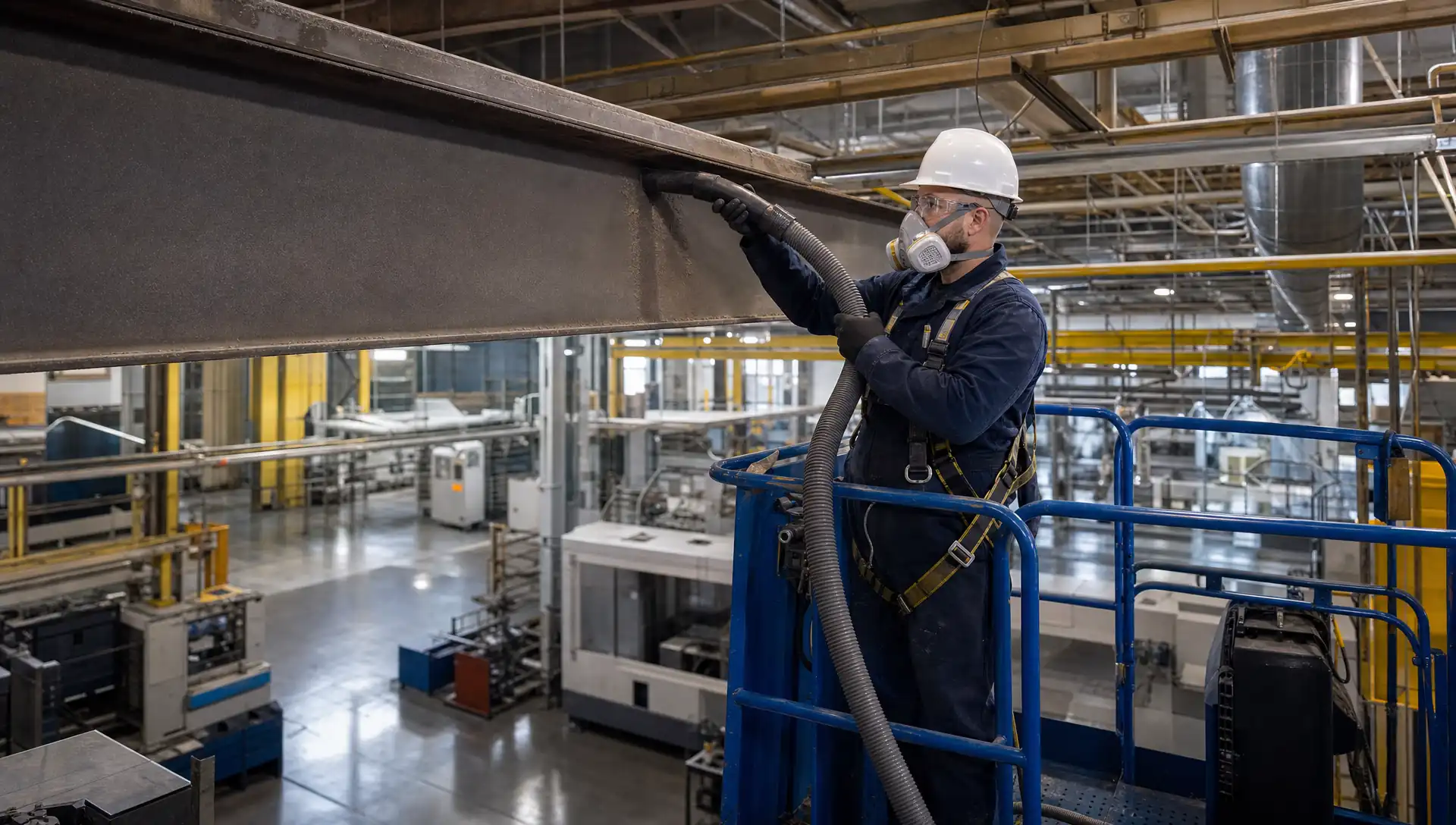
Combustible Dust Removal Aligned to NFPA 652
A Dust Hazard Analysis that flags accumulation is only step one — someone has to remove the dust with methods that don't ignite it. Service-Tech executes documented, NFPA-aligned housekeeping remediation for powder-handling plants.
- NADCAMember since 1990
- 100,000+Facilities serviced since 1960
- 4.9Rated across 185 Google reviews
- Veteran-ownedUS Army veteran ownership since 2019
What Combustible Dust Removal Involves
Combustible dust removal is the controlled cleaning of explosible dust — wood, grain, flour, sugar, metal powders, plastics, and many chemical intermediates — from the surfaces where it accumulates: overhead structure, beams and joists, cable trays, equipment housings, duct exteriors, and the concealed spaces above ceilings and inside chases that a walkthrough never sees. It is a compliance discipline within our Industrial & Facilities Cleaning practice, performed to close the housekeeping obligations that NFPA 652 places on any facility whose dust can burn.
The word "controlled" carries the weight. Removing combustible dust with the wrong method — compressed-air blowdown, unrated shop vacuums, dry sweeping that lofts fines — converts a settled hazard into an airborne one. The cloud you create while cleaning is the exact condition a deflagration needs.

The 1/32-Inch Rule: What an Inspector Actually Measures
Combustible dust enforcement runs on a startlingly small number. NFPA guidance and the OSHA Combustible Dust National Emphasis Program both work from accumulation thresholds on the order of 1/32 of an inch — roughly the thickness of a paper clip wire — across a meaningful fraction of a room's footprint, with overhead surfaces counting toward the total. Under those criteria, a plant that "looks a little dusty" can already be citable, because the layer on your joists, ledges, and duct tops adds up across thousands of square feet nobody looks at.
Two practical consequences. First, visual comfort is not compliance — depth-and-area criteria are measurable, and inspectors measure. Second, overhead and concealed surfaces dominate the math, which is why credible remediation is mostly work at height and behind access panels, not floor sweeping. Confirm the specific thresholds applying to your facility with your DHA consultant and AHJ; editions and commodity-specific standards (such as NFPA 654 for many industrial dusts) vary in the details, but the order of magnitude is the point: the margin is thin.
From DHA Finding to Closed Item
NFPA 652 requires facilities with potentially combustible dust to complete a Dust Hazard Analysis — and a DHA that flags accumulation creates an open item someone must close, with evidence. That closure work is Service-Tech's lane. The workflow that survives scrutiny:
- 01
Prioritize From the DHA
Findings are ranked by accumulation depth, dust type, and proximity to ignition sources; the cleaning sequence attacks the highest-risk zones first.
- 02
Method Plan
Surface-by-surface methods chosen for the dust class — vacuum-first collection with HEPA equipment with grounding and bonding controls, no blowdown, no dry sweeping of fines.
- 03
Controls During Work
Hot-work restrictions in the cleaning zone, coordination with your permit systems, and housekeeping of our own operation so cleaning never becomes the ignition event.
- 04
Documented Closure
Scope, areas, photo evidence before and after — the record that lets your safety team mark the DHA item closed and show an inspector or insurer exactly what was done, where, and when.
- 05
Frequency Recommendation
Accumulation rates observed during the work translate into a housekeeping interval, so the finding doesn't simply regrow.
Methods Matter More Here Than Anywhere Else
In ordinary industrial cleaning, a sloppy method costs quality. In combustible dust work, it can cost the building. Our discipline is explicit: HEPA-filtered vacuum collection with equipment with grounding and bonding controls appropriate to the dust; mechanical agitation only in coordination with active vacuum capture; absolutely no compressed-air blowdown of explosible dust — the practice that turns a layer into a cloud; and containment protecting adjacent operations while overhead work proceeds. Where caked residues on equipment surfaces resist vacuuming, our in-house dry ice blasting can remove them without adding water, chemicals, or blast media to a dust-sensitive environment — always scoped and sequenced so surface cleaning and dust collection work together rather than against each other.
When you evaluate any vendor for this work, ask three questions: What equipment do you use and how is it rated for my dust? What is your position on compressed air? What documentation closes the project? Wrong answers to the first two are disqualifying.

Why Housekeeping Is the First Line Cited After Dust Incidents
Post-incident investigations of dust explosions return to the same finding with grim regularity: the fuel was accumulation that housekeeping should have removed. A primary event — often small — lofts the dust layered on overhead surfaces, and that secondary cloud is what levels buildings. This is why OSHA's National Emphasis Program targets housekeeping directly, why insurers ask about dust programs at renewal, and why the layer on your beams is a different category of problem from ordinary dirt: it is the stored energy of a secondary explosion, measured in coverage area and depth.
Wood and grain operations, flour and sugar processors, metal powder and plastics plants, and chemical processors carry the heaviest exposure. Regionally, our Arkansas crews see grain and wood dust across the ag-processing belt, while Ohio manufacturing runs to metals and plastics — different dusts, same physics, and method plans built for each. Food-side powder plants get the dual benefit of coordination with our food plant sanitation practice, since overhead dust there is simultaneously a food-safety and fire-code finding. More sectors are on our industries page.

When to Act: The Triggers
- An open DHA finding — the compliance clock is already running.
- Insurer or AHJ findings — accumulation observations at inspection or renewal.
- Visible layering — dust approaching the 1/32-inch order on ledges, joists, or equipment tops.
- Before hot work — welding or cutting above or near accumulation is the classic ignition scenario.
- After process changes — new equipment or throughput changes accumulation rates and can invalidate old housekeeping intervals.
What Combustible Dust Removal Costs
Every facility is quoted after a site assessment: dust type, accumulation depth, square footage of affected surface (overhead area dominates), access, and required controls all drive the number. Free estimate — quote after site assessment. Travel is factored into the quote across our 150-mile service radius from each office. Many clients convert the initial remediation into a recurring housekeeping program priced per cycle — the structure NFPA 652 implicitly expects, and broader facility scopes can fold into an industrial plant cleaning program.
What's at Stake If Accumulation Stays
The downside here is not hypothetical. Layered combustible dust is the fuel load of a secondary deflagration — the mechanism behind the deadliest dust incidents on record. Short of catastrophe, the exposure is still expensive: OSHA NEP citations with abatement deadlines, insurance non-renewal or premium escalation when dust programs can't be evidenced, and production interruptions when an AHJ forces the issue on their schedule instead of yours. Documented removal, on a maintained interval, is the least expensive position a powder-handling plant can occupy.

Close your DHA housekeeping findings with documented, NFPA-aligned removal.
The Threshold and the Prohibited Method
NFPA 660 sets the housekeeping action level at a combustible dust layer of 1/32 in (0.8 mm) over 5% of a room's floor area, counted on beams, joists, ductwork and cable trays as well as the floor — which is why the layer nobody sees from ground level usually decides the answer. NFPA 652 requires a dust hazard analysis, and your analysis sets the frequency rather than a vendor's schedule. Compressed-air blowdown is prohibited outright: it converts a settled layer that can burn into a suspended cloud that can deflagrate, and the secondary explosion — the pressure wave lifting and igniting what was resting on the structure above — is what turns an incident into a total loss. Work is done with conductive tooling bonded and grounded to the equipment, HEPA capture at 99.97% of particles at 0.3 micron, and OSHA 1910.147 lockout-tagout on every energy source before anyone starts.

Frequently Asked Questions
How much combustible dust is too much?
Enforcement criteria work from accumulation on the order of 1/32 of an inch — about a paper clip wire's thickness — over a meaningful fraction of a room's surface area, with overhead surfaces counting. A plant can look merely dusty and already be citable. Confirm the exact thresholds for your dust and jurisdiction with your DHA consultant; the practical answer is that visible layering on structure deserves action.
Why can't we just blow the dust down with compressed air?
Because a suspended dust cloud is the explosion condition. Compressed-air blowdown converts a settled layer into exactly the airborne concentration a deflagration requires, in the presence of whatever ignition sources your plant contains. NFPA-aligned housekeeping uses vacuum-first collection with HEPA-filtered equipment with grounding and bonding controls — removal without suspension.
Does combustible dust removal close our DHA findings?
It closes the housekeeping items — with evidence. Our deliverable documents scope, areas cleaned, and before/after photo records so your safety team can mark accumulations findings closed and demonstrate abatement to inspectors and insurers. Findings about equipment, venting, or ignition control belong to your engineering consultants; we coordinate with them and handle the removal side.
Which dusts and industries does this apply to?
Any dust that can burn: wood and paper, grain and flour, sugar, most plastics, many metals (aluminum, magnesium, titanium among them), and numerous chemical powders. Woodworking, grain and food processing, metal powder operations, and plastics compounding carry the heaviest exposure. If your DHA classified your dust as combustible or explosible, this service applies to you.
How often does combustible dust cleaning need to happen?
At the interval that keeps accumulation below your facility's action level — which depends on how fast your process generates dust. During remediation we observe accumulation rates by zone and recommend a housekeeping frequency, so the program is grounded in your plant's data rather than a generic calendar. Process changes should trigger a re-check.