
Industrial Cleaning Services by Industry: The Standard Behind Every Facility
A food plant, a hospital, and a foundry don't clean for the same reason — or under the same rulebook. Since 1960, Service-Tech has matched the right method to the right facility across 100,000+ jobs.
- NADCAMember since 1990
- 100,000+Facilities serviced since 1960
- 4.9Rated across 111 Google reviews
- Veteran-ownedUS Army veteran ownership since 2019
Every Industry Cleans for a Different Reason
Generic "industries we serve" pages list verticals with a paragraph of adjectives each. Here's the version that's actually useful: in every industry, one or two specific standards or risks drive the cleaning program — NFPA 96 in commercial kitchens, combustible-dust housekeeping in manufacturing, ventilation hygiene expectations in healthcare, sanitation requirements in food production. Know your facility's driver and you know what to clean, how often, and what documentation you need when the inspector arrives. Below: the driver, the services that answer it, and the local market context for each vertical we serve.
Manufacturing & Heavy Industry
Northeast Ohio remains one of America's dense manufacturing corridors, and it's where Service-Tech has worked since 1960. The compliance driver here is combustible dust: settled dust on rafters, ducts, and equipment is a housekeeping hazard addressed by OSHA enforcement attention and NFPA's combustible-dust standards. Add process grime, overhead grime migrating onto product, and HVAC systems ingesting shop contaminants. We answer with industrial cleaning — combustible dust removal, high dusting, dry ice blasting of production equipment — plus commercial air duct cleaning for plant HVAC. Serving plants from Cleveland, Columbus, and Dayton.

Food & Beverage Processing
Food plants clean to protect product, audits, and schedules. Moisture is often the enemy: water-based cleaning near electrical, packaging, or dry-process equipment creates its own risks. That's why dry ice blasting is our flagship method here — no moisture, no chemical residue, no secondary waste — alongside food plant sanitation programs (from a $1,375 minimum engagement) and hygienic air system cleaning. Sanitation gaps in this industry don't produce warning letters alone; they produce recalls and lost production days. Our crews work inside sanitation windows measured in hours, sequence around production schedules, and leave the documentation your quality team needs for the next audit binder.
Healthcare & Hospitals
Hospitals and clinics clean air systems because ventilation is part of patient safety — ASHRAE's healthcare ventilation guidance sets expectations that facility teams must defend. Service-Tech performs commercial air duct cleaning with the containment and negative-pressure discipline occupied healthcare settings demand, plus institutional kitchen exhaust hood cleaning for hospital food service, and cooling tower cleaning where Legionella prevention is a named responsibility.

Data Centers & Critical Environments
Dust in a data hall is a threat to uptime: it insulates heat-generating components and rides airflow into equipment. Data center cleaning requires methods that generate no moisture, control particulate, and respect live infrastructure. Our industrial cleaning discipline covers data center cleaning, and dry ice blasting handles electrical and mechanical equipment without water or abrasives.

Education & Campus Facilities
Universities and school districts run a portfolio in miniature: classroom HVAC, dining hall exhaust systems, pools, plants, and towers — with hard scheduling constraints around breaks and semesters. One Service-Tech contract can cover duct systems, dining-hall hood cleaning to NFPA 96, and cooling towers across a whole campus, scheduled around your academic calendar. Campus facilities teams also inherit the widest audience of any vertical — students, parents, staff, and boards — which makes documented, standards-based work the difference between a routine line item and a public question.

Government & Municipal Facilities
Public buildings answer to public accountability: documented procedures, verifiable standards, and vendors with a track record procurement can defend. Service-Tech brings 66 years of continuous operation, NADCA membership since 1990, and documentation with every job — from courthouse air systems to municipal utility structures. For procurement teams, a vendor whose claims can all be verified — founding year, association memberships, public review history — is a vendor whose file writes itself.

Hospitality & Restaurants
For restaurants, hotels, and event venues, the driver is NFPA 96: kitchen exhaust systems must be inspected and cleaned at frequencies based on cooking volume, and fire marshals check the paperwork. Our IKECA-member kitchen exhaust hood cleaning starts from $599 per cleaning and covers hoods, grease ducts, fans, and filters — with documentation for your inspector and insurer.

Warehousing & Logistics
High-bay warehouses accumulate dust on racking, joists, and fixtures where it's expensive to reach and easy to ignore — until an insurance inspection or a sprinkler-system audit flags it. High dusting and rope access services let us clean at elevation without scaffold builds that block aisles and dock doors — which means receiving keeps receiving and picking keeps picking while the overhead work gets done.

Utilities, Chemical & Process Plants
Boiler houses, stacks, precipitators, and process structures combine elevation, confined spaces, and regulated waste streams. Service-Tech crews work on redundant two-rope systems under a documented fall-protection training program, taking cleaning to places lifts can't reach — stack cleaning, high-elevation washdowns, and confined-space work under our industrial cleaning discipline.

Aerospace & Advanced Manufacturing
The Dayton region's aerospace corridor demands contamination control with zero tolerance for abrasive damage or moisture intrusion on precision equipment. Dry ice blasting cleans tooling, fixtures, and production cells without media residue, and our Dayton office has served the region since ~1980.

Matching the Method to the Facility
| Facility priority | Wrong method | Right method |
|---|---|---|
| Food-contact surfaces, no moisture | Pressure washing | Dry ice blasting |
| Occupied building air systems | "Blow-and-go" vacuuming | NADCA-style source removal with containment |
| Grease-laden kitchen exhaust | Surface degreasing | Bare-metal cleaning per NFPA 96 |
| Live electrical / data hall | Wet methods | Dry ice blasting / controlled dry methods |
| High-elevation structures | Weeks of scaffolding | Rope access on two-rope systems |
Shutdown Windows Differ by Industry
Food plants clean during sanitation windows measured in hours; foundries book turnaround weeks a season ahead; hospitals phase work zone-by-zone because the building never closes; campuses compress everything into breaks; data centers require change-controlled access with zero disruption to live loads. Since 1960 we've planned around all of them. The practical advice is the same in every vertical: book the window as soon as the date is firm, get the site walked early, and lock the scope in writing — planned windows fill fastest in spring and fall turnaround seasons, and a scope agreed in advance is the difference between a window spent cleaning and a window spent negotiating. Tell us your window and we'll build the scope to fit it.

Example Projects
Three jobs from three different sectors — each one written up in full on our blog.
 Healthcare
Hospital HVAC Restored After a Fire
A fire forced a hospital to move about 150 patients. Service-Tech led four crews — about 30 technicians and 1,500 man-hours — through the 11 HVAC systems most critical to reopening, and the hospital reopened 10 days after the fire.
 Education
University Student Housing Exhausts
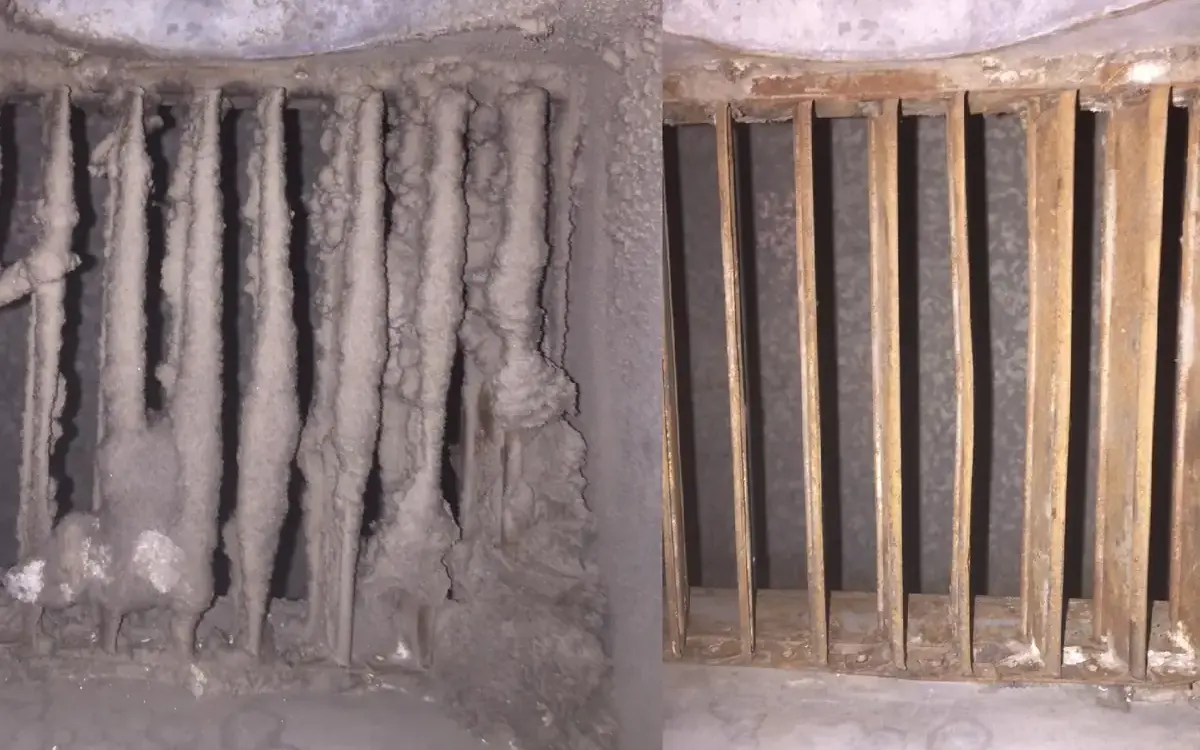
A major university asked Service-Tech to clean more than 150 bathroom exhaust systems in its student housing, so stale air leaves the rooms instead of drifting between walls and above ceilings.
 Sports & Entertainment
Cooling Tower Fill Pack at an Arena
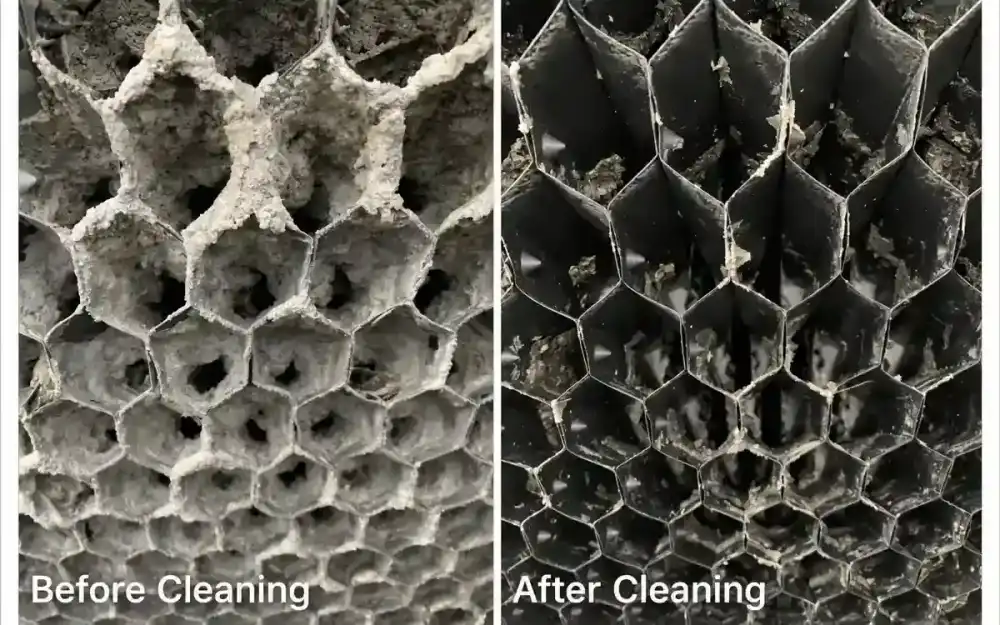
Construction dust, calcium and dirt clogged the fill pack of an outdoor sports arena’s cooling tower. A chemical cleaning process removed more than 85 percent of the buildup and restored full airflow.

Whatever your facility, there's a standard driving its cleaning program. Let's scope yours.
The Method Each Sector Actually Needs
Industry sector is a poor predictor of scope. What varies is the physical problem, and the method follows from that rather than from the sign over the door.
| Facility problem | The method it calls for |
|---|---|
| Combustible dust on beams, joists and equipment | Conductive vacuums bonded and grounded to the equipment; compressed air is prohibited |
| Hardened process residue on floors and vessel walls | Hydroblasting, with runoff contained, where vacuuming cannot lift it |
| Equipment that must be cleaned in place, dry | Dry ice pellets that sublimate on impact, leaving no medium behind |
| Grease-laden exhaust from continuous cooking | Lock out, then scrape and degrease from hood plenum to rooftop fan |
| Biofilm and scale in an open cooling loop | Isolate and drain the cell, dose and circulate, then jet the fill; descale separately |
| Contamination inside an occupied air system | Agitate and extract under continuous negative pressure with HEPA capture |
| Deposits above a live production line | Overhead work on rope, with technicians who descend to the position rather than scaffold to it |
| Anything requiring entry to a silo, pit or vessel | Purge, gas-test, permit, attendant, and monitor the atmosphere throughout |
Tell us the problem and we will tell you the method — including when the answer is a different kind of contractor.
Frequently Asked Questions
Which industries does Service-Tech serve?
Manufacturing, food and beverage processing, healthcare, data centers, education and campus facilities, government, hospitality and restaurants, warehousing and logistics, utilities and chemical processing, and aerospace. Since 1960 we've serviced more than 100,000 facilities across these verticals.
What cleaning standard applies to my facility?
It depends on the vertical: NFPA 96 governs commercial kitchen exhaust, combustible-dust housekeeping standards drive manufacturing, healthcare ventilation follows ASHRAE guidance, and food plants clean to sanitation and audit requirements. We'll identify the governing driver during your free site assessment and scope to it.
Can one contract cover different facility types?
Yes. Multi-site portfolios — a campus, a hospital system, a manufacturer with several plants — can put duct cleaning, hood cleaning, cooling towers, and industrial cleaning under one Service-Tech contract across Ohio, Florida, and Arkansas.
Why is dry ice blasting recommended for food and electrical environments?
Because it cleans without moisture, chemicals, or abrasive media, and leaves no secondary waste. That makes it safe for food-contact surfaces, electrical components, and precision equipment where water or grit would create new problems.
How much does industry-specific cleaning cost?
Commercial air duct cleaning starts from $1,375 and kitchen exhaust hood cleaning from $599 per cleaning; food plant sanitation and cooling tower cleaning carry a $1,375 minimum engagement, and dry ice blasting starts at a $2,000 minimum. Everything else is quoted free after a site assessment, with travel factored in.