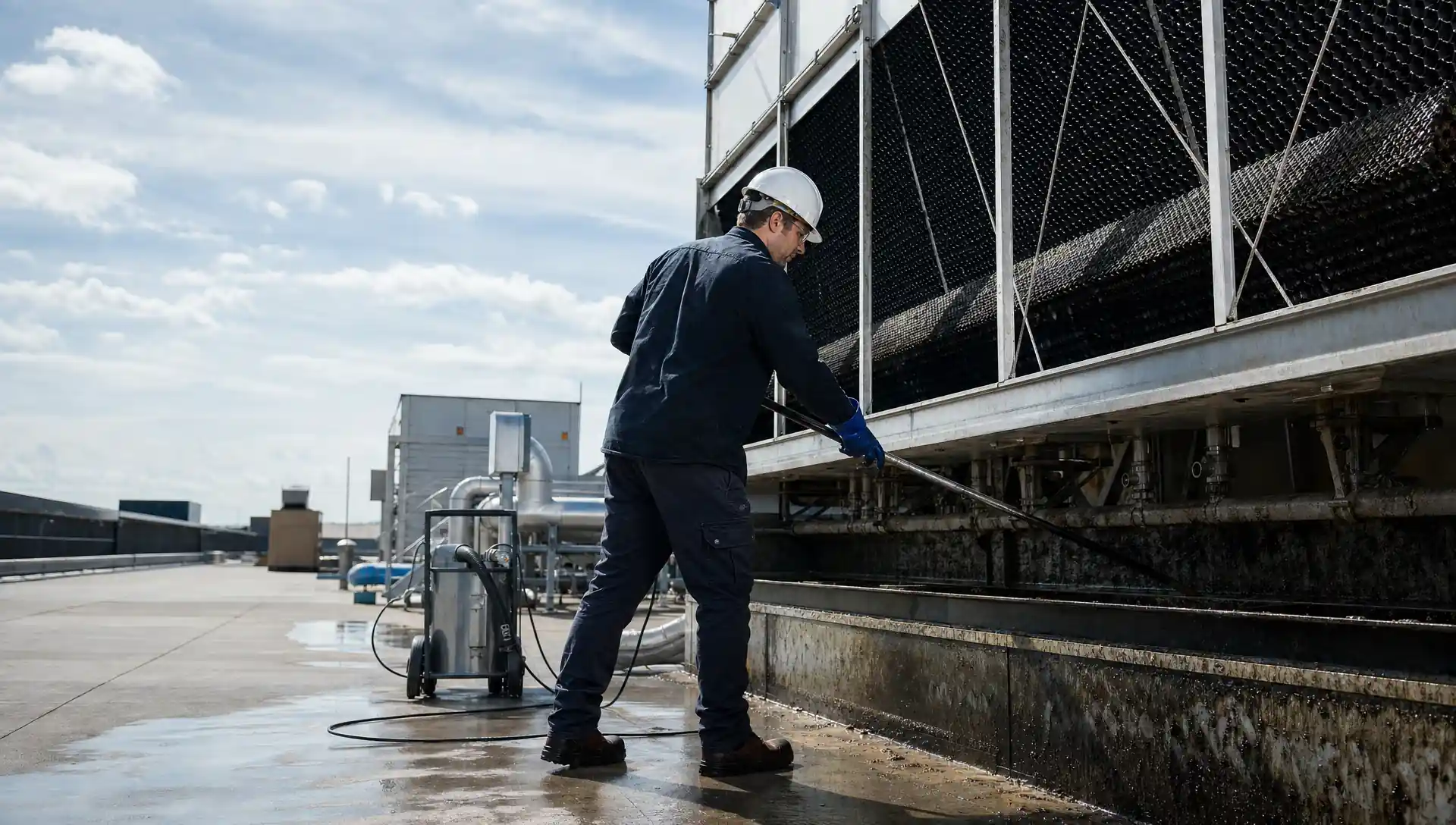
Cooling Tower Cleaning Services Aligned With ASHRAE 188
Your water management plan requires documented cleaning and disinfection. Your chiller plant requires clean fill. Service-Tech delivers both — the mechanical deep clean your water treatment vendor doesn't perform.
- NADCAMember since 1990
- 100,000+Facilities serviced since 1960
- 4.9Rated across 185 Google reviews
- Veteran-ownedUS Army veteran ownership since 2019
The Dirtiest Water in Your Building Is Also the Most Regulated
A cooling tower is an outdoor scrubber wired into your building's most expensive equipment. It inhales airborne dust, pollen, construction debris, and organic matter all season, concentrates them in warm recirculating water, and grows biofilm on every wetted surface. The result is the single highest-consequence hygiene point in a commercial facility: the primary amplification site for Legionella pneumophila, a drag on chiller efficiency, and — under ASHRAE Standard 188 — a documented control point your water management program is expected to inspect, clean, and disinfect.
Here's the gap in the market: the companies dominating cooling tower search results are water-treatment vendors. They own the chemistry — biocide programs, scale and corrosion inhibitors, water sampling — but the physical work of removing sediment from basins, cleaning fill media without destroying it, and washing down distribution decks is work many of them subcontract. Service-Tech Corporation is the mechanical deep-clean specialist on the other end of that subcontract: the crews, containment, and documented protocol that turn a water management plan's cleaning requirement into a completed, photographed, filed task. We've been cleaning building systems since 1960, and we coordinate directly with your water treatment vendor rather than competing with them.

What Cooling Tower Cleaning Includes
Cooling tower cleaning is the systematic removal of biofilm, scale, sediment, and organic matter from every wetted component of the tower, followed by disinfection — aligned with ASHRAE 188 water management practice.
- Basin and sump cleaning — vacuum removal of sediment, sludge, and debris from cold- and hot-water basins; see dedicated cooling tower basin cleaning
- Fill media cleaning — fill-safe methods that remove scale and biofilm from the tower's heat-transfer heart without collapsing or crushing the media
- Distribution deck and nozzle cleaning — restoring even water distribution so the tower actually delivers its design approach temperature
- Drift eliminator cleaning — removing the buildup that raises drift (and with it, the aerosol pathway Legionella rides)
- Structural washdown — louvers, casing, and accessible internals
- Disinfection — post-cleaning disinfection coordinated with your treatment program
- Photo documentation — before/after records formatted for your water management plan file
Why Tower Cleaning Is a Compliance Task, Not Just Maintenance
Legionella risk lives in the physical fouling. Biofilm and sediment are where Legionella colonizes and multiplies — sheltered from the biocide residual your chemical program maintains in the bulk water. That's why chemistry alone can't substitute for mechanical cleaning: a treatment program dosing against a sediment-loaded basin is medicating a wound it can't reach. CDC guidance and ASHRAE 188 water management practice both treat physical cleanliness of the tower as a control measure in its own right.
ASHRAE 188 expects documentation. If your facility operates a water management program — and for hospitals and many institutional buildings, that's an expectation with teeth — the program identifies the cooling tower as a control point with monitoring, cleaning, and corrective actions that must be performed and documented. An undocumented cleaning is, for audit purposes, a cleaning that didn't happen. Every Service-Tech tower project closes with dated photo documentation your facility engineer can file directly into the WMP records.
Efficiency is the quiet cost. Scale and fouling on fill media degrade heat transfer, raising the tower's approach temperature; the chiller compensates by working harder. Fouling also overloads the chemical program itself — treatment vendors dose against demand, and a dirty system creates demand. A mechanically clean tower is the precondition for both efficient operation and effective water treatment.
STC's 9-Step Cooling Tower Cleaning Protocol
The water-treatment pages ranking for this keyword explain why towers must be cleaned; almost none explain how. This is Service-Tech's published protocol — what your team can expect on site, step by step.
- 01
Safety review and permitting
Site-specific hazard review, coordination with your permit systems, and confined-space entry planning where basin or plenum access requires it.
- 02
Drain-down and containment
Controlled draining with debris containment, protecting roof drains and the surrounding area from sediment discharge.
- 03
Basin sediment removal
Vacuum extraction of sludge and sediment from basins and sumps — the reservoir where biofilm anchors and biocides fail.
- 04
Fill-media-safe cleaning
Low-impact washing and flushing techniques matched to your fill type and condition. Fill media is fragile: aggressive pressure washing shreds or collapses it, converting a cleaning into a five-figure fill replacement. Method-matching here is the difference between a specialist and a pressure-washing crew.
- 05
High-pressure washing where appropriate
Casing, louvers, decks, and structural components that tolerate it get pressure washed; components that don't, don't.
- 06
Disinfection
Post-cleaning disinfection of cleaned surfaces, executed to align with your water management plan's requirements.
- 07
Chemistry coordination
Handoff with your water treatment vendor so the treatment program restarts against a clean baseline — we do the mechanical work their program needs.
- 08
Refill and restart support
Systematic refill and return-to-service coordinated with your operations team.
- 09
Photo documentation
Before/after photo records and a completion report formatted for your ASHRAE 188 water management plan file.
Scale and Biofilm Are Two Different Jobs
Most tower-cleaning quotes treat the inside of a tower as one surface with one problem. It is two, they behave differently, and a job that addresses only one leaves the other in place.
| Mineral scale | Biofilm | |
|---|---|---|
| What it is | Calcium and magnesium carbonate deposited out of the make-up water | A living matrix of bacteria bound in the film it secretes |
| Where it collects | Fill media, distribution nozzles, heat-transfer surfaces | Basin floor, fill, drift eliminators, low-flow dead legs |
| What removes it | Descaling chemistry, circulated and then rinsed | Physical stripping — brushing and high-pressure jetting |
| What does not | Brushing alone; scale is bonded, not adhered | Biocide alone; chemistry cannot penetrate the film to the base layer |
| What it costs you | Lost approach and heat-transfer efficiency | Legionella risk and accelerated fouling |
That last row is the reason both matter. Scale is an energy problem. Biofilm is a health problem, and it is the one ASHRAE 188 was written about.
The Cleaning Sequence, and Why Order Matters
- 01
Isolate and drain the cell
Each cell is taken offline and drained so surfaces are accessible and the loop volume is known.
- 02
Dose and circulate before touching anything
The system is dosed to 5–10 ppm free chlorine and recirculated for a minimum of one hour. This kills what is suspended in the water and loosens the biofilm's outer layer — it does not remove it.
- 03
Strip mechanically
Basin floor and walls are brushed, and fill media, nozzles and drift eliminators are jetted with controlled high-pressure water to lift sludge and film that chemistry cannot reach.
- 04
Descale where scale is present
Where mineral deposit is bonded to fill or heat-transfer surface, descaling chemistry is circulated and then flushed — a separate step with separate chemistry from the disinfection dose.
- 05
Rinse, refill, and re-establish treatment
The system is flushed of residues, refilled, and handed back to your water-treatment programme with the bleed and cycles reset.
- 06
Culture-sample and document
A post-clean sample and a dated record with photographs is what your water management plan actually needs on file.
The Interval, and Who Sets It
ASHRAE 188 and most jurisdictions treat two complete cleanings and disinfections per year as the minimum — typically at startup and at shutdown of the cooling season. Towers with elevated culture results, or serving a high-risk occupancy, move to quarterly or monthly. CMS separately requires a water management programme in hospitals and long-term-care facilities regardless of state law, and OSHA's general duty clause applies to any employer whose tower exposes workers. Neither Ohio nor Florida operates a New York-style tower registration scheme today — but ASHRAE 188 is the standard of care a health department and a plaintiff's expert will both reach for after a case cluster, and the first document requested is the plan and its maintenance records.
Winterising Is Not the Same as Cleaning
A tower taken out of service for the season should be cleaned and disinfected before it sits, not after. Standing water in a drained-but-dirty basin over winter re-seeds the system, and a spring startup on a fouled tower distributes whatever grew there through the building's cooling loop on the first warm day.
When to Clean: Spring Startup, Fall Shutdown, and the Ohio Calendar
Standard industry practice — reflected in CDC and cooling-industry guidance — is to clean and disinfect towers at least twice per year, and the Midwest seasonal cycle makes the timing natural:
- Spring startup (Ohio/Midwest). A tower that sat idle over winter restarts with stagnant basin water and accumulated debris — the worst possible baseline for the season. Clean before startup, not after the first heat wave.
- Fall shutdown. Cleaning at layup removes the season's sediment load so it doesn't sit and corrode under deposits all winter.
- Year-round towers (Tampa, Tallahassee). Subtropical towers never get a layup window; cleaning is scheduled around load and coordinated shutdowns, and the fouling clock runs all twelve months.
Beyond the calendar, five triggers should move a cleaning up the schedule: water-sample exceedances or positive Legionella results, visible biofilm or algae, degraded thermal performance (rising approach temperature), construction or demolition dust nearby, and an upcoming health-department or insurance inspection. When a sample exceedance forces immediate action, Service-Tech provides rapid response scheduling — call (440) 735-1505.
For facilities that want the condition question answered before committing to scope, we offer a standalone cooling tower inspection and audit, and ongoing Legionella prevention and control support that ties cleaning cycles to your water management plan.
Who Needs Documented Tower Cleaning
- Hospitals and healthcare campuses — the tightest Legionella scrutiny and the clearest ASHRAE 188 expectations; cleaning documentation is inspection-ready evidence
- Data centers — cooling is uptime; fouled towers erode the thermal margin the whole facility depends on
- Commercial chiller plants and office towers — efficiency and tenant-safety exposure
- Food, beverage, and pharmaceutical process cooling — audit-driven environments where hygiene records are contractual
- Universities and district plants — multi-tower campuses that benefit from program contracts
See all industries we serve.
One Mobilization, Multiple Systems
A crew on your roof for tower cleaning is a crew already past your security, scheduling, and access hurdles. Facility managers increasingly bundle scopes on one mobilization: cooling tower cleaning plus commercial air duct cleaning for the air side, kitchen exhaust hood cleaning for foodservice buildings, and industrial cleaning scopes for plants — one vendor, one PM contract, one documentation standard across systems. For campuses and hospitals, that consolidation is often worth more than any line-item price difference.
Elevated and hard-to-reach towers are a Service-Tech specialty case: where a rooftop or structure-mounted tower would otherwise need cranes or scaffolding for access, our rope access services crews reach the work directly. Related heavy-wash scopes — industrial high-pressure washing and stack cleaning — ride the same mobilization.

What Cooling Tower Cleaning Costs
Service-Tech publishes what the water-treatment giants won't: cooling tower cleaning is a $1,375 minimum engagement, with a fixed-price quote after site assessment. What moves the number above the minimum:
- Tower size and cell count — each cell is its own basin, fill bank, and deck
- Sediment load — a tower cleaned annually vacuums out fast; a neglected basin is an excavation
- Access — grade-level towers vs. rooftop or elevated structures needing rigging or rope access
- Disinfection scope — coordination requirements with your water management plan and treatment vendor
- Scheduling — coordinated shutdowns and after-hours windows
The assessment is free, the quote is fixed, and travel is factored in — no separate surcharge.
What a Fouled Tower Costs You
- Legionella liability. An outbreak traced to a cooling tower means mandated shutdowns, public health investigation, litigation exposure, and a name in the news — the highest-consequence failure a building system can produce.
- Chiller efficiency loss. Fouled fill raises approach temperature and the chiller pays for it every operating hour.
- Fill media collapse. Sediment weight and biological loading destroy fill — replacement costs multiples of the cleanings that would have prevented it.
- Corrosion under deposits. Sediment blankets create the anaerobic conditions that eat basins from the inside.
- Failed reviews. Health-department scrutiny and insurance inspections increasingly ask for the WMP file — including cleaning records you either have or don't.
Proof: The Mechanical Specialist Behind the Water Program
Since 1960 — 66 years of building-systems cleaning · 100,000+ facilities serviced · 50+ field technicians · 150-mile service radius from every office · 4.9-rated across 185 Google reviews
Service-Tech Corporation has cleaned critical building systems since 1960 — family-owned from 1960 to 2019, veteran-owned since 2019 under US Army veteran Gabriel S. Chick. Tower crews operate from all six markets: Cleveland, Columbus, and Dayton in Ohio, plus Tampa, Tallahassee, and Pine Bluff — with a 150-mile service radius from every office, covering multi-site portfolios under one contract. Browse all services.

Cooling Tower Cleaning Services We Provide
Each service below is a dedicated capability with its own crews, equipment, and page — the depth behind this hub:
- Cooling Tower Basin Cleaning — fill-safe removal of the basin sediment Legionella grows in
- Legionella Prevention & Control — cleaning and disinfection behind your ASHRAE 188 water management plan
- Cooling Tower Inspection & Audit — fill, drift eliminators, basin, and structure graded, with a photo report
- Industrial High-Pressure Washing — wash-water containment and live-plant scheduling
- Stack Cleaning — deposit removal by rope access and confined-space-trained crews, camera documented

Your water management plan has a cleaning requirement with your name on it. Get it scoped, scheduled, and documented — $1,375 minimum engagement, fixed-price quote after a free assessment.
The Specification, in One Place
- Minimum frequency. Two complete cleanings and disinfections per year under ASHRAE 188, typically at startup and shutdown of the cooling season; quarterly or monthly where culture results are elevated or the occupancy is high-risk.
- Disinfection dose. 5–10 ppm free chlorine, recirculated for at least 1 hour before mechanical cleaning begins, rather than dosed and drained.
- Inspection interval. Visual inspection monthly through the operating season, against a twice-yearly deep clean.
- Technician qualification. ASHRAE 188 guidance points to ASSE certification as the benchmark for whoever performs the work — worth asking any contractor to evidence.
- Programme obligation. CMS requires a documented water management programme in hospitals and long-term-care facilities in all 50 states, independent of any local tower registration law.
- Biocide selection. EPA-registered products only, applied to the loop volume you actually calculated rather than an estimate.
Frequently Asked Questions
How Often Should a Cooling Tower Be Cleaned?
Standard industry practice is at least twice per year — typically at spring startup and fall shutdown in the Midwest — plus event-driven cleanings after water-sample exceedances, visible biofilm, nearby construction, or performance degradation. Towers running year-round, like those in our Tampa and Tallahassee markets, schedule around load rather than layup. Your water management plan may specify its own frequency; we clean and document to it.
Does Cooling Tower Cleaning Prevent Legionella?
Mechanical cleaning is a core control measure, not a standalone cure. Legionella colonizes biofilm and sediment, where it's sheltered from the biocide residual in bulk water — so removing that material physically is what makes your chemical treatment and monitoring program effective. ASHRAE 188 water management practice treats cleaning and disinfection as documented control activities; Service-Tech performs both and delivers the records for your file.
What Does Cooling Tower Cleaning Cost?
Cooling tower cleaning is a $1,375 minimum engagement, with a fixed-price quote after a free site assessment. Tower size and cell count, sediment load, access (grade-level vs. rooftop or elevated), disinfection scope, and scheduling drive the final number. Travel is factored into the quote — no separate surcharge.
Can You Clean Fill Media Without Damaging It?
Yes — and it's the most important technical question you can ask a tower cleaning vendor. Fill media is fragile; aggressive pressure washing crushes or shreds it, turning a cleaning into a fill replacement project. Service-Tech uses fill-safe washing and flushing methods matched to your fill type and condition, and reserves high-pressure washing for the structural components that tolerate it.
Do You Coordinate With Our Water Treatment Vendor?
Yes — by design. We're the mechanical arm of the program, not a competitor to your chemistry vendor. We schedule drain-down and disinfection with them, hand the system back at a clean baseline their treatment program can actually maintain, and document the work for the shared water management plan file.
What Is Included in the 9-Step Cleaning Protocol?
Safety review and permitting, drain-down with containment, basin sediment removal, fill-media-safe cleaning, high-pressure washing of appropriate components, disinfection, chemistry coordination with your treatment vendor, refill and restart support, and before/after photo documentation formatted for your water management plan records.
Can You Reach Rooftop or Elevated Towers Without a Crane?
In most cases, yes. Service-Tech's rope access crews reach elevated and structure-mounted towers directly using redundant two-rope systems under our documented fall-protection program — avoiding crane mobilization and extensive scaffolding. Access method is confirmed during the free site assessment and priced into the fixed quote.
Request Your Free Estimate
Use the form below or call the office nearest you. For unplanned shutdowns, contamination events, or failed inspections, call rather than write — we mobilize rapid-response crews by phone.