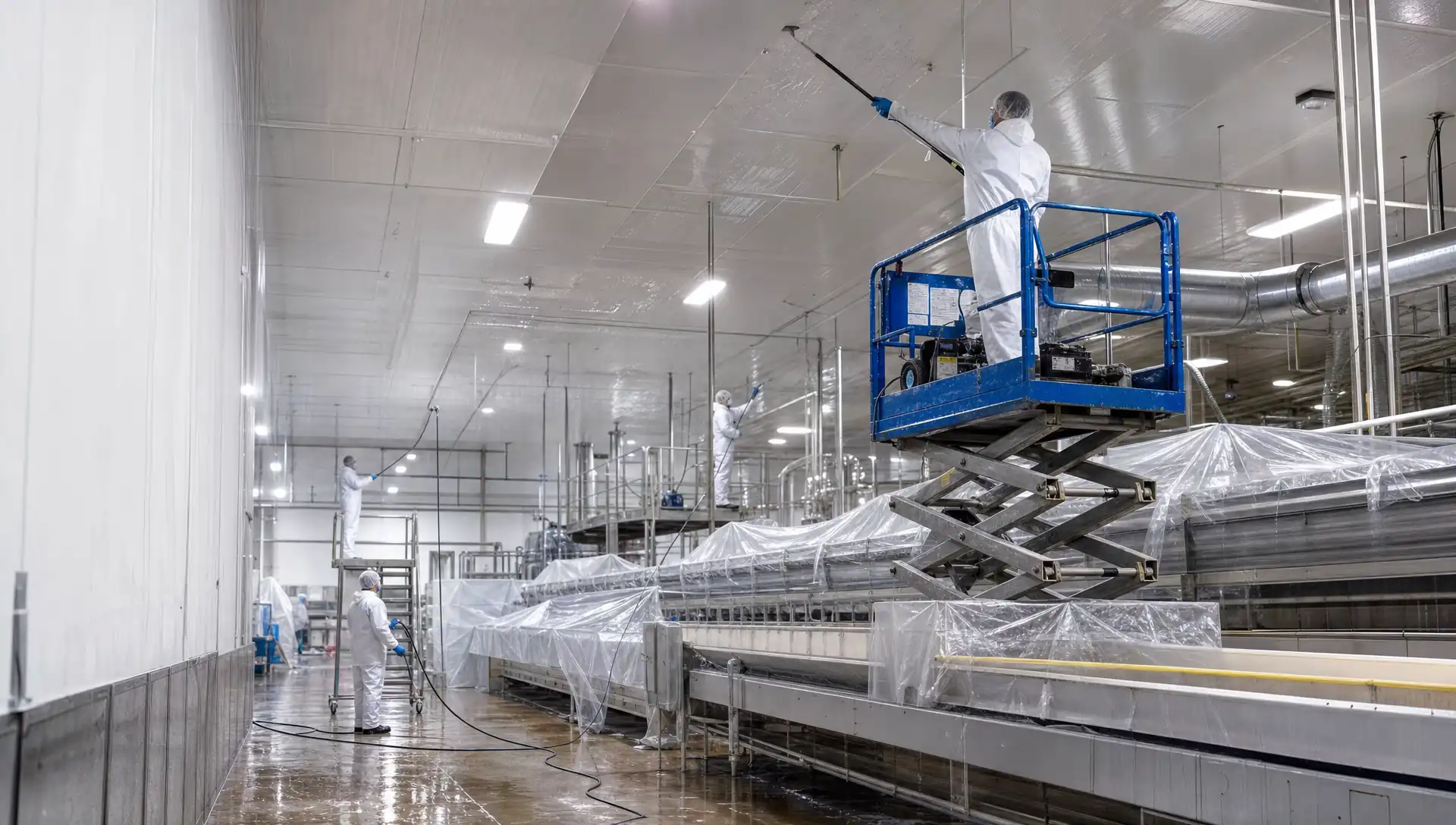
Food Plant Sanitation for the Work Your Daily Crew Can't Reach
Your sanitation team owns the daily clean. Service-Tech owns everything above, behind, and inside — overhead structure, ductwork, air handlers, and production equipment — deep-cleaned to the standard your auditors hold you to.
- NADCAMember since 1990
- 100,000+Facilities serviced since 1960
- 4.9Rated across 185 Google reviews
- Veteran-ownedUS Army veteran ownership since 2019
What Specialty Food Plant Sanitation Covers
Food plant sanitation, as Service-Tech performs it, is the periodic deep cleaning of the infrastructure your daily sanitation program is not staffed, equipped, or scheduled to reach: overhead structure and rafters, HVAC ductwork and air handling units, production equipment interiors, high walls, and the concealed surfaces where dust, product residue, and condensate accumulate between audits. The work is performed to the expectations of FDA- and USDA-inspected environments and the GFSI-benchmarked audit schemes those plants operate under.
This is a distinct discipline within our Industrial & Facilities Cleaning practice — and it is deliberately not daily contract sanitation. Understanding that boundary is the first step in scoping the work correctly.

Daily Sanitation Crew vs Specialty Deep-Clean Contractor
Most content about food plant sanitation describes the daily cycle — SSOPs, pre-op inspection, master sanitation schedules. All essential, and none of it Service-Tech's lane. Here is the division of labor that works:
| Responsibility | Daily Sanitation Crew | Service-Tech (Specialty) |
|---|---|---|
| Food-contact surfaces, daily | Yes — SSOP-driven | No |
| Floors, drains, routine GMP areas | Yes | No |
| Overhead structure, rafters, joists | Rarely equipped or scheduled | Yes — core scope |
| HVAC ductwork, AHUs, exhaust | Almost never | Yes — core scope |
| Equipment interiors and frames (periodic teardown-level) | Sometimes | Yes — including dry ice methods |
| High walls, ledges, light fixtures | Occasionally | Yes |
| Master sanitation schedule long-interval items | Owns the schedule | Executes the hard items on it |
The failure mode we see in plants is the gap between the two columns: long-interval master-schedule items that stay perpetually "planned" because the in-house crew lacks lifts, containment equipment, or the hours. Those are precisely the items auditors trend, and precisely what we are built to close.
Why Audits Fail in the Zones Nobody Owns
Modern food-safety pressure — FSMA's preventive-controls mindset, GFSI scheme audits, customer audits layered on top — extends scrutiny well beyond food-contact surfaces. Overhead contamination is the classic finding: dust, flaking residue, or condensate above exposed product is an immediate problem in any inspection, because gravity makes everything overhead a potential contaminant. Air systems are the quieter version — ductwork and air handlers move air across your zones, and their interior condition is part of your environmental story whether or not anyone has looked inside them lately.
These are infrastructure problems, and they respond to infrastructure cleaning: scheduled, documented, and performed with methods suited to an inspected environment.
Dry Ice Blasting: Deep Cleaning Without Water or Chemistry
The hardest cleaning problem in a food plant is the surface that cannot get wet: electrical enclosures and control panels, equipment interiors where washdown water pools in niches, ovens and dryers where moisture damages refractory, and any zone where introducing water means introducing a microbial habitat. Service-Tech's in-house dry ice blasting answers exactly that case — CO2 pellets lift residue and sublimate on contact, leaving no water, no chemical residue, and no blast media in an inspected environment. Carbonized residue in ovens, protein and sugar buildup on equipment frames, adhesive and label residue on packaging lines: removed dry, in place, without a rinse step your HACCP plan has to account for. Few sanitation vendors bring this capability in-house; for plants, it routinely turns a teardown weekend into a single shift.

Overhead Dust: A Food-Safety and Combustible-Dust Problem at Once
In plants handling flour, sugar, starch, grain, or powdered ingredients, the dust on your rafters is two findings waiting to happen. To a food-safety auditor, it is overhead contamination above exposed product. To an insurer or fire authority applying NFPA 652, it is fuel — organic dusts are combustible, and elevated accumulation is the classic deflagration hazard. One cleaning addresses both exposures, but only if it is performed with methods that do not create the very dust cloud the fire code fears: HEPA-filtered vacuum-first collection rather than blowdown, with containment protecting the production floor below. Our overhead work is coordinated with our combustible dust removal discipline, so powder-handling plants close the food-safety and NFPA exposures in one documented scope.

How Service-Tech Cleans Inside an Inspected Plant
- 01
Scope against your master sanitation schedule
We walk the plant with your sanitation or QA lead and take the long-interval, high-difficulty items — overheads, air systems, equipment deep cleans — into a defined scope.
- 02
Plan for the environment
Zone-appropriate methods, containment protecting product and lines below, and coordination with your GMP entry and hygiene protocols.
- 03
Execute in your window
Shutdowns, holidays, weekends — crews mobilize to your production calendar across Ohio, Florida, and Arkansas.
- 04
Document for your food-safety file
Scope description, areas completed, and photo documentation formatted so the work is demonstrable at your next audit — not just done, but provable.
That documentation matters because audit schemes reward evidence: a completed-and-documented infrastructure cleaning is a closed line on your master schedule, and a photo record is the difference between "we cleaned it" and proof.
When to Schedule Deep Sanitation
- Pre-audit — closing master-schedule items and overhead findings before certification or customer audits.
- Scheduled shutdowns and holidays — the natural window for overhead and air-system work.
- Post-incident — after a swab exceedance, pest event, or contamination finding traced to infrastructure.
- Seasonal cycles — condensation seasons and production peaks each leave their signature on the plant.
Food and beverage processors, packaging operations, and cold storage facilities make up this practice — including the Columbus-corridor logistics belt and the ag-processing base around our Pine Bluff, Arkansas service area. Broader plant-wide scopes beyond the food-safety envelope run through our industrial plant cleaning service, and other sectors appear on our industries page.
What Food Plant Sanitation Costs
Food plant sanitation engagements start at a $1,375 minimum, with each project quoted after a site assessment — free of charge. Scope, plant size, zone requirements, and scheduling window drive the number, and travel is factored into the quote across our 150-mile service radius from each office. Recurring programs aligned to your master sanitation schedule are quoted as programs.
What a Failed Audit Actually Costs
A failed or downgraded audit is never just the finding. It is the corrective-action burden on your QA team, the re-audit fees, the customer notifications, and in the worst cases the suspended production or lost contract that follows when a buyer's confidence breaks. Recalls traced to environmental contamination cost multiples of any cleaning program ever quoted. Infrastructure sanitation is inexpensive insurance against exactly that chain — and unlike most insurance, it also leaves you with a visibly cleaner plant.

Close the master-schedule items your auditors keep trending. Engagements from $1,375, quoted free after a site assessment.
Where Duct and Overhead Work Meets the Food-Safety File
- The regulation reaches ducts indirectly. FDA current good manufacturing practice under 21 CFR Part 117 requires adequate ventilation and protection of food from contamination, including drip and condensate — dusty or condensate-bearing ducts over an exposed product zone are how that becomes a finding.
- The audit schemes ask for the programme. GFSI schemes such as SQF and BRCGS want a documented environmental and overhead sanitation programme with risk-based frequencies and records, and the usual finding is not dirt but the absence of a schedule.
- Combustible dust applies here too. Flour, sugar, starch and powder handling put a food plant squarely inside NFPA 660, whose housekeeping action level is a layer of 1/32 in (0.8 mm) over 5% of floor area — a fire-code exposure inside a food-safety facility.
- Containment is absolute. Negative-air capture with HEPA at 99.97% of particles at 0.3 micron, physical isolation from production, and sequencing that never opens duct above uncovered lines.
- Chemistry is restricted. Agents appropriate for food-facility use, applied so no residue migrates to food-contact surfaces, with documentation for your chemical-control programme.
- The deliverable is the record. A method statement, a dated execution record with photographs, and a schedule — formatted for the FSMA and audit files rather than as an invoice attachment.
The Controls That Let This Happen Around Production
- Energy control before access. Conveyors, air handlers and process equipment are locked out and tagged under OSHA 1910.147 before any panel opens.
- Confined spaces are permitted. Silos, hoppers, mixers and duct interiors are purged, gas-tested and entered under OSHA 1910.146 with an attendant and continuous monitoring — not a single reading at the hatch.
- Dust is captured, never blown. Conductive tooling bonded and grounded to the equipment, HEPA capture at 99.97% of particles at 0.3 micron, and no compressed air: flour, sugar and starch put a food plant inside NFPA 660, whose action level is a layer of 1/32 in over 5% of floor area.
- Waste is characterised. Removed material is containerised and manifested where the residue is regulated, with the paperwork returned for your file.
- Sequencing protects product. Work is scheduled into washdown and changeover windows, with physical isolation from exposed lines and nothing opened above uncovered product.
Frequently Asked Questions
How is this different from our daily contract sanitation crew?
Daily crews own SSOP-driven food-contact and GMP-area cleaning. Service-Tech owns the periodic infrastructure work they are not staffed or equipped for: overhead structure, HVAC ductwork and air handlers, equipment deep cleans, and high-access surfaces. We complement your daily program by executing the long-interval master-schedule items that otherwise stay perpetually planned.
Can you clean during production, or only during shutdowns?
Overhead and air-system work above exposed product requires production to be down in the affected zone, with containment protecting lines below. We mobilize to your calendar — shutdowns, holidays, weekends, and zone-by-zone scheduling — so deep sanitation happens without stealing production hours.
What methods do you use in FDA/USDA-inspected environments?
Dry-clean-first discipline: HEPA-filtered vacuum collection for dust and overheads, dry ice blasting where surfaces cannot tolerate water or chemical residue, and zone-appropriate wet methods only where they belong. Every method is selected against your environment's rules, and our crews follow your GMP entry and hygiene protocols.
Does deep cleaning help with SQF or BRC audit readiness?
Yes — as evidence. GFSI-benchmarked schemes expect master sanitation schedules to be executed and demonstrable, and overhead or infrastructure findings are classic audit downgrades. Our deliverable includes scope and photo documentation formatted for your food-safety file, so completed work is provable, not just claimed.
How much does food plant sanitation cost?
Engagements start at a $1,375 minimum, with every project quoted after a free site assessment based on scope, plant size, and scheduling window. Recurring programs aligned to your master sanitation schedule are quoted as programs, and travel is factored into the quote across our 150-mile service radius.