
Commercial Dryer Vent & Exhaust Cleaning, Verified by Airflow
For facility managers running laundromats, hotel and multifamily laundry rooms, senior-living and healthcare laundries, or industrial process dryers. Service-Tech removes the lint packed inside long exhaust runs, risers and booster fans, then measures airflow to confirm the system actually vents — with the records your fire marshal and insurer ask for.
- NADCAMember since 1990
- 100,000+Facilities serviced since 1960
- 4.9Rated across 111 Google reviews
- Veteran-ownedUS Army veteran ownership since 2019
What Commercial Dryer Vent Cleaning Covers
Commercial dryer vent cleaning, done properly, covers the whole exhaust path from the machine to the outdoor termination — not only the lint screen your staff already empties. On a typical commercial system that means:
- The lint-trap housing and transition duct behind each dryer, where lint first escapes the screen
- The exhaust duct run, including long horizontal stretches above ceilings and the vertical risers of multi-story buildings
- Booster fans and inline components that move air through runs too long for the dryer to push on its own
- The exterior termination and vent hood, including a damper flap that should swing freely whenever a dryer runs
- Airflow and static-pressure readings after cleaning, so the result is measured rather than judged by eye
Dryer exhaust work sits inside our commercial air duct and HVAC cleaning practice, using the same source-removal methods and documentation our crews apply to building ductwork.
Why Lint in a Dryer Exhaust Duct Becomes a Fire Risk
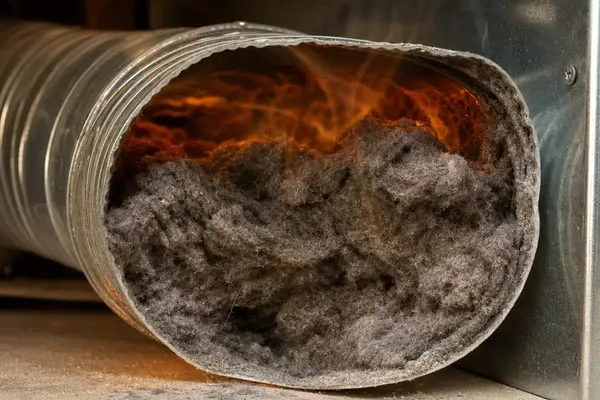
Lint in a dryer exhaust duct is fuel that has already been delivered to the hottest part of the system. As it builds up, it restricts the airflow that carries heat and moisture out of the machine. Heat then accumulates inside the dryer, and when a mechanical failure throws a spark, that lint can ignite. A fire that starts inside the dryer can escape through the duct, burning the trapped lint along its path into the building wall.
Failure to clean is the leading contributing factor in clothes dryer fires, according to the U.S. Fire Administration’s analysis. In a commercial building the exposure is larger, because its duct runs are longer and turn more often, with most of their length out of sight.
How Often Commercial Dryer Vents Need Cleaning
Cleaning frequency for a commercial dryer vent depends on how heavily the dryers run and how long the exhaust duct is. As a general guideline:
| Facility type | Recommended cleaning frequency |
|---|---|
| Laundromats & commercial laundries | Every 3–6 months |
| Hotels & multifamily laundry rooms | Every 6–12 months |
| Senior living & healthcare facilities | Every 6 months |
| Industrial & process dryers | Per manufacturer schedule, often quarterly |
These intervals are general guidance. Your local fire code, your insurer and the dryer manufacturer can each set a shorter one, and the strictest of the three is the schedule to keep.
Signs a Facility’s Dryer Exhaust Needs Cleaning
A facility’s dryer exhaust usually announces a blockage before an inspection does. Watch for:
- Loads that need more than one cycle to dry
- A dryer or laundry room that runs unusually hot
- A burning or musty smell during drying cycles
- Visible lint collecting around the exterior vent hood
- A vent-hood flap that stays shut while a dryer is running
How Service-Tech Cleans a Commercial Dryer Exhaust System
- 01
Assess and measure
A free site assessment maps every dryer, the duct route, risers, booster fans and the roof or wall termination, and takes baseline airflow and static-pressure readings.
- 02
Protect the space
Dryers are shut down and isolated, and the laundry area and access points are protected before any duct is opened.
- 03
Remove the lint at the source
Crews open the run at access points and use brushing, air agitation and HEPA-filtered negative air to pull lint out of the duct rather than push it further down the line.
- 04
Clear the termination
The exterior vent hood and its damper are cleaned and checked so the flap opens fully under airflow.
- 05
Verify and document
Airflow and static pressure are measured again and recorded beside before-and-after photos, so the file shows the system venting properly.

Get the lint out of the duct runs nobody can see — and an airflow reading that proves it.
Records for Fire Marshals and Insurers
Records for a commercial dryer exhaust system matter as much as the cleaning itself. Insurers can deny a commercial claim tied to a lint fire when no maintenance records exist, so every Service-Tech visit ends with dated before-and-after photos and the airflow readings taken at the start and finish of the job.
Pricing for dryer exhaust cleaning depends on the number of dryers, the length and route of the duct, the risers and booster fans in the system, and access to the termination. We quote it after a free site assessment, and the same mobilization can cover kitchen exhaust hood cleaning where a facility runs a commercial kitchen with the same fire-code exposure. For the background on lint fires, read how dryer exhaust cleaning prevents fires.
Frequently Asked Questions
How often should commercial dryer vents be cleaned?
Commercial dryer vents generally need cleaning every 3 to 12 months, depending on facility type and use. High-volume laundromats and commercial laundries sit at the short end of that range, senior-living and healthcare laundries at about six months, and lower-use hotel or multifamily laundry rooms closer to a year.
Can a clogged dryer vent actually cause a fire?
Yes. Lint is flammable, and a clogged vent traps heat inside the dryer instead of letting it escape. When a mechanical failure produces a spark, the trapped lint can ignite, and the fire can travel along the duct into the building.
Does emptying the lint trap replace duct cleaning?
No. The lint trap catches only part of the lint a load produces; the rest travels into the exhaust duct and builds up out of sight over months or years. Emptying the trap after every load still matters, but it does not clean the duct.
Is commercial dryer exhaust cleaning required by fire code?
Requirements vary by jurisdiction and facility type. Fire codes, insurers and dryer manufacturers can each set a cleaning schedule, so documented professional cleaning is the safest way for a commercial facility to show the system is maintained.
How much does commercial dryer vent cleaning cost?
Commercial dryer vent cleaning is priced per system after a free site assessment, because the number of dryers, the duct length and route, risers, booster fans and roof access all change the scope. The quote is firm once the scope is written, with travel already factored in.