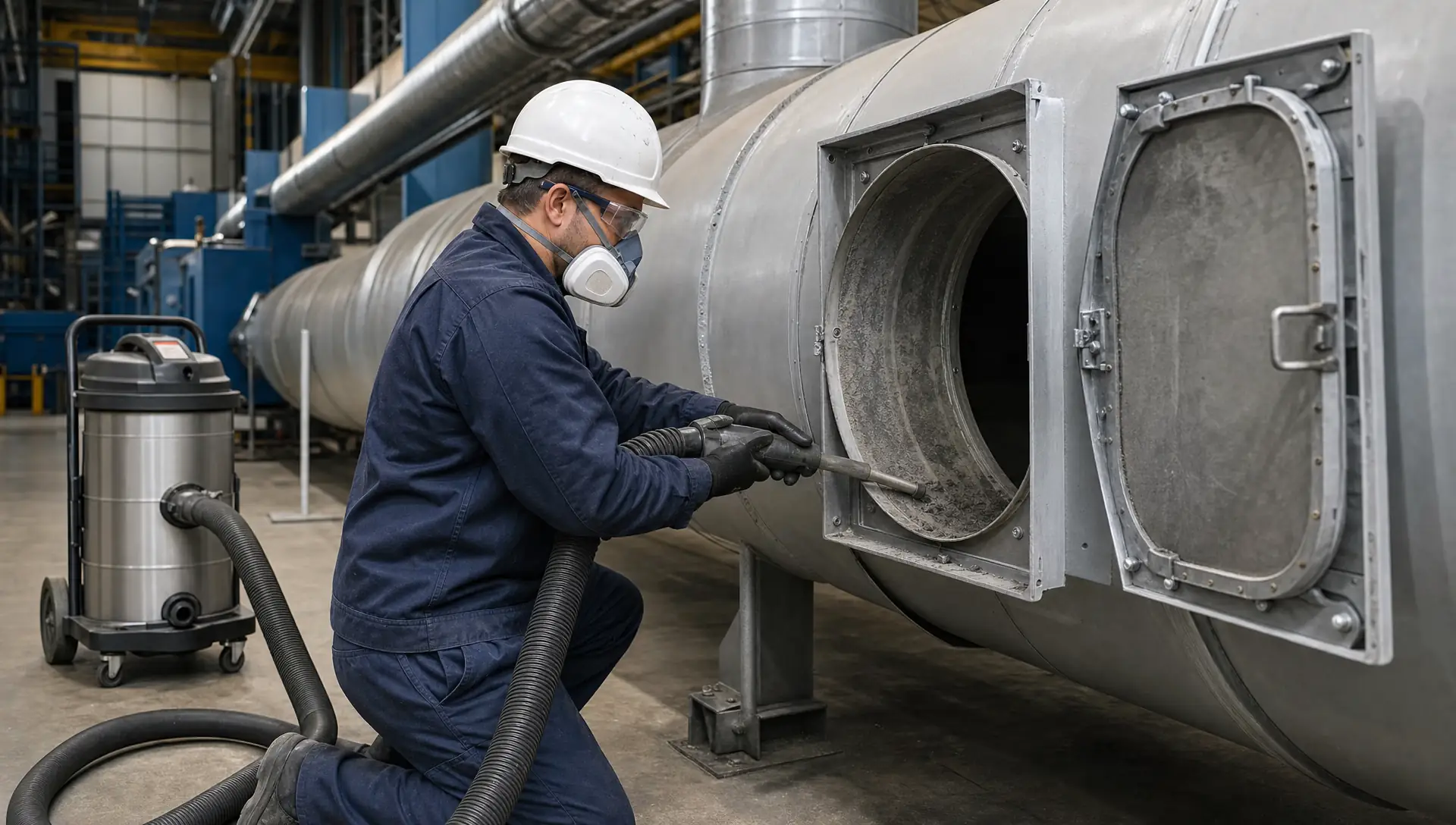
Industrial Air Duct Cleaning for Manufacturing and Process Facilities
Process dust, oil mist, and weld fume load industrial ductwork in ways office HVAC never sees. Service-Tech Corporation has cleaned plant duct systems to NADCA standards since 1960 — with containment, negative air, and documentation your EHS file can stand on.
- NADCAMember since 1990
- 100,000+Facilities serviced since 1960
- 4.9Rated across 185 Google reviews
- Veteran-ownedUS Army veteran ownership since 2019
What Industrial Air Duct Cleaning Involves
Industrial air duct cleaning is the source-removal cleaning of large-bore ductwork, process exhaust runs, and plant HVAC distribution — the systems that move air through manufacturing environments rather than offices. It is one of the core services within our Commercial Air Duct & HVAC Cleaning practice, and it is the one that demands the most from a contractor: bigger duct, heavier contaminants, and consequences measured in fire risk and OSHA citations rather than dusty vents.
Where a commercial office system collects paper dust and skin cells, industrial ductwork accumulates whatever your process generates: metal fines and weld fume condensate, oil mist that turns duct interiors tacky, flour and powder in food plants, fiber in converting operations. Source removal means physically dislodging and capturing that material under negative pressure — not deodorizing it, not encapsulating it, and never blowing it downstream.

Industrial vs Commercial Duct Cleaning: Why the Distinction Matters
Most companies that advertise "industrial" duct cleaning are describing commercial office work at a larger square footage. The difference is not size — it is contaminant class, access method, and standard of care.
| Factor | Commercial (Office/Retail) | Industrial (Plant/Process) |
|---|---|---|
| Typical contaminants | Ambient dust, fibers, construction debris | Process dust, oil mist, weld fume residue, combustible fines |
| Duct construction | Rectangular sheet metal, 8–24 in. | Large-bore round/rectangular, welded runs, process exhaust |
| Access method | Vacuum hose, rotary brush via service openings | Manual-entry cleaning where diameter permits; engineered access doors |
| Governing concerns | IAQ, occupant comfort | OSHA housekeeping, NFPA 652 combustible dust, product contamination |
| Downtime sensitivity | Nights/weekends | Planned shutdown windows, phased production zones |
A crew equipped for office HVAC cannot safely enter a 60-inch process exhaust duct, and a vendor who treats weld-fume residue like ordinary dust may be redistributing a combustible or toxic material through your plant. When you evaluate proposals, ask specifically how the contractor classifies your contaminant and what capture method they will use — the answer separates industrial specialists from commercial generalists.
This work serves manufacturers, foundries, food processing plants, and aerospace suppliers — including the Dayton-corridor aerospace base we have supported for decades. Explore the sectors we serve on our industries page.
Why Industrial Ductwork Is a Housekeeping and Fire-Risk Exposure
Industrial duct interiors are out of sight, which makes them the last surface addressed and the first one an incident investigator examines. Accumulated process dust inside ductwork is fuel: if the dust is combustible, the duct is an enclosed vessel connecting ignition sources to the rest of your facility. OSHA's general-industry housekeeping expectations do not stop at the duct flange, and a Dust Hazard Analysis performed under NFPA 652 will treat duct interiors as accumulation surfaces requiring documented housekeeping.
Beyond fire risk, loaded ductwork chokes exhaust airflow. Capture velocity at your hoods drops, fugitive emissions rise at the source, fans work harder against restricted static pressure, and product in clean-sensitive operations picks up contamination from air that was supposed to protect it.
How Service-Tech Cleans Industrial Duct Systems
Our method follows NADCA's ACR standard — the same source-removal discipline we have practiced as a NADCA member since 1990 — adapted to industrial construction.
- 01
System survey and access plan
We walk the system, identify contaminant type, map duct runs, and specify where code-compliant access doors must be installed so the system can be cleaned now and inspected later.
- 02
Containment and negative air
Work zones are isolated and the duct section placed under negative pressure with HEPA-filtered collection equipment, so dislodged material moves to the collector — not into your plant.
- 03
Source removal
Manual-entry cleaning where duct dimensions permit a technician to work inside the duct; mechanical agitation and contact vacuuming elsewhere. Every square foot of interior surface is physically cleaned.
- 04
Verification and documentation
Post-cleaning inspection of representative sections, with reporting suitable for your EHS records and audit file.
NADCA's ACR Standard on a Plant Floor
NADCA's ACR standard defines what "clean" means: surfaces cleaned to bare substrate by source removal, verified by inspection. On a plant floor, applying it honestly requires judgment the standard assumes but franchise operators rarely bring — recognizing when oil-mist-bound dust demands degreasing-assisted removal, when a process exhaust duct must be treated as a combustible dust surface with grounding and bonding controls on vacuum equipment, and when duct liner or corrosion means a section should be flagged for repair rather than cleaned and forgotten. As a NADCA member firm since 1990, we clean to the standard and we document against it, so your record shows a defined benchmark rather than a vendor's opinion.

When Duct Cleaning Meets Combustible Dust
If your plant handles wood flour, grain, sugar, metal powder, or plastic fines, duct cleaning is not a standalone task — it is one line item in an NFPA 652 housekeeping program. A DHA that flags floor and beam accumulation almost always implicates the ductwork that moves that dust. We frequently pair industrial duct cleaning with facility-wide combustible dust housekeeping so the duct interiors, overhead structure, and equipment surfaces are remediated in one mobilization and documented in one closure package. Cleaning the ducts while leaving the joists loaded — or vice versa — leaves the hazard chain intact. Tell us during the assessment which dusts your DHA covers, and we scope both together.

Six Decades of Industrial Duct Systems
Service-Tech has been inside industrial ductwork since 1960, across more than 100,000 facilities serviced. That history shows up as pattern recognition: we know where oil mist condenses in a stamping plant's exhaust, where flour bridges in a bakery's collection runs, and why post-war Ohio plants hide unlined bypass ducts that no drawing shows. For facility managers running plants in more than one region, our offices cover Ohio, Florida, and Arkansas — each with a 150-mile service radius — so a multi-plant duct program can sit with a single vendor and a single standard of documentation.

When to Schedule Industrial Duct Cleaning
- Planned shutdown windows — the natural slot for manual-entry work on production-critical exhaust.
- After a DHA or insurer finding that cites duct accumulation.
- Visible loading at grilles, hoods, or access points — by the time you can see it, interior surfaces carry more.
- On an assessment-based schedule set from a baseline inspection, rather than an arbitrary calendar interval.
Related HVAC hygiene work is most economical in the same mobilization: HVAC coil cleaning restores heat-transfer performance while systems are down, and fire damper inspections use the very duct access our crews create.
What Industrial Duct Cleaning Costs
Industrial duct projects vary too widely for flat pricing — linear feet, duct dimension, contaminant class, and access all drive the number. Free estimate — quote after site assessment. Travel is factored into the quote for any facility within our 150-mile service radius from each office. If your system also leaks conditioned air, ask about pairing cleaning with Aeroseal duct sealing in one scope.
What Happens If Industrial Ductwork Is Neglected
Neglected industrial duct is a compounding liability: dust-fueled fire risk inside an enclosed pathway that connects your building; OSHA housekeeping and NFPA 652 citation exposure; product contamination claims in food, coating, and cleanroom-adjacent operations; and fan and motor failures as static pressure climbs. The cost of the eventual emergency response — production down, duct sections replaced, an incident on your record — dwarfs the cost of a scheduled cleaning program.

Get a duct system assessment from the firm that has cleaned industrial systems since 1960. Free estimate, quote after site assessment.
How the Work Is Physically Done
Source removal means the contaminant is dislodged and extracted in the same motion. Rotary brushes agitate bare metal; compressed-air whips and skipper heads work lined or fragile runs more gently; and the system is held under continuous negative pressure through HEPA capture the entire time the interior is disturbed. Crews borescope runs beyond arm's reach before quoting, swab and weigh a sample against the acceptance figure afterwards, and open the plenum, drain pan and fan housing rather than stopping at the grilles. A liner that delaminates under light pressure is encapsulated or replaced, never brushed into failure. Coil fins are straightened back to plane, panels are reinstated, and the system is pressurized and checked before it goes back into service. On heavier-gauge industrial duct the same standard applies through manual entry — a technician working inside the run under a confined-space permit rather than through an access door.

Frequently Asked Questions
What is the difference between industrial and commercial air duct cleaning?
Commercial duct cleaning addresses office and retail HVAC carrying ambient dust. Industrial duct cleaning addresses process exhaust, weld fume, oil mist, and combustible fines in large-bore plant systems — requiring manual-entry methods, HEPA-filtered negative-air capture, and awareness of OSHA housekeeping and NFPA 652 obligations that office work never touches.
Does industrial duct cleaning require a production shutdown?
Not always. Systems serving production-critical processes are usually cleaned during planned shutdown or turnaround windows, while plant HVAC distribution can often be cleaned in phases during nights and weekends. We build the schedule around your production calendar during the site assessment.
Is duct cleaning part of NFPA 652 combustible dust compliance?
Yes, where the dust is explosible. Duct interiors are accumulation surfaces, and a Dust Hazard Analysis will expect documented housekeeping for them. We pair duct cleaning with facility-wide combustible dust housekeeping so DHA items can be closed in a single documented scope.
What standard governs the cleaning itself?
We clean to NADCA's ACR standard — full source removal of contaminants from interior duct surfaces, verified by inspection. Service-Tech has been a NADCA member since 1990, and our reporting references the standard so your records show a defined benchmark.
How much does industrial air duct cleaning cost?
Pricing depends on duct dimensions, linear footage, contaminant type, and access, so every project is quoted after a site assessment. The estimate is free, and travel within our 150-mile service radius from each office is factored into the quote rather than billed as a surcharge.