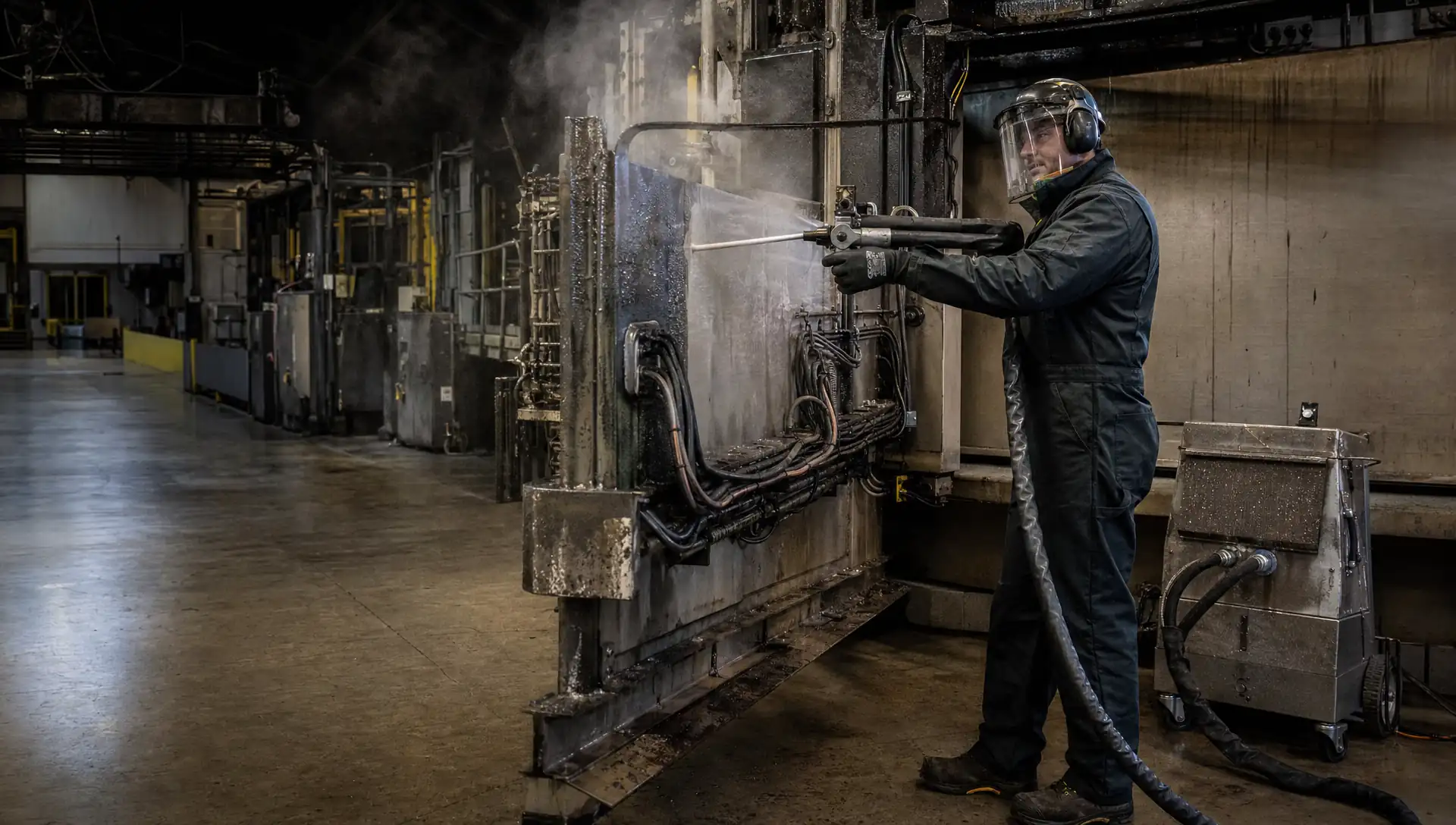
Dry Ice Blasting Services for Industrial and Food-Grade Cleaning
Clean production equipment in place — no water, no chemicals, no blast media to sweep up. Service-Tech's dry ice blasting crews serve plants across Ohio, Florida, and Arkansas, with engagements starting at $2,000.
- NADCAMember since 1990
- 100,000+Facilities serviced since 1960
- 4.9Rated across 185 Google reviews
- Veteran-ownedUS Army veteran ownership since 2019
What Dry Ice Blasting Is and How It Works
Dry ice blasting propels rice-sized pellets of solid CO2 at a contaminated surface. On impact, the pellets sublimate — flash from solid to gas — with two useful effects: the rapid expansion lifts the contaminant off the substrate, and the thermal shock embrittles residues like grease, adhesive, carbon, and paint so they release cleanly. Because the blast medium vanishes as gas, nothing is left behind but the contaminant you knock down. No water. No chemical rinse. No sand, soda, or grit worked into bearings and threads.
That single property — no secondary waste — is why dry ice blasting is the method of choice for cleaning production equipment in place: electrical panels and energized-adjacent equipment where water is disqualified, food-contact surfaces where chemical residue and wet niches are prohibited, and precision machinery where abrasive media would destroy tolerances. It is the flagship capability of our Industrial & Facilities Cleaning practice, and the tool we reach for across many of our other services.

Hire a Contractor or Buy a Machine?
Most of what ranks for this keyword is published by equipment manufacturers, whose answer to every cleaning problem is a machine purchase — with published system prices running roughly $15,000 to $50,000 before you buy pellets, train operators, and maintain compressors. For a plant that blast-cleans daily, ownership can make sense. For everyone else, the math favors a contractor:
| Factor | Buying Equipment | Hiring Service-Tech |
|---|---|---|
| Upfront cost | ~$15,000–$50,000 per system (manufacturer-published) plus compressor capacity | $2,000 minimum engagement, quoted per project |
| Dry ice supply | Sourced and stored per use; pellets sublimate in storage | We bring fresh media to the job |
| Operators | Your staff, trained, pulled from production | Experienced crews from a 50+ technician field team |
| Safety program | CO2 ventilation, PPE, and procedures you own | Managed by us under our safety program |
| Utilization | Pays back only with frequent use | Pay only when you clean |
If your usage genuinely justifies ownership, we will tell you so — a manufacturer's pillar page cannot say the same. Most plants land on scheduled contractor visits: quarterly or shutdown-based programs that keep equipment clean without carrying the asset.
Why Plants Choose Dry Ice Over Water, Chemicals, and Grit
- Cleans in place. Equipment is blasted where it stands — no disassembly, no transport to a wash bay, no reassembly and realignment afterward. For a production line, that is the difference between hours and days of downtime.
- Safe for sensitive surfaces. Non-abrasive at the substrate level: panels, motors, molds, and machined surfaces keep their tolerances and finishes.
- No moisture. Nothing to dry, no corrosion trigger, no water in electrical enclosures or absorbed into refractory and insulation.
- No chemical residue. Critical in food plants and anywhere a rinse step is impossible.
- No media disposal. Sand and soda blasting create tons of contaminated media; dry ice creates only the removed contaminant, minimizing disposal cost and simplifying containment.
Automotive, plastics, food processing, printing, utilities, and aerospace operations are the heaviest users — mold cleaning, adhesive and ink removal, weld-line and press cleaning, generator and switchgear-adjacent work, and oven and equipment de-carbonizing. See more sectors on our industries page.
CO2 Displaces Oxygen: The Fact That Governs Enclosed-Space Work
This is the question a plant engineer asks before letting a blasting crew into a pit, a vessel, or a tight mezzanine, and it is the one most dry-ice pages skip past with the word "non-toxic".
Carbon dioxide is not toxic, but it is an asphyxiant, and sublimated CO2 gas is roughly 1.5 times denser than air. It does not disperse upward — it settles into the lowest part of the space, which is where the operator's feet, a floor-level pit, or a sump is. In an open bay with normal air changes this is a non-issue. Inside a vessel, a basement, or a machine pit it is the controlling hazard of the job.
- Ventilation is engineered, not assumed. Forced-air ventilation is set up and running before blasting begins, exhausting from the low point of the space rather than the ceiling.
- The atmosphere is monitored continuously. Oxygen and CO2 are metered throughout the work, not sampled once at entry, because the concentration rises as the job proceeds.
- Confined spaces are permitted. Entry is under a permit-required confined-space procedure with an attendant, a retrieval plan, and lockout of the equipment being cleaned.
- Equipment is de-energised and dried. Panels and switchgear are locked out and tagged before cleaning. Dry ice introduces no water, which is the reason it is used on electrical gear at all, but "non-conductive medium" is not the same as "safe to clean live".
Any contractor who cannot describe their ventilation and monitoring plan for your specific space should not be blasting inside it.
The Physics, in Numbers
The reason dry ice cleans a mould without dulling it comes down to three measurable properties, and every one of them is published by the equipment manufacturer rather than being a claim we make about ourselves.
| Property | Figure | What it means on your equipment |
|---|---|---|
| Pellet temperature | −109 °F (−78.9 °C) | Thermal shock embrittles and shrinks the contaminant so it fractures off the substrate |
| Hardness | 1.5–2 on the Mohs scale | Softer than aluminium, steel, and most tooling — the medium fails before the surface does |
| Volumetric expansion on sublimation | Up to 800 times, within milliseconds | The phase change itself lifts the deposit; the impact does very little of the work |
| Secondary waste | None from the medium | The pellet leaves as gas, so only the removed contaminant needs collecting |
Compare that to abrasive media. Silica sand sits around 7 on the same scale — harder than the mild steel and aluminium it is fired at — so it cuts a profile into the surface as it cleans and leaves a spent-media stream to collect, characterise and dispose of. Dry ice is denser in impact energy than plastic bead but softer than every common substrate, and it leaves nothing behind at all. That difference — not speed, not cost — is why dry ice is the method for moulds, tooling, switchgear and food-contact equipment, and why it is the wrong method when a profiled surface for repainting is exactly what you want (dry ice figures per Cold Jet).
Honest Limits: What Dry Ice Blasting Doesn't Do Well
No method is universal, and the fastest way to waste a mobilization is to blast the wrong problem. Dry ice excels at surface residues — grease, oil, carbon, adhesives, paint layers, biofilm, powder buildup — on substrates from steel to delicate tooling. It is marginal or wrong where you need profile cutting or heavy rust removal (abrasives still win there), where contamination is soaked deep into porous material rather than sitting on it, and in tightly enclosed unventilated spaces unless CO2 monitoring and mechanical ventilation are part of the plan — sublimated CO2 displaces oxygen, and our crews treat ventilation and exposure control as a hard requirement on every job. Noise is real, too: blasting is loud, and hearing protection zones are established around the work. We scope all of this in the site assessment, and when dry ice is the wrong tool, we say so and quote the right one.
One Capability, Many Scopes
Because Service-Tech runs dry ice blasting in-house rather than subbing it out, it slots into our other service lines wherever it is the right method — often inside a single mobilization:
- Food plants: blast-cleaning production equipment, conveyors, and ovens without water or chemistry, inside our broader food plant sanitation scopes for FDA/USDA-inspected environments.
- Whole-plant programs: as one method among several in industrial plant cleaning — dry ice where surfaces demand it, HEPA vacuuming and conventional methods where they don't.
- Dust-adjacent surface cleaning: removing caked residues from equipment in facilities that also carry combustible dust removal obligations, with methods coordinated so surface cleaning never becomes a dust-cloud event.
- Fire and smoke restoration: lifting soot and char from structure and equipment where wet methods would compound the loss.
One vendor, one safety program, one report — across plants in Ohio, Florida, and Arkansas, each office covering a 150-mile service radius.
How a Service-Tech Dry Ice Project Runs
- 01
Site assessment
We identify substrates, contaminants, access, and ventilation; confirm dry ice is the right method; and quote the project.
- 02
Scheduling around production
Shutdown windows, changeovers, nights, weekends — the method cleans in place, so the schedule bends to your line, not ours.
- 03
Containment and safety setup
Ventilation and CO2 exposure controls, hearing protection zones, and containment for the removed contaminant.
- 04
Blasting
Crews work systematically across the scoped equipment; parameters (pellet size, pressure) are tuned per surface.
- 05
Closeout
The lifted contaminant is collected and removed; equipment is ready for service immediately — nothing to dry, rinse, or cure.
What Dry Ice Blasting Costs
Dry ice blasting engagements start at a $2,000 minimum, with each project quoted after a site assessment based on scope, access, and schedule. The estimate is free, and travel is factored into the quote across our 150-mile service radius from each office. Recurring programs — quarterly equipment cleaning, shutdown-cycle work — are quoted as programs, which consistently beats pricing each visit alone.
What the Alternatives Cost You
Choose the wet or abrasive path and the invoice is only the beginning. Water and chemical methods force disassembly and drying time, put moisture where it doesn't belong, and generate rinse water that may itself need managed disposal. Abrasive media cleans fast and then costs you twice: contaminated grit to dispose of, and substrate wear on every surface it touches. Manual scraping is slow, inconsistent, and hard on both the equipment and the people. The recurring theme is downtime — disassembly, drying, cleanup — and downtime is the most expensive line item in any plant. In-place dry cleaning exists to delete it.


Clean it in place: dry ice turns to gas on contact, so only the removed contaminant is left to collect. Quoted free after a site assessment.
Where Dry Ice Sits Against the Alternatives
| Dry ice | Water or steam | Abrasive grit | Solvent | |
|---|---|---|---|---|
| Secondary waste to collect | None from the medium | Contained runoff, often manifested | Spent media, characterised and disposed | Spent solvent, plus vapour control |
| Effect on the substrate | Non-abrasive at 1.5–2 Mohs | None, but introduces moisture | Cuts a profile; silica sand is about 7 Mohs | Chemical attack risk on seals and coatings |
| Usable on energised-adjacent gear | Yes, locked out and dry | No | No | Rarely |
| Cleans in place, no disassembly | Usually | Sometimes | Rarely | Sometimes |
| Downtime driver | Access and ventilation setup | Dry-out time, often 12–24 hours | Masking, containment, clean-up | Ventilation and cure time |
Dry ice wins on the two lines that dominate a plant's real cost: no dry-out wait and no waste stream to characterise. It loses where you need a profiled surface for a coating, and it needs 1 to 2 hours of ventilation setup before anyone works inside a vessel.
Frequently Asked Questions
How much does dry ice blasting service cost?
Service-Tech dry ice blasting engagements start at a $2,000 minimum, with each project quoted after a free site assessment based on scope, substrate, access, and scheduling. Recurring programs are quoted as programs and cost less per visit than one-off mobilizations. Travel within our 150-mile service radius is factored into the quote.
Is it cheaper to hire a contractor or buy a dry ice blasting machine?
Manufacturers publish system prices of roughly $15,000–$50,000, before pellets, compressor capacity, operator training, and a CO2 safety program. Ownership pays back only with frequent, sustained use. For periodic cleaning — even quarterly — a contracted crew is almost always the better economics, and we will tell you honestly if your usage justifies buying instead.
Is dry ice blasting safe for food processing equipment?
Yes — it is one of the method's strongest use cases. The process uses no water, no chemicals, and no abrasive media, leaving no residue on food-contact surfaces and creating no wet niches for microbial growth. We deploy it routinely inside FDA/USDA-inspected environments as part of food plant sanitation scopes.
Does dry ice blasting damage equipment surfaces?
Used correctly, no. The pellets are soft relative to abrasive media and sublimate on impact, so substrates keep their tolerances and finishes — which is why the method is trusted on molds, machined surfaces, and electrical equipment. Parameters are tuned per surface, and delicate substrates are tested before full blasting.
What are the limitations of dry ice blasting?
It removes surface residues, not deep corrosion or material soaked into porous substrates, and it does not create a surface profile the way abrasives do. It is loud, requiring hearing protection zones, and sublimated CO2 requires ventilation and exposure controls in enclosed spaces. We scope these factors during assessment and recommend a different method when dry ice is the wrong tool.