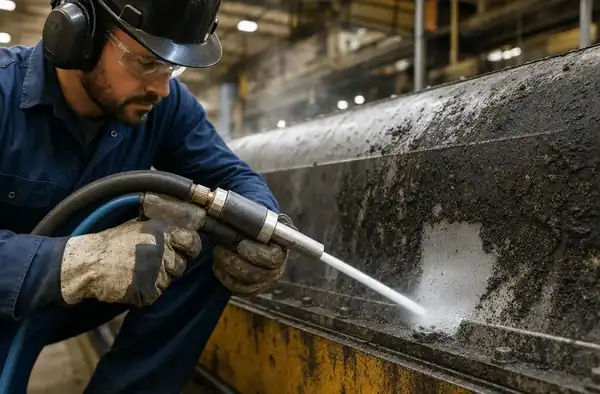
The equipment makers explain the physics. Here's the service-provider version — what the process looks like on a real job, what it removes well, and when we'd tell you to use something else.
Direct Answer: Dry ice blasting is an industrial cleaning method that fires soft pellets of solid CO2 (dry ice) at a contaminated surface using compressed air; the pellets embrittle the contaminant with extreme cold, fracture it on impact, and then sublimate — turn straight to gas — lifting the contaminant off without water, chemicals, abrasion, or any leftover blasting media. Service-Tech Corporation performs dry ice blasting for manufacturing and commercial facilities across Ohio, Florida, and Arkansas.
How Does the Cleaning Action Work?
Three mechanisms fire in the milliseconds after each pellet hits — this is the framework the equipment industry teaches, and it holds up on the job site:
Kinetic energy.
Pellets accelerated by compressed air strike the contaminant layer and mechanically crack it. Dry ice is soft compared to sand or grit — the impact breaks the dirt, not the surface under it.
Thermal shock.
Dry ice sublimates at roughly -109°F (-78.5°C). That cold snap embrittles grease, adhesive, paint, and residue, and the difference in thermal contraction between contaminant and substrate breaks the bond between them.
Sublimation expansion.
On impact the pellet flashes from solid to gas, expanding to many times its solid volume in an instant. That micro-burst gets underneath the fractured contaminant and pops it off the surface.
Then the pellet is gone. No grit, no rinse water, no solvent — the only cleanup is vacuuming the contaminant that fell.
What Does Dry Ice Blasting Remove Well — and What Does It Struggle With?
Honest answer from the people holding the nozzle: it's a removal tool for adhered surface contamination, not a cure-all.
| Removes well | Struggles with |
|---|---|
| Grease, oils, and carbonized residue | Thick, heavy rust scale (abrasive media is faster) |
| Adhesives, release agents, resins | Profile-critical surface prep for coating (won't create an anchor pattern) |
| Paint and powder-coat overspray | Deeply embedded stains within porous material |
| Mold and smoke/fire residue | Contamination inside sealed assemblies the pellet stream can't reach |
| Production buildup on molds and tooling | Very soft substrates that can't take any impact (evaluated case by case) |
What Does a Job Look Like From the Service Side?
Equipment sellers describe the machine; here's what a contracted blast job actually involves:
- Crew. Typically a lead technician and support tech — one blasting, one managing pellets, hoses, vacuum recovery, and monitoring.
- Compressed air. Blasting rigs demand industrial air volumes; crews bring or arrange compressor capacity rather than borrowing plant air, which is rarely sized for it.
- Pellets. Food-grade CO2 pellets are consumed continuously and are perishable — they sublimate in storage — so pellet logistics are planned to the job date.
- Ventilation and safety. CO2 gas displaces oxygen, so crews ventilate and monitor enclosed work areas, and wear hearing and eye protection appropriate to the equipment.
- Containment and recovery. The contaminant that comes off is captured — HEPA vacuuming where the material requires it — leaving the area ready for inspection.
Which Industries Use Dry Ice Blasting?
In Service-Tech's Ohio, Florida, and Arkansas markets, the recurring buyers cluster around a few contamination problems:
| Industry | Typical contaminant | Why dry ice fits |
|---|---|---|
| Food and beverage | Baked-on production residue, allergen changeover | No water or chemicals near product zones; fits sanitation windows |
| Automotive and plastics | Adhesives, release agents, weld-cell spatter | Cleans tooling in place without dimensional wear |
| Electrical and utilities | Dust, carbon, contamination on de-energized gear | Non-conductive, moisture-free medium |
| Fire and water restoration | Char, smoke residue, mold | Reaches irregular surfaces; no added moisture |
| General manufacturing | Grease and process buildup on production lines | Minimal downtime; no media cleanup |
It's typically delivered as part of a broader industrial cleaning scope — the same facilities buying blast work usually have ducts, exhaust systems, or towers on the same maintenance calendar.
When Is Dry Ice Blasting NOT the Right Method?
A practitioner can say what a machine seller won't. We'd steer you elsewhere when:
- You need surface profile. If the job is preparing steel for a coating system that specs an anchor profile, abrasive blasting is the right tool — dry ice cleans, it doesn't etch.
- Heavy rust or mill scale is the target. CO2 will take surface oxidation, but thick scale removal is slow going; abrasives finish faster and cheaper.
- The scope is tiny and standalone. With a $2,000 minimum engagement reflecting crew and rig mobilization, a single small item may not justify a standalone visit — bundle it with other cleaning work instead.
- Noise or CO2 management can't be accommodated. Blasting is loud, and enclosed spaces need ventilation planning. Almost always solvable, but it's engineering, not hand-waving.
TL;DR — Dry Ice Blasting in One Paragraph
Dry ice blasting cleans by cold, impact, and sublimation: soft CO2 pellets embrittle and fracture surface contamination, then flash to gas and lift it away — leaving no media, no moisture, and no chemical residue. It excels on grease, adhesives, mold, fire residue, and production buildup, especially where equipment must be cleaned in place; it's the wrong tool when you need a coating-ready surface profile or fast heavy-scale removal. Delivered by a professional crew, it's a contained, planned operation with real air, pellet, and safety logistics behind it.
Frequently Asked Questions
Is Dry Ice Blasting Abrasive? Will It Damage Equipment?
Dry ice is dramatically softer than sand, grit, or even soda media, and it leaves no embedded particles. With pressure and pellet size tuned to the substrate, it routinely cleans machined tooling, mold cavities, and wiring that abrasive media would destroy. Damage risk lives in operator skill — which is why parameters are set per surface, not per job.
Where Does the Dirt Go if the Ice Disappears?
The pellets sublimate to CO2 gas, but the contaminant doesn't vanish — it falls or is thrown from the surface as dry particles or flakes. Crews capture it by vacuum (HEPA-filtered where the material calls for it) and dispose of it appropriately. You dispose of the dirt only, not tons of dirt-plus-media.
How Much Does Dry Ice Blasting Cost?
Service-Tech projects start at a $2,000 minimum engagement, scaled by contaminant, substrate, access, containment, and schedule, with free estimates and travel factored into the quote. The full breakdown of what moves the number is on the blog and in our cost resources.