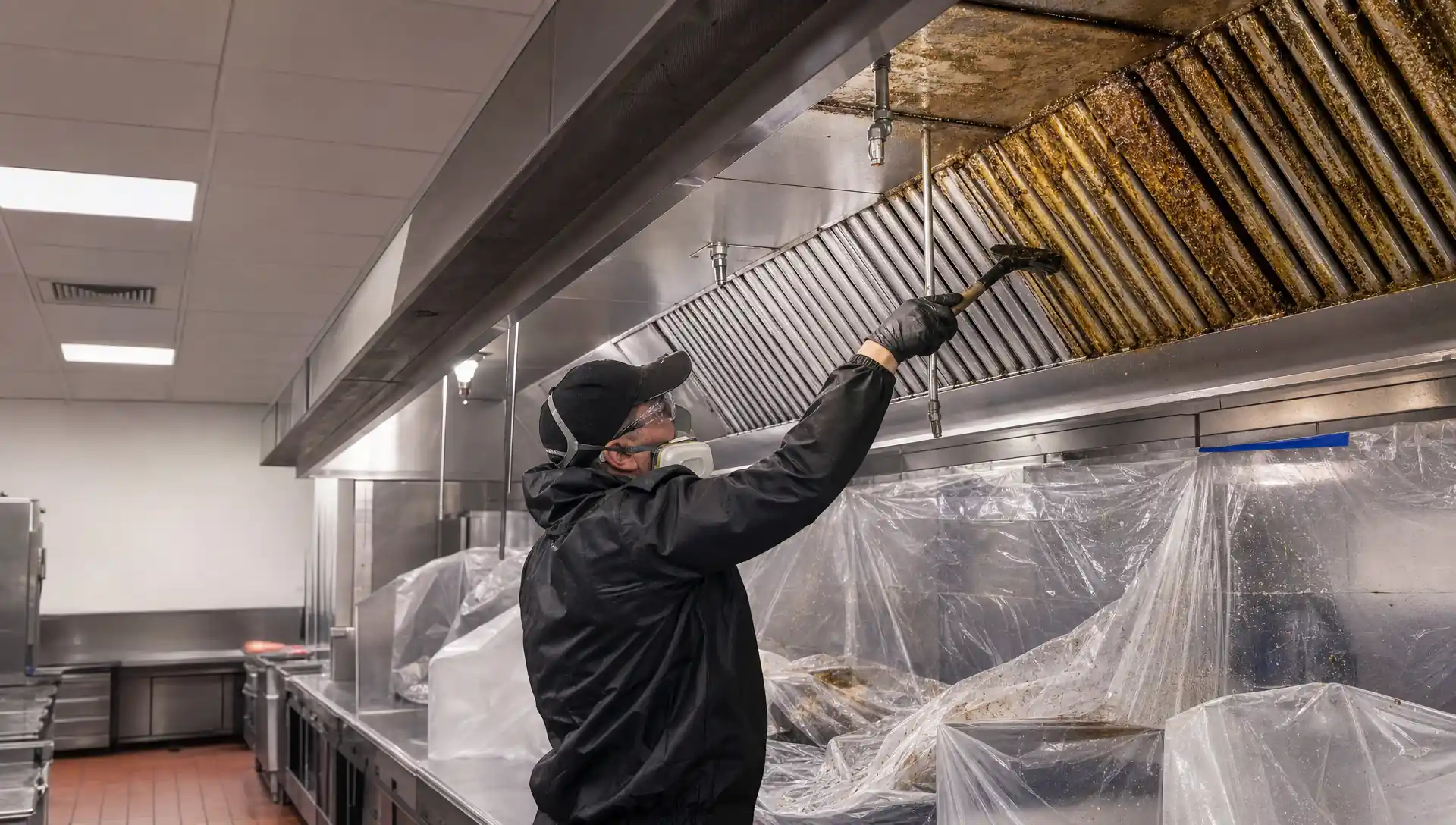
Kitchen Exhaust Hood Cleaning to the NFPA 96 Bare-Metal Standard
The grease in your exhaust duct is the fuel path for a kitchen fire — and the first thing the fire marshal and your insurer check. Service-Tech cleans the entire exhaust path, hood to fan, and documents it.
- NADCAMember since 1990
- 100,000+Facilities serviced since 1960
- 4.9Rated across 185 Google reviews
- Veteran-ownedUS Army veteran ownership since 2019
The Fire Code Line Item That Can Close Your Kitchen
Every commercial kitchen has a fire waiting in the exhaust system. Grease vapor rises off the cookline, condenses inside the hood, coats the duct, and accumulates on the exhaust fan — building a continuous fuel path from the flame source to the roof. NFPA 96, the Standard for Ventilation Control and Fire Protection of Commercial Cooking Operations, exists because that path burns: it mandates cleaning of the entire exhaust system, on a defined frequency, down to bare metal, by qualified personnel — and it's enforced twice, first by the fire marshal's inspection and again by your insurer's underwriting file after any loss.
Here's what the operators who call us have usually just learned: a hood cleaning that stops at the hood doesn't satisfy the code, the inspector, or the insurance adjuster. The cut-rate crews that polish the visible canopy and skip the duct runs, the rooftop fan, and the inaccessible sections leave you with a shiny hood, a fuel-loaded system, and a service sticker that won't survive scrutiny. Service-Tech Corporation cleans the entire exhaust path — hood, filters, ductwork, and fan — to the bare-metal standard, and delivers the certification documentation the people who inspect you actually want to see. We are an IKECA member — the International Kitchen Exhaust Cleaning Association — the professional body that sets kitchen exhaust cleaning standards, and a credential none of the national brands ranking for this keyword claim.

What NFPA 96 Hood Cleaning Actually Covers
NFPA 96 doesn't regulate "hood cleaning" — it regulates the exhaust system. A compliant cleaning covers:
- The hood — canopy interior, grease troughs, and plenum behind the filters
- Grease filters — cleaned or exchanged; see grease filter maintenance programs
- The duct run — horizontal and vertical grease duct from hood collar to fan, including sections behind access panels; see grease duct & exhaust fan cleaning
- The exhaust fan — blades, housing, and the rooftop grease containment around it
- Documentation — a service sticker on the hood, a written report identifying any areas not cleaned (inaccessible sections), and photo evidence
Two details separate a compliant vendor from a cheap one. First, bare metal is the standard: NFPA 96 requires the system be cleaned to remove grease down to bare metal — not wiped, degreased "as practical," or coated over. Second, inaccessible areas must be reported, not ignored: if a duct section can't be reached because the system lacks access panels, a professional documents it and recommends access installation. What you don't clean, you must disclose — because after a fire, the un-cleaned section is exactly where the investigation goes.
Why the Fire Marshal and Your Insurer Care
Grease-loaded exhaust systems turn cookline flare-ups into structure fires: flame contacts the grease in the hood, ignites the duct interior, and the exhaust fan pulls the fire through the building to the roof. That mechanism is why enforcement is layered:
- The fire marshal (AHJ) checks the service sticker, asks for the cleaning report, and can look behind filters and access panels. A failed inspection means citations, re-inspection, and in serious cases a shutdown order until the system is cleaned.
- Your insurer underwrites against NFPA 96 compliance. After a kitchen fire, the adjuster's first request is the cleaning documentation — frequency, scope, and who performed it. A missed or partial cleaning history is how covered losses become disputed ones.
- Your landlord and franchisor often carry their own compliance requirements that reference NFPA 96 directly.
The documentation is therefore not paperwork after the service — it is half the service. Service-Tech's certification report with before/after photos, sticker, and inaccessible-area disclosure is written to survive all three audiences.
The Hood-to-Fan Process
The national brands ranking for this keyword describe outcomes; here is the actual process, so you can compare any vendor's proposal against what complete looks like.
- 01
Pre-inspection
System walk-through: hood count, duct routing, fan access, existing access panels, grease loading, and any prior vendor's skipped sections — documented before work begins.
- 02
Cookline and kitchen protection
Appliances, cooklines, and floors are covered and masked; the kitchen is protected before the first pass of water.
- 03
Hood and plenum cleaning to bare metal
Hot-water pressure washing and hand scraping of the canopy, troughs, and plenum — down to metal, not down to "looks clean."
- 04
Duct cleaning through the full run
Vertical and horizontal duct cleaned via access panels; where the system lacks access, we tell you and can install panels so the next cleaning reaches what this one couldn't.
- 05
Exhaust fan and rooftop service
Fan blades and housing degreased, hinged fans tipped and cleaned properly, and rooftop grease containment serviced — the grease-slicked roof around the fan is both a fire and a roof-membrane problem.
- 06
Filter service and reassembly
Filters cleaned or exchanged, system reassembled, and the kitchen returned ready for the next shift.
- 07
Certification documentation
Service sticker applied, and a written report delivered with before/after photos and any inaccessible-area disclosures — per IKECA practice, formatted for the fire marshal and your insurance file.
Most of this work happens overnight. Crews schedule around your service hours so the cookline that closed at 10 pm is ready for prep at 6 am.
The Number Your Inspector Actually Measures
Every hood-cleaning company on this search result says it is NFPA 96 compliant. Not one of them tells you the measurement that decides it. Here it is.
An inspector, or your own maintenance lead, places a grease depth comb gauge against the interior surface of the hood, plenum or duct and reads the depth of deposit.
| Measured grease depth | What NFPA 96 requires |
|---|---|
| 0.002 in (50 micrometres) or more | The entire exhaust system shall be cleaned |
| 0.078 in (2,000 micrometres) or more | The surfaces shall be cleaned — this is the act-now threshold |
| Below 0.002 in | Continue on your Table 11.4 frequency |
Two things follow from that. First, "it looks clean" is not the test — a film well under a millimetre thick already triggers a full-system clean. Second, the trigger applies to the entire system, not the section you can see: hood interior, filters and baffles, the full duct run, the fan housing and blades, and the rooftop termination.
What "Clean to Bare Metal" Rules Out
The standard requires deposits removed rather than covered, and it names some specific prohibitions worth knowing before you sign a quote.
- No coatings after cleaning. Surfaces are cleaned to the original bare metal and left that way. Powder or paint applied over a cleaned surface is not compliance; it is concealment.
- Electrical locked out first. Switches that could be energised accidentally are locked out before work starts.
- No flammable solvents or cleaning aids. Prohibited outright — in a system whose entire hazard is accumulated fuel.
- The whole path, mechanically. Bare metal on a heavily loaded system takes mechanical scraping ahead of chemistry: crews scrape, then degrease and hot-wash, squeegee the runoff to containment, and polish the accessible stainless. Baffle filters are pulled and soaked rather than wiped in place.
- Access where there is none. A duct run with no access panel cannot be cleaned or inspected. Fitting compliant access doors at the required intervals is part of bringing a system to standard, not an upsell.
Rooftop Grease Is Your Landlord's Problem and Your Liability
The part of the system nobody looks at is the roof. A fan discharging grease onto a membrane degrades it, and the resulting damage lands in the lease as tenant liability long before it shows up as a leak. Grease containment at the fan — a catchment box with an absorbent medium, checked and changed on the same visit as the cleaning — costs almost nothing next to a membrane repair, and a cleaning contract that never mentions the roof is a contract that has left the expensive part out.
How Often Does NFPA 96 Require Cleaning?
NFPA 96 sets inspection frequency by cooking volume and fuel type. The schedule below reflects the standard's frequency categories — confirm your classification with your AHJ, since local adoption governs:
| Cooking Operation | NFPA 96 Frequency | Typical Examples |
|---|---|---|
| Solid-fuel cooking (wood, charcoal) | Monthly | Wood-fired pizza, smokehouse, charbroilers over solid fuel |
| High-volume cooking | Quarterly | Extended-hours, high-throughput charbroiling and wok cooking |
| Moderate-volume cooking | Semi-annually | Most full-service restaurants and busy institutional kitchens |
| Low-volume cooking | Annually | Churches, day camps, seasonal kitchens, low-use senior-living kitchens |
Two clarifications operators get wrong: the frequency clock runs on inspection — systems must be inspected at these intervals and cleaned when grease accumulation requires it, which for most working kitchens means cleaned at the same intervals; and volume classification follows how you actually cook, not how the kitchen was designed. Add a solid-fuel appliance and your frequency changes with it. Service-Tech's recurring compliance programs put your classification, schedule, and reminder cycle on our calendar so a missed quarter never becomes an inspection finding — see NFPA 96 compliance cleaning.
Beyond Restaurants: Institutional and Multi-Site Kitchens
The hood cleaning market is built around single restaurants. Service-Tech's B2B footprint is built for the kitchens facility managers own:
- Hospitals and healthcare dining — infection-control-aware crews, documentation for environment-of-care files, scheduling around patient food service
- Universities and campus dining — multi-hood dining halls scheduled into breaks, one report per building for the facilities office
- Hotels and conference centers — banquet and restaurant systems on one visit
- Corporate cafeterias and stadiums — high-volume, event-driven cooking with compressed service windows
- Multi-site foodservice portfolios — one vendor, one standard, one documentation format across Ohio, Florida, and Arkansas locations, instead of a different local hood cleaner per site
For these buyers the differentiator is rarely price — it's that the same company already services the building's air systems. Pairing hood cleaning with commercial air duct cleaning, cooling tower cleaning, or plant-side industrial cleaning consolidates compliance vendors under one contract. Restaurant operators can go straight to restaurant hood cleaning.
What the Cut-Rate Cleaning Leaves Behind
Fire investigators and IKECA-member companies see the same deficiency list over and over. When you're comparing quotes, ask each vendor how they handle these — the answers separate a compliance partner from a sticker service:
- Duct runs skipped because the system lacks access panels — and no disclosure that they were skipped
- Rooftop fans wiped but not opened — hinged fans never tipped, grease pooling in the fan housing
- No rooftop grease containment — grease saturating the roof membrane around the fan base
- "Cleaned" over old buildup — degreaser sprayed over carbonized grease that only scraping removes
- A sticker with no report — nothing in writing about what was and wasn't reached
Service-Tech's report discloses inaccessible areas explicitly and quotes the access-panel installation that fixes them. It costs more than a sticker service. It's also the version that protects you after a fire.
What Hood Cleaning Costs
Kitchen exhaust hood cleaning starts at $599 per cleaning. Recurring compliance contracts are quoted per program. What moves a system above the starting price:
- Hood count and size — each canopy adds cleaning surface and filter volume
- Duct length and routing — longer runs, more turns, and multi-story vertical duct add time and access work
- Roof and fan access — fan condition, hinge kits, and rooftop logistics
- Grease load — a system on schedule cleans predictably; a neglected one is a restoration project
- Frequency classification — monthly solid-fuel programs price differently than annual low-volume service
Estimates are free, quotes are fixed after the pre-inspection, and travel is factored in — no separate surcharge. Multi-site operators receive portfolio pricing on one contract.
What a Missed Cleaning Costs
- A duct fire. The exhaust system is the fire path NFPA 96 exists to interrupt — grease fires that enter the duct travel the building.
- A shutdown order. Fire marshals can and do close kitchens over exhaust findings; every dark day is lost revenue.
- A disputed claim. After a loss, missing cleaning documentation is the difference between a covered fire and a coverage fight.
- Citations and re-inspection cycles that consume management time.
- A grease-slicked roof — membrane damage and slip hazards around the fan.
Proof: The Specialist Behind the Sticker
Since 1960 — 66 years serving commercial facilities · IKECA member · 100,000+ facilities serviced · 50+ field technicians · 4.9-rated across 185 Google reviews
Service-Tech has serviced commercial buildings since 1960 — family-owned from 1960 to 2019, veteran-owned since 2019. As an IKECA member and a NADCA member since 1990, we bring ventilation-system depth to kitchen exhaust work that hood-only crews don't have: the same company cleaning your grease duct understands your building's entire air path. Hood crews serve all six markets, with Ohio service detailed on our Cleveland, Columbus, and Dayton pages — browse all services and industries we serve.
Kitchen Exhaust Hood Cleaning Services We Provide
Each service below is a dedicated capability with its own crews, equipment, and page — the depth behind this hub:
- Restaurant Hood Cleaning — hood, duct, and fan cleaned to bare metal, with documentation for your fire marshal
- Grease Duct & Exhaust Fan Cleaning — the concealed fire path beyond the hood, with access panels installed per code
- Grease Filter Maintenance Programs — scheduled filter exchange and cleaning, with documented visits
- NFPA 96 Compliance Cleaning — bare-metal cleaning, deficiency reporting, and the records your AHJ and insurer ask for

Your next fire-marshal visit is already scheduled — your next cleaning should be too. Hood-to-fan, bare metal, documented. From $599 per cleaning.
Frequently Asked Questions
How Often Does NFPA 96 Require Hood Cleaning?
Frequency follows cooking volume and fuel type: monthly for solid-fuel cooking, quarterly for high-volume operations, semi-annually for moderate volume, and annually for low-volume kitchens. The classification follows how you actually cook, and your local AHJ's adopted edition governs. Service-Tech confirms your classification at pre-inspection and runs recurring programs so the schedule never slips.
What Does a Professional Hood Cleaning Include?
The entire exhaust path: hood canopy and plenum, grease filters, the full duct run through access panels, and the rooftop exhaust fan with grease containment — cleaned to bare metal per NFPA 96. It closes with a service sticker and a written certification report including before/after photos and disclosure of any inaccessible areas. A cleaning that stops at the hood is not a compliant cleaning.
How Much Does Kitchen Hood Cleaning Cost?
Kitchen exhaust hood cleaning starts at $599 per cleaning; recurring compliance contracts are quoted per program. Hood count, duct length and routing, roof and fan access, and grease load drive pricing above the starting point. Estimates are free, the quote is fixed after pre-inspection, and travel is factored in with no separate surcharge.
What Happens If We Fail a Fire Marshal Inspection?
Expect citations, a re-inspection deadline, and — for serious grease accumulation — the possibility of a shutdown order until the system is cleaned. Service-Tech provides rapid response scheduling for failed-inspection situations and delivers the bare-metal cleaning and documentation the re-inspection requires. The cheaper path is the recurring program that prevents the finding.
Do You Provide Certification Documentation for Insurance?
Yes. Every cleaning closes with a dated service sticker and a written certification report with before/after photos and explicit disclosure of any areas not accessible for cleaning, per IKECA practice. That report is written for the three audiences that will read it: the fire marshal, your insurer's underwriting or claims file, and your own compliance records.
Can You Clean Overnight Without Disrupting Kitchen Service?
Yes — overnight is our default for working kitchens. Crews arrive after close, protect the cookline and appliances, complete the hood-to-fan cleaning, and return the kitchen ready for morning prep. Multi-hood institutional kitchens are sequenced so food service never loses a full day.
What Are Inaccessible Areas, and Why Do They Matter?
Duct sections that can't be reached because the system lacks access panels. NFPA 96-compliant practice requires disclosing them in the service report rather than pretending the duct was fully cleaned — after a fire, un-cleaned sections are where investigations focus. Service-Tech documents every inaccessible area and can install access panels so future cleanings reach the full run.
Request Your Free Estimate
Use the form below or call the office nearest you. For unplanned shutdowns, contamination events, or failed inspections, call rather than write — we mobilize rapid-response crews by phone.