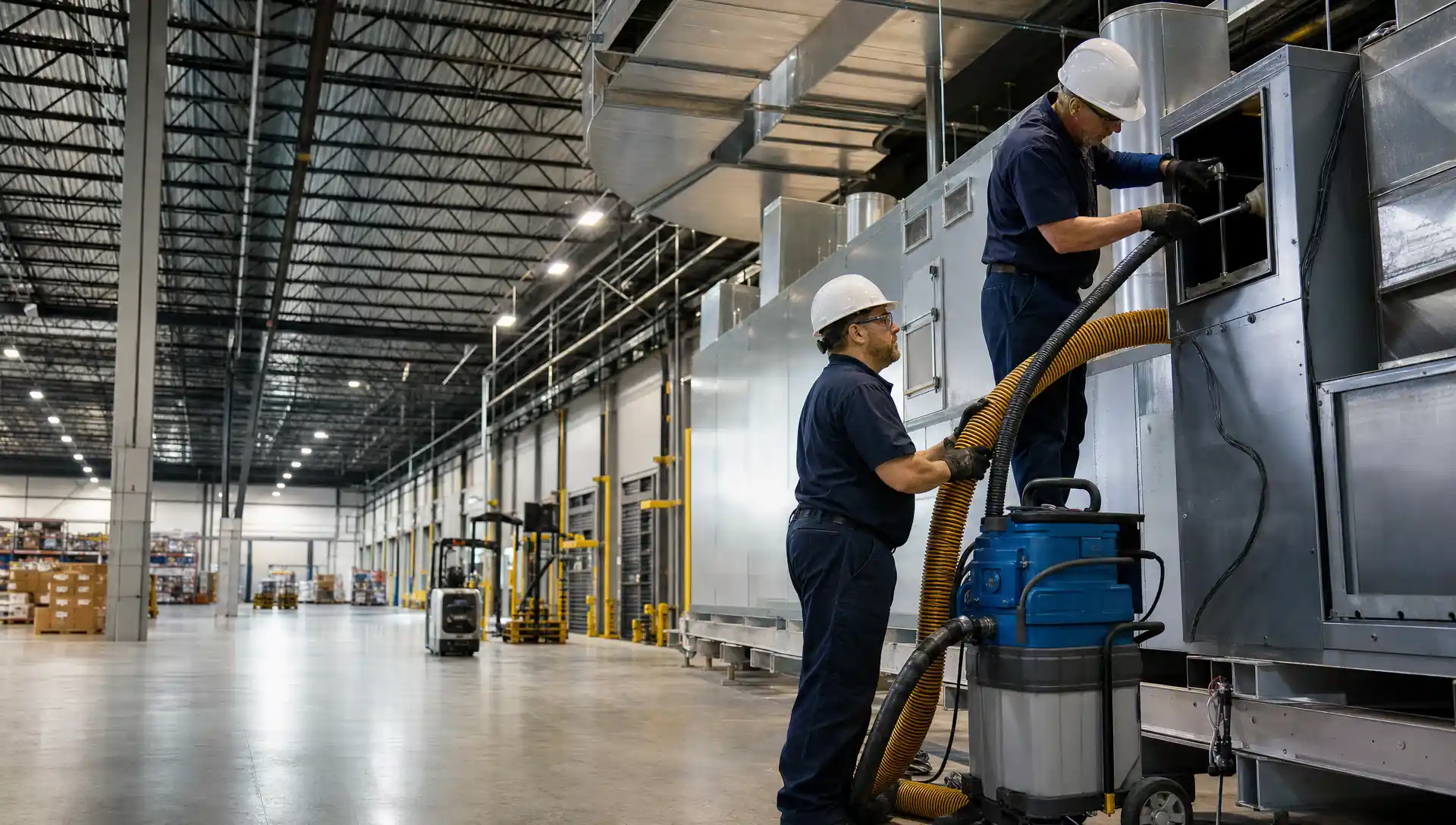
Industrial & Commercial Cleaning Services in Columbus, OH
Central Ohio is adding data centers, mega-warehouses, and institutional square footage faster than any market we serve — and every one of those buildings has ductwork, exhaust, and cooling systems that a janitorial contract will never touch. Service-Tech's Columbus office has covered them since around 1980.
- NADCAMember since 1990
- 100,000+Facilities serviced since 1960
- 4.9Rated across 111 Google reviews
- Veteran-ownedUS Army veteran ownership since 2019
Service-Tech Corporation provides industrial and commercial cleaning services in Columbus, Ohio from a staffed office at 625 Cross Pointe Rd Suite 1 in Gahanna. We've served central Ohio since around 1980 — long before the current wave of data centers and fulfillment giants — cleaning the building systems that keep facilities compliant and air handling equipment efficient: commercial air ducts, kitchen exhaust systems, cooling towers, industrial plants, and high structures. Founded in Cleveland in 1960 and NADCA members since 1990, we bring specialty-contractor depth to a Columbus market where most "commercial cleaning" search results are janitorial franchises or lead-gen sites that broker your job to whoever answers the phone.
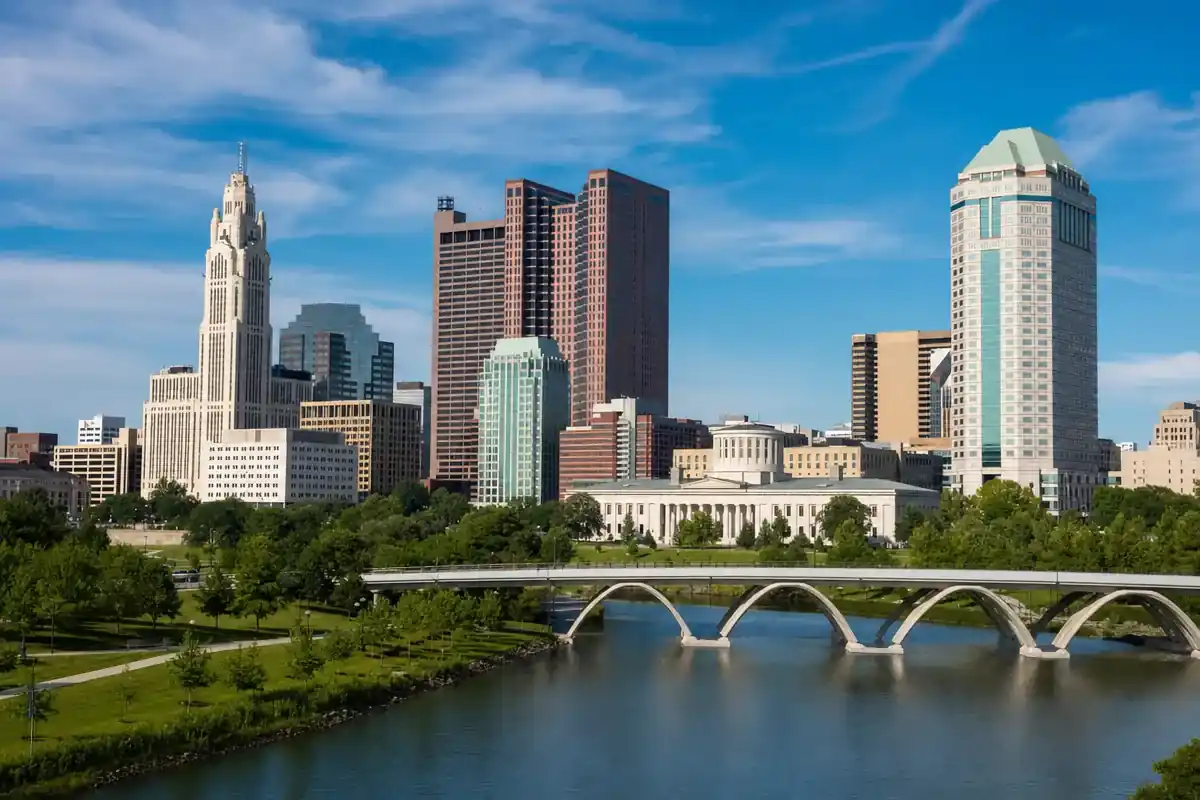
Columbus Is Building Faster Than Its Air Systems Are Being Maintained
Columbus isn't one facility market — it's four growth sectors, each with a distinct air-system cleaning problem that no ranking janitorial page even mentions.
Data centers and the New Albany corridor. The hyperscale buildout across New Albany and Licking County has created a class of facility where airborne particulate is an operational threat, not a housekeeping nuisance. Dust in air handling systems, on raised floors, and around cooling infrastructure works against the filtration and thermal management these buildings depend on. This is IAQ-sensitive, documentation-heavy work — a specialty contractor's job, with controlled methods and written reporting.
Logistics at Rickenbacker scale. The distribution and fulfillment belt around Rickenbacker runs high-bay warehouses where dust accumulates on roof joists, racking, light fixtures, and sprinkler infrastructure forty feet up. High-bay dust removal is lift-and-vacuum work under a fall-protection program — and at these ceiling volumes, duct and exhaust systems are proportionally large jobs franchises aren't equipped to bid.
The state capital's institutional portfolio. State agency buildings, county facilities, and courthouses procure through formal bids that require scope language, standards references, and documentation. So do Ohio State-scale university operations: dining halls with NFPA 96 exhaust obligations, labs, dormitory air handlers, and central plants with cooling towers.
Healthcare and food production. Central Ohio's hospital networks and food processing plants both live under audit regimes — infection control on one side, food-safety programs on the other — where "we had it cleaned" only counts if there's a report behind it.

Specialty Cleaning Services for Columbus Facilities
Five service lines, one Columbus office, one point of contact. Our own field technicians perform the work — Service-Tech maintains 50+ field technicians companywide.
- Industrial cleaning — High-bay dust removal for Rickenbacker-corridor warehouses, plant and process-equipment cleaning, and industrial vacuuming. Dry ice blasting carries a $2,000 minimum engagement.
- Commercial air duct cleaning — NADCA ACR-standard source-removal duct cleaning for offices, data-center support spaces, government buildings, campuses, and healthcare. From $1,375.
- Cooling tower cleaning — Fill, basin, and distribution-system cleaning for central plants and high-rise mechanical systems, supporting ASHRAE 188 water-management plans. $1,375 minimum engagement.
- Kitchen exhaust hood cleaning — NFPA 96 hood-to-fan cleaning for restaurants, university dining, stadium concessions, and institutional kitchens. From $599 per cleaning, performed by an IKECA member company.
- Rope access services — Redundant two-rope systems under a documented fall-protection training program for stacks, high steel, and facade-level work without scaffolding mobilization.
Facility portfolio across multiple buildings? Most Columbus institutional clients consolidate ducts, hoods, towers, and high work under one contract — one insurance file, one scheduling contact, one documentation standard. Browse everything we do on the services page.
Hiring for Compliance: An RFP Readiness Checklist
Government, university, and corporate procurement in Columbus increasingly runs through formal RFPs — and most cleaning vendors can't answer the technical questions. Before you award an air-system or industrial cleaning contract, require each bidder to state in writing:
- The standard the work follows. Duct cleaning should reference the NADCA ACR standard; kitchen exhaust must reference NFPA 96; cooling tower work should slot into your ASHRAE 188 water-management program.
- Who performs the work. Ask whether crews are the bidder's own trained employees or subcontractors. Lead-gen "industrial cleaning" websites ranking in Columbus broker jobs out; you won't know who walks into your facility until they arrive.
- What documentation you receive. Before-and-after photo evidence and a written service report should be deliverables, not extras. That paperwork is what survives a fire-marshal visit, an insurance loss-control audit, or a university facilities review.
- How pricing is structured. Site-assessed quotes beat per-square-foot guesses. Our estimates are free, travel is factored into the quote, and published floors (from $1,375 for duct work and from $599 for hood work) mean no bait pricing.
- Verifiable trade membership. NADCA and IKECA membership are checkable claims; "fully certified" is not. Service-Tech has held NADCA membership since 1990.
What Each Discipline Actually Involves
Columbus facilities are dominated by data centres, distribution, and institutional campuses. Here is the physical work behind each service.
- Duct cleaning is source removal under negative pressure. NADCA's ACR standard requires contaminants to be mechanically dislodged and extracted at the same time: rotary brushes and compressed-air whips agitate the duct interior while the system is held under continuous vacuum through HEPA filtration, so nothing released reaches a server room or a classroom. ACR's gravimetric acceptance test — 0.75 mg of residue per 100 cm² of surface — is the figure to hold a contractor to, and where a fibreglass liner is shedding the decision is to encapsulate it or replace the run.
- Cooling towers get isolated, dosed, then physically cleaned. Cells are isolated and drained, basin deposits are brushed out, and the loop is dosed to 5–10 ppm free chlorine and circulated for at least an hour before any mechanical work — AWT and ASHRAE 188 guidance, and the reason is sequence: chlorine kills what is suspended and loosens biofilm, brushing and jetting remove what chlorine cannot penetrate. Mineral scale has to be descaled; biofilm has to be stripped. They are not the same job.
- Hood cleaning is gauged before it is cleaned. NFPA 96 sets a measurable trigger: 0.002 in (50 µm) of grease depth on a comb gauge requires the whole exhaust system cleaned, and 0.078 in (2,000 µm) means immediately. Panels are locked out, flammable solvents are prohibited, and crews scrape and degrease from hood plenum through the duct run to the rooftop fan — which is what "clean to bare metal" means for a campus dining hall or a distribution-centre canteen.
- Combustible dust is a code threshold, not a housekeeping preference. NFPA 660 puts the housekeeping action level at a 1/32 in (0.8 mm) layer over 5% of floor area. Compressed-air blowdown is prohibited; the work uses conductive vacuums bonded and grounded to the equipment, and where crews purge and enter a silo, hopper, or pit it is under a confined-space permit with the atmosphere monitored throughout. Warehouse and packaging dust in Columbus is exactly this class of hazard.
- Rope access is rigging first. Crews descend on two independently anchored lines — one working, one backup — and reach what a lift cannot using a rebelay (an anchor below the main one that pulls the rope off the fall line) and deviations (a sideways pull holding the rope clear of an edge). On a wide distribution roof or an atrium, that is the difference between access and a scaffold bill.
- Dry ice blasting is non-abrasive by physics. Pellets at −109 °F embrittle a deposit and sublimate on impact, expanding up to 800 times in milliseconds to lift it clear; at 1.5–2 on the Mohs scale the medium is softer than the substrate, so switchgear and control panels clean up without being profiled (figures per Cold Jet). CO₂ gas is heavier than air and settles low, so enclosed rooms are ventilated and monitored while work proceeds.
How We Work in Columbus Facilities
Free site assessment.
A technician from our Gahanna office surveys your systems, photographs conditions, and writes a fixed scope — bid-ready language for procurement teams that need it.
Scheduled execution.
Work is planned around your operation: overnight for offices and government buildings, shutdown windows for plants and warehouses, between-service windows for kitchens.
Documented closeout.
Before-and-after photos and a written report land in your compliance file, formatted to survive an audit.
When Columbus Facility Managers Call Us
Typical triggers in this market: a fire-marshal or health-department finding on kitchen exhaust; a new warehouse lease where overhead dust was inherited from the prior tenant; a data-center or lab environment failing particulate expectations; an upcoming state or university bid cycle that requires a standards-based cleaning vendor; or supply registers pushing visible dust after an office fit-out. For unplanned shutdowns and urgent contamination events, our Columbus office offers rapid emergency response — call (614) 864-9415.
A Staffed Columbus Office, Not a Lead-Gen Broker
Some of what ranks for industrial cleaning in Columbus is programmatic lead generation — city-name-swapped pages that sell your inquiry to a third party. Service-Tech's Columbus operation is a staffed office at 625 Cross Pointe Rd Suite 1, Columbus (Gahanna), OH 43230, dispatching our own crews since around 1980. The company behind it has been family-owned 1960–2019 and veteran-owned since 2019 under US Army veteran Gabriel S. Chick, holds a 4.9 rating across 111 Google reviews on two GBP listings, and has serviced 100,000+ facilities since 1960.
Service Area: Central Ohio from Our Gahanna Office
(614) 864-9415
We cover a 150-mile radius from the Columbus office — Franklin County plus Delaware, Union, and Licking counties and the rest of central Ohio, including Dublin, Westerville, New Albany, Grove City, Newark, Marion, Lancaster, and Springfield. Facilities outside this radius can find their nearest Service-Tech office on the service areas page.

Whether it's a single kitchen exhaust system or a portfolio-wide duct contract, the scope starts with a free site assessment from our Columbus office.
Frequently Asked Questions
How quickly can you respond to a Columbus facility?
Our office in Gahanna puts crews within a short dispatch of most Franklin County facilities, and scheduling typically follows the free site assessment. Office hours are Monday–Friday 8:30am–4:30pm; for unplanned shutdowns or urgent contamination events we offer rapid emergency response at (614) 864-9415.
Which industries do you serve in central Ohio?
Data centers and their support facilities in the New Albany–Licking County corridor, distribution and fulfillment warehouses around Rickenbacker, state and county government buildings, universities and campus dining, healthcare facilities, food production plants, and commercial offices. If the building has ducts, exhaust, a cooling tower, or high structures, it's our kind of work.
What's your service radius from the Columbus office?
150 miles from our Gahanna office — Franklin, Delaware, Union, and Licking counties and effectively all of central Ohio. Travel is factored into your quote rather than billed as a surcharge.
Can you support a formal bid or RFP process?
Yes. Our free site assessment produces a written, fixed scope with standards references (NADCA ACR, NFPA 96), and every project closes with before-and-after photo documentation and a service report. That's the paperwork institutional procurement teams need on file.
Do you subcontract Columbus jobs out?
No. The work is performed by Service-Tech's own trained field technicians — 50+ companywide — dispatched from our Columbus office. That's a meaningful difference from lead-gen sites that resell your inquiry and franchises that broker specialty work.
What does commercial cleaning of building systems cost in Columbus?
Commercial air duct cleaning starts from $1,375 and kitchen exhaust hood cleaning from $599 per cleaning. Cooling tower cleaning carries a $1,375 minimum engagement and dry ice blasting a $2,000 minimum. Larger and industrial scopes are quoted after a free on-site assessment.
Request Your Free Estimate
Use the form below or call the office nearest you. For unplanned shutdowns, contamination events, or failed inspections, call rather than write — we mobilize rapid-response crews by phone.