
Industrial & Facilities Cleaning in Columbus, OH — Service-Tech Corporation
From Rickenbacker mega-warehouses to central Ohio plants — overhead dust, combustible residue, and production soils removed by crews built for structure and air systems, not mop-and-bucket janitorial.
- NADCAMember since 1990
- 100,000+Facilities serviced since 1960
- 4.9Rated across 111 Google reviews
- Veteran-ownedUS Army veteran ownership since 2019
Service-Tech Corporation provides industrial and facilities cleaning in Columbus, OH from our staffed office at 625 Cross Pointe Rd in Gahanna — crews we've based in this market since around 1980. Columbus industrial cleaning has its own shape: the fastest-growing logistics belt in the Midwest around Rickenbacker and the I-70 corridor, food processors and manufacturers across central Ohio, and institutional campuses from the Capitol district to OSU. What those facilities share is the problem janitorial contracts never touch — contamination on structure, at height, and in the systems that move air.
What Industrial Cleaning Means for a Columbus Facility
Industrial and facilities cleaning is the planned, safety-managed removal of process residue, combustible dust, overhead contamination, and production soils — method-matched to each surface rather than mopped at floor level:
- High-bay dusting and overhead structural cleaning — joists, deck, racking tops, conduit, sprinkler lines, and light fixtures at warehouse ceiling height
- HEPA industrial vacuuming — capture-at-source removal of settled and combustible dust
- Dry ice blasting — residue removal from production equipment and electrical without water or chemical carryover
- Degreasing and steam cleaning — oil mist, coolant film, and food-plant soils
- Process exhaust and ventilation cleaning — the ductwork that carries what production makes airborne
- Post-construction and pre-audit deep cleans — including new-build logistics and industrial space coming online across the metro
The full technical scope lives on our industrial & facilities cleaning service hub; this page is about how the work runs in Columbus.

Three Kinds of "Industrial Cleaning" Contractor — and When to Call Each
The Columbus SERP mixes three genuinely different trades under one search term. Knowing the difference saves you a round of wrong-fit quotes:
| Contractor type | What they do | Call them when |
|---|---|---|
| Process / hydroblasting firms | High-pressure water, vacuum trucks, tank and line cleaning inside process equipment | Your problem is inside a vessel, pit, sewer, or process line |
| Airside & structure specialists (Service-Tech) | Overhead structure, high-bay dust, combustible dust housekeeping, ducts and exhaust, equipment surfaces — dry, capture-at-source methods | Your problem is on or above the building: elevated dust, contaminated structure, loaded ductwork, audit-driven deep cleans |
| Janitorial / facility services | Floors, restrooms, offices, day-to-day upkeep | Your problem is routine housekeeping at floor level |
Central Ohio has a genuinely strong heavy-process incumbent class, and we don't pretend to compete for hydroblasting scopes. Service-Tech's lane is the building itself — the structure overhead and the air systems within it — which is precisely the scope heavy-process firms don't mobilize for and janitorial firms can't reach.
Why 40-Foot Ceiling Dust Matters: The High-Bay Problem
The Rickenbacker and I-70 logistics belt has filled central Ohio with 500,000+ sq ft distribution buildings — and every one of them is quietly accumulating dust on joists, deck, fixtures, and racking steel 40 feet over the pick lines. Three reasons that matters before anyone sneezes:
- Fire load and sprinkler performance. Dust blankets on overhead steel are fuel above everything you store, and accumulation on sprinkler heads and escutcheons degrades the system that's supposed to protect the building. Fire inspections and insurer walkthroughs increasingly look up.
- Product and brand contamination. In e-commerce and food-adjacent distribution, dust fall onto cartons and product is a customer-complaint engine — and for food-grade warehousing, an audit finding.
- It compounds. Overhead dust is invisible from the floor until air movement — dock doors, HVLS fans, seasonal HVAC swings — starts shaking it loose. By then the cleaning scope has doubled.
Our crews clean high-bay structure with HEPA-vacuum-first methods from lifts, and rope access services in Columbus where racking density rules lifts out — sequenced aisle-by-aisle with your operation so the building keeps shipping while it gets clean.
Combustible Dust and Food-Grade Housekeeping in Central Ohio
Columbus-region manufacturing and food processing carry the same regulatory physics as the rest of industrial Ohio: dust-generating operations face NFPA 652 Dust Hazard Analysis expectations and OSHA housekeeping enforcement, and food plants answer to FDA/USDA and customer audits where overhead contamination is an automatic finding. Service-Tech crews remove accumulated dust from elevated surfaces with HEPA-filtered capture, coordinate with your safety team on hot-work and grounding constraints, and sequence food-plant work zone-by-zone to protect product areas. If an audit, insurance inspection, or DHA finding started your search — bring us the finding, and we'll scope directly against it.
How We Scope and Run Large Industrial Jobs
Big-box and plant-scale work rewards disciplined scoping. Here's what we ask before quoting a large Columbus industrial job — and what the answers do:
- 01
What triggered this?
An audit finding, insurance letter, DHA, or planned shutdown defines the compliance target the scope must satisfy.
- 02
How big, how high, how loaded?
Square footage, ceiling height, and contamination depth size the crew and the calendar.
- 03
What's below the work?
Racking, product, production lines, or open floor determines containment, sequencing, and access method — lift versus rope.
- 04
When can we have the space?
Occupied-operation cleaning, night/weekend windows, or full shutdown access each produce a different plan and price.
- 05
What must the record show?
Photo documentation and verification walks are standard; audit-driven scopes get documentation built to the finding.
Then the project runs the way our industrial work has run since 1960: site walk and hazard assessment, containment and lockout coordination, method-matched cleaning per surface, and a closing verification walk with photo documentation.
The Columbus Facilities We Clean
- Distribution and fulfillment centers — Rickenbacker, I-70/I-71 corridor, and metro logistics parks with high-bay structure and racking-level dust
- Manufacturers — automotive-adjacent, plastics, and general manufacturing plants across central Ohio
- Food and beverage processors — audit-driven sanitation support and overhead contamination control
- Data centers and critical-environment construction — post-construction and pre-commissioning cleans in the New Albany-corridor building boom, scoped to the cleanliness spec your commissioning agent sets
- Universities, hospitals, and government campuses — OSU-scale institutional facilities and state-capital building stock
- Warehouse conversions and new builds — post-construction cleaning that gets space certificate-of-occupancy clean
Post-Construction Cleaning for New Industrial Space
Central Ohio is in the middle of an industrial building boom, and new space has its own cleaning problem: construction dust. Drywall, concrete, and fireproofing dust settles on every joist, deck flute, and duct top during the build, and a certificate of occupancy doesn't remove it. For warehouses, that dust becomes the first thing HVLS fans rain onto racking; for food-adjacent and critical-environment space, it's a commissioning blocker. Our post-construction scope takes new industrial buildings from broom-clean (the GC's standard) to operations-clean (yours): HEPA vacuuming of overhead structure, cleaning of exposed systems and surfaces, and — where a commissioning agent or facility standard sets a cleanliness spec — work scoped and verified against that spec. Booking this before racking and equipment install is dramatically less expensive than cleaning over a live operation later; developers and fit-out GCs who call us during the punch-list phase are buying the easy version.

Timing: Shutdowns, Audits, and Peak-Season Realities
Columbus adds a wrinkle to the usual shutdown calculus: logistics buildings don't get shutdowns — they get slow seasons. For distribution clients, the cleaning calendar keys to post-peak windows (the weeks after holiday volume breaks) and pre-audit dates rather than outage weeks. For manufacturers, the classic sequence holds: get the scope walked 8–12 weeks before a planned outage, lock crew-days early, and decide deliberately whether cleaning leads the window or closes it. And when the trigger is unplanned — an incident, a failed inspection, a surprise audit date — our Gahanna office responds on rapid-response timelines with crews based in this market, not dispatched from out of state.
Audit-driven work deserves one more note: when a customer audit, insurance walkthrough, or regulatory visit has a date, the cleaning scope should be built backward from that date with margin — finished, verified, and photo-documented before the auditor arrives, not the week they do. Bring us the audit date and the finding list together; the quote comes back as a schedule, not just a number.

What Industrial Cleaning Costs in Columbus
General industrial and facilities cleaning is quoted per project: free estimate, fixed quote after a site assessment — plant scale, contamination type, height, and access vary too much for honest flat-rate pricing. Two confirmed anchors: dry ice blasting engagements start at a $2,000 minimum, and travel is factored into every quote with no separate surcharge. Quotes hold no surprises because the scoping questions above get answered before the number does.
What Deferral Costs a Columbus Facility
Skip the cleaning long enough and the building starts issuing its own invoices: a combustible-dust citation after a DHA the housekeeping program couldn't back up; a food-safety audit failure over product zones; dust-triggered sprinkler and fire-system findings in a warehouse your insurer just walked; product returns traced to contamination raining off overhead steel. Every one of those costs more than the planned version of this work — and arrives on someone else's schedule, usually the least convenient one available. Facilities that put overhead and structural cleaning on a recurring calendar simply stop having this category of surprise.
A Columbus Industrial Cleaning Contractor With 66 Years Behind It
Service-Tech Corporation — founded in Cleveland in 1960, family-owned until 2019 and veteran-owned since — has served the Columbus market since around 1980 from our Gahanna office, with 50+ field technicians company-wide and a 150-mile service radius from every office. Explore the full local lineup on our Columbus, OH hub, bundle scopes like commercial air duct cleaning in Columbus and cooling tower cleaning in Columbus into one mobilization, or compare our HQ-market program: industrial cleaning in Cleveland.
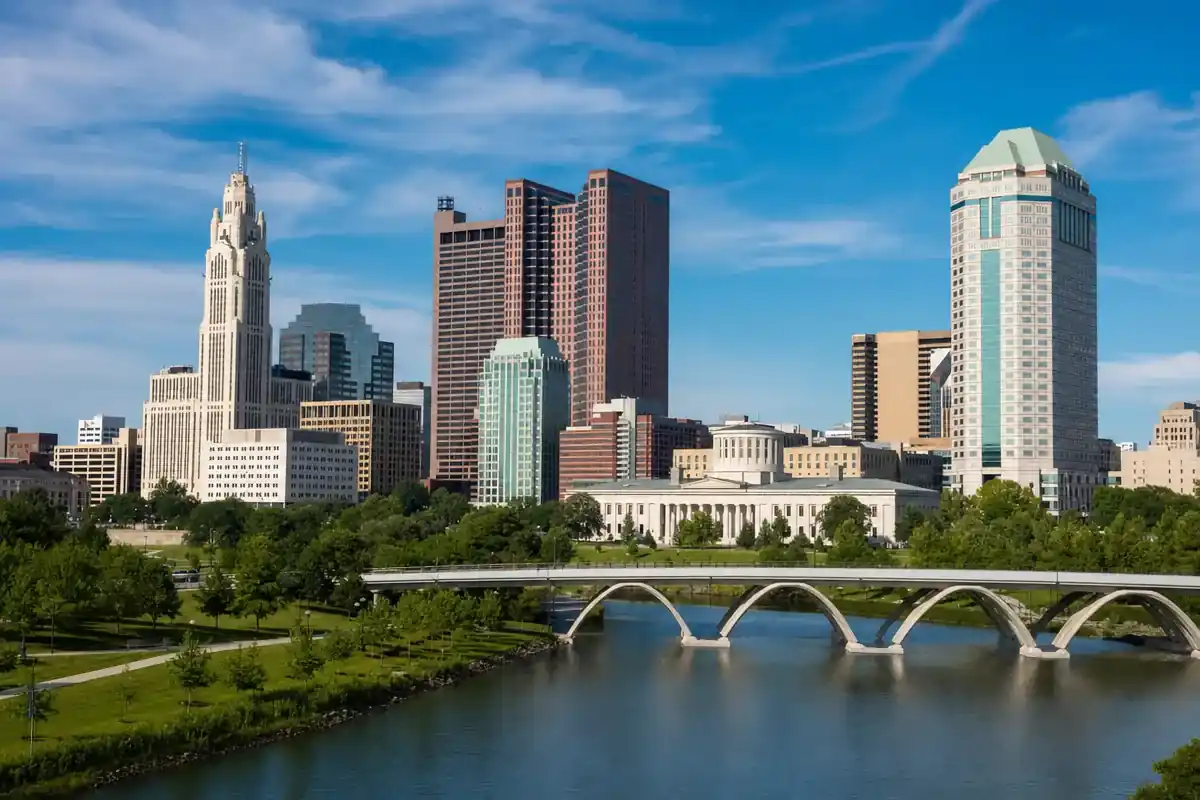
Whether it's a DHA finding or a post-peak warehouse window, the scope starts with a free site walk from our Gahanna crew.
What Your Scope of Work Should Specify
Warehouse and packaging dust is Columbus's version of the combustible dust problem — lighter than foundry dust, easier to overlook, and accumulating on rack tops and roof steel across a million square feet. The NFPA 660 action level is measured the same way regardless, and 5% of a bay's floor area is a smaller footprint than most managers expect.
- Housekeeping action level. A combustible dust layer of 1/32 in over 5% of a room's floor area, per NFPA 660, counted on elevated horizontal surfaces as well as the floor.
- Programme basis. NFPA 652 requires a dust hazard analysis, and your analysis — not a vendor's schedule — sets the frequency.
- Prohibited method. Compressed-air blowdown of combustible dust. Conductive vacuums, bonded and grounded to the equipment, with HEPA capture at 99.97% at 0.3 micron.
- Entry procedure. Purge, gas-test, permit, attendant, lockout-tagout, and continuous atmospheric monitoring for the full duration.
- Method selection. Dry ice where water and grit are both disqualified; hydroblasting where residue has hardened beyond vacuuming.
The Figures Your Housekeeping Programme Is Measured Against
- Action level. A combustible dust layer of 1/32 in over 5% of a room's floor area, per NFPA 660 — counted on beams, joists and ductwork as well as the floor.
- Programme basis. NFPA 652 requires a dust hazard analysis, and the analysis sets the interval rather than a vendor's calendar.
- Capture specification. HEPA at 99.97% of particles at 0.3 micron, on conductive tooling bonded and grounded to the equipment.
- Regulatory overlay. OSHA 1910 subparts govern the lockout-tagout, confined-space entry and respiratory protection the work runs under.
Frequently Asked Questions
Do you clean high-bay warehouses near Rickenbacker and the I-70 corridor?
Yes — high-bay distribution buildings are core Columbus work for us. We remove dust from joists, deck, racking steel, fixtures, and sprinkler-adjacent surfaces at full warehouse height, using HEPA-vacuum capture from lifts or rope access, sequenced aisle-by-aisle so your operation keeps shipping during the work.
Can you clean our facility while it's operating?
Usually, yes. Occupied-operation cleaning is planned zone-by-zone with containment and barricaded work areas, and night or weekend windows cover the sections that can't be worked live. Full-shutdown access produces the fastest schedule, but it isn't a requirement — tell us what access you can give and we'll build the plan around it.
How are you different from hydroblasting firms and janitorial companies in Columbus?
We occupy the lane between them. Hydroblasting and vacuum-truck firms clean inside process equipment; janitorial companies handle floor-level upkeep. Service-Tech cleans the building itself — overhead structure, high-bay dust, combustible dust housekeeping, process exhaust and ductwork — with dry, capture-at-source methods neither of the other two brings.
What does industrial cleaning cost in Columbus?
It's quoted per project after a free site assessment — facility size, height, contamination, and access drive the number, and we'll walk those variables with you before quoting. Dry ice blasting engagements start at a $2,000 minimum, and travel is factored into the quote with no separate surcharge.
Do you support combustible dust and food-plant audit findings?
Yes. Bring us the DHA finding, insurance letter, or audit report and we scope directly against it: HEPA-filtered removal of accumulated dust from elevated surfaces, coordination with your safety team on hot-work and grounding constraints, zone-sequenced work in food plants, and photo documentation for the record.
Where do your Columbus crews come from and how far do they travel?
Crews work from our staffed office at 625 Cross Pointe Rd in Gahanna and serve a 150-mile radius — covering Franklin County and central Ohio from Marion to Chillicothe and Springfield to Zanesville. We've served this market since around 1980.