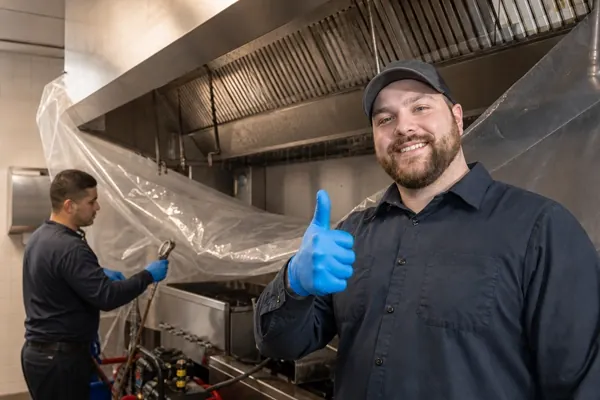
Five signs any manager can spot tonight, five more a technician looks for — and the specific fire mechanism each one is warning you about.
Direct Answer: The five clearest signs a restaurant hood needs cleaning are visible grease on the hood or filters, weakened smoke capture (smoke rolling out past the hood edge), persistent grease odors, grease drips or staining around the hood and rooftop fan, and it simply being past your NFPA 96 interval. Any one of them means the system is overdue for professional kitchen exhaust hood cleaning — because each is a symptom of fuel accumulating in your fire path.
What Are the Five Signs — and What Fire Mechanism Does Each Signal?
The franchise listicles name the signs; here's what each one means, because the fire logic is what should move a manager to act:
| Sign | What you observe | The fire mechanism it signals |
|---|---|---|
| 1. Visible grease | Film or droplets on canopy edges; filters glisten a week after washing | Fuel load building at the flame boundary — flare-ups now have a ladder into the duct |
| 2. Smoke roll-out | Smoke escaping the hood edge instead of being captured | Grease-narrowed duct and loaded fan are cutting airflow; vapor (and fire) can bypass the system |
| 3. Persistent odor | Stale grease smell that survives nightly cleaning | Rancidifying grease in the plenum and duct — accumulation you can't see, announced by smell |
| 4. Drips and staining | Grease tracks at hood seams; dark staining around the rooftop fan | The system is saturated past capacity; the rooftop stain is your duct's overflow gauge |
| 5. Past the interval | No sticker, or a sticker older than your NFPA 96 class allows | Statistically, the fuel is there — the interval exists because accumulation is predictable |
A grease-loaded exhaust system turns a routine cooktop flare-up into a structure fire: flame contacts the grease at the filter line, ignites the duct interior, and the fan pulls the fire through the building to the roof. Every sign above is one stage of that fuel path filling in.
What Does a Technician Look for That Managers Miss?
The generic five are the manager's list. A crew that opens systems for a living reads earlier signals:
- Grease depth at the measuring points. Professionals gauge accumulated depth in the duct rather than eyeballing it — measured depth against the ANSI/IKECA C10-style criterion is the objective "clean now" trigger.
- Fan belt slip and noise. Grease reaching the fan throws belt tension and balance off — a squealing or laboring rooftop fan is often a grease symptom before it's a mechanical one.
- Hinge-kit and access-panel leakage. Grease weeping from duct panel seams means the interior is loaded enough to pool against them.
- Capture velocity drift. When the hood needs the cooks to "help it" with repositioned pans, airflow has degraded — loaded filters, duct narrowing, or fan grease are the usual suspects.
- Rooftop grease containment overflow. The containment system around the fan filling early is a direct read on how much is passing through the duct.
How Do You Run a Monthly Self-Inspection?
Ten minutes, once a month, before opening — a printable rhythm for any Cleveland kitchen:
- 01
Filters out, look up
Check the plenum behind the filters with a flashlight — wipe a white cloth on the metal; grease film means the system is loading.
- 02
Walk the hood perimeter
Look for drips, tracks at seams, and film on the canopy edges.
- 03
Watch a busy burner
During a rush, watch whether smoke fully captures or curls past the hood lip.
- 04
Smell test at opening
Stale grease odor before any cooking starts is stored grease talking.
- 05
Check the sticker
Confirm the last service date against your NFPA 96 class — the frequency logic is covered in our cleaning-schedule guide on the blog.
- 06
Roof check quarterly (safely)
Staining or full grease containment around the fan = call now.
Log it — a dated checklist file impresses inspectors and catches drift while it's still cheap.
What Do Technicians Actually Find in Overdue Cleveland Systems?
When Service-Tech crews open a system that's been running on wipe-downs, the pattern is consistent: hardened grease layering the vertical duct, fans caked to the point of imbalance, and access panels sealed shut by accumulation — conditions no nightly cleaning touches, in systems whose owners were often confident they were fine because the visible hood looked clean. That's the trap of judging by the canopy: cooking type sets accumulation speed (a wok line or charbroiler loads a duct dramatically faster than a soup-and-salad kitchen), and the loading happens where you can't see it. It's also why serious operators pair the monthly self-check with professional inspection on the NFPA 96 cycle — the self-check catches symptoms, the pro cycle measures the cause. Service-Tech has run that cycle for Cleveland kitchens since 1960.
TL;DR — The Signs, Ranked by What They Mean
Visible grease, smoke roll-out, persistent odor, drips/rooftop staining, and a lapsed sticker — each is a stage of fuel accumulating along your kitchen's fire path. Managers should run the ten-minute monthly self-check; technicians add measured grease depth, fan behavior, and containment overflow as the earlier, objective triggers. Judge nothing by the canopy — the parts that burn are the parts you can't see.
Frequently Asked Questions
If I See One of the Five Signs, How Urgent Is It?
Treat visible grease, roll-out, or rooftop staining as a this-month problem, not a someday problem — each means the fuel path is already loaded. Persistent odor and a lapsed sticker call for scheduling an inspection promptly. None of them improve on their own; grease only accumulates.
Will an Overdue Cleaning Cost More?
Usually, yes — hardened, layered grease takes longer to remove to bare metal than maintenance-level buildup, and overdue systems sometimes need access panels installed before the duct can be fully cleaned. Service-Tech cleanings start from $599, with the overdue premium disclosed at the free assessment, not on the invoice.
My Hood Looks Clean — Can I Skip This Year?
The canopy is the least meaningful surface in the system. The fire load lives in the plenum, duct, and fan, none of which you can see from the line. Run the white-cloth plenum test and check the sticker date; if either fails, the shiny canopy is telling you nothing.
Confirming It, and What Happens Next
Gauge the surface rather than guessing from appearance — a comb reading settles the question in seconds and gives you a number for the file. If it is due, the work runs in a fixed order: isolate the section and lock out the electrical, pull and soak the baffle filters, shroud the fan, scrape the hardened deposit mechanically, then degrease and hot-wash from the hood plenum through the duct run. Runoff is squeegeed to containment, accessible stainless is polished, and everything is reinstated and test-run before service resumes.