Frequency is the requirement everyone knows. Access panels, the bare-metal endpoint, fan cleaning, and recordkeeping are the requirements that actually generate citations — here's the full map for Ohio operators.
Direct Answer: NFPA 96 requires commercial kitchen exhaust systems to be inspected on a cooking-volume schedule and, when found grease-laden, cleaned to bare metal by properly trained and qualified personnel — covering the hood, the entire duct run, and the exhaust fan — with access panels provided wherever needed and the work documented with stickers and written reports. Service-Tech Corporation's NFPA 96 compliance cleaning delivers that full requirement set for Ohio operators, not just the cleaning date.
What Does NFPA 96 Require Besides a Cleaning Schedule?
The ranking articles stop at the frequency chart. The standard's cleaning-related requirements cluster into five groups — and the last four are where inspections actually go wrong:
| Requirement cluster | What the standard demands | Where operators get caught |
|---|---|---|
| Inspection frequency | Cooking-volume schedule (solid fuel monthly through low-volume annual) | Menu changed, class changed, schedule didn't |
| Cleaning endpoint | Contaminated surfaces cleaned to bare metal | "Cleaned last month" but the duct interior fails a wipe test |
| System coverage | Hood, plenum, entire duct run, and exhaust fan | Fan and vertical duct skipped by a lowball vendor |
| Access | Panels adequate to reach every portion of the duct | Duct sections physically impossible to clean or inspect |
| Qualification and records | Cleaning by qualified/trained personnel; sticker + written report, including areas not cleaned | No documentation trail when the inspector or insurer asks |
How Does NFPA 96 Enforcement Actually Work in Ohio?
NFPA 96 isn't law by itself — it binds through adoption. Ohio's chain: the Ohio Fire Code (OAC 1301:7-7) incorporates NFPA standards by reference, and your local fire authority (AHJ) — Cleveland Fire, a suburban department, or a county fire marshal — inspects against it. Practical consequences:
- The AHJ's interpretation governs. Two neighboring jurisdictions can differ on documentation expectations; your inspector's checklist is the one that matters.
- Health and fire inspections cross-pollinate. A health inspector who sees a grease-heavy hood can flag it to fire authorities, and vice versa.
- Insurance runs a parallel enforcement track. Carriers ask for cleaning records at renewal and after claims — an uninsurable kitchen closes just as surely as a cited one.
What Does "Clean to Bare Metal" Mean in Practice?
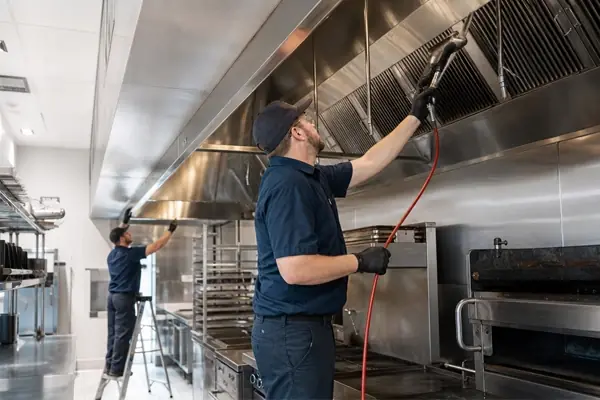
Bare metal is a verifiable endpoint, not a vibe: after cleaning, the metal surface of the hood, plenum, duct, and fan housing is exposed — no residual grease film that a cloth wipe picks up. From the IKECA-member practitioner side, that implies things cheap cleanings can't deliver: chemical foaming and hot-water washing or scraping through every access panel (not fogging from the ends), fans opened and cleaned rather than wiped around, and photos taken inside the duct as proof. A compliant report also lists what could not be reached — because a duct with no access panels can't be cleaned to bare metal, and the honest fix is installing panels, not omitting the section from the paperwork.
What Does a Citation Actually Look Like — and What Does It Cost You?
Ohio enforcement typically escalates rather than ambushes: a violation notice with a correction deadline, a re-inspection, and — for ignored or repeat findings — the authority to restrict the cooking operation until the system is compliant. The real cost stack is rarely the fine itself: emergency-priced remedial cleaning plus access-panel installation, possible operating restrictions during correction, an insurance file that now contains a fire-code violation, and — after any fire — the finding that the system wasn't maintained per NFPA 96, which is the sentence no operator wants read back to them.
How Do You Stay Compliant Without Thinking About It?
The operators who never see a violation run it as a standing program, which is what Service-Tech's kitchen exhaust hood cleaning service builds for Cleveland-area kitchens:
- 01
Classify the system
by cooking volume and set the inspection/cleaning cycle.
- 02
Fix access first
install any missing panels so every duct section is reachable.
- 03
Clean to bare metal on schedule
full system, hood to fan.
- 04
File the paperwork
sticker on the hood, photos and written report in a folder your manager can produce in under a minute.
- 05
Re-classify after changes
new equipment, new hours, new menu triggers a fresh look.
TL;DR — Compliance Beyond the Chart
NFPA 96 compliance is five clusters, not one: the inspection schedule, the bare-metal endpoint, full-system coverage including the fan, access panels for every duct section, and qualified-personnel documentation. In Ohio it binds through the Ohio Fire Code and your local AHJ, with insurance as the parallel enforcer. Run it as a standing program — classify, fix access, clean to bare metal, file the report — and inspections become non-events.
Frequently Asked Questions
Does NFPA 96 Require a Certified Company, or Can Our Staff Clean the System?
The standard requires the exhaust system cleaning to be performed by properly trained, qualified personnel — in practice, a professional company working to the standard, since bare-metal duct and fan cleaning requires equipment and access work kitchen staff don't have. Staff-level tasks like filter washing remain yours, but they don't satisfy the system-cleaning requirement.
We Passed Our Health Inspection — Are We NFPA 96 Compliant?
Not necessarily. Health inspections target food safety; NFPA 96 compliance is enforced by your fire authority against a different checklist — grease in the duct and fan, access panels, and cleaning records. Plenty of kitchens hold an A rating over a duct that would fail a fire inspection the same afternoon.
What Does NFPA 96 Compliance Cost per Year?
Service-Tech hood system cleanings start from $599 per cleaning; your annual number is that per-cleaning cost times your NFPA 96 class frequency (from one to twelve cleanings a year), plus any one-time access-panel corrections on the first visit. A free assessment classifies the kitchen and produces the exact figure.
What Compliance Looks Like as Physical Work
The standard describes an outcome; here is the sequence that reaches it. Electrical is locked out and the section isolated. Baffle filters are pulled and soaked rather than wiped in place. The fan is shrouded before wash-down. Hardened deposit is scraped mechanically, because no degreaser removes a set film on its own, and only then is the surface degreased and hot-washed from hood plenum to rooftop termination. Runoff is squeegeed to containment. Accessible stainless is polished, panels are reinstated, and the system is test-run. Coating a cleaned surface afterwards is prohibited — bare metal is the finish, not a starting point for paint.