NADCA wrote the standard. Contractors wave the logo. Here is what ACR actually obligates a crew to do on your job — translated by a member firm that has worked under it for decades.
Direct Answer: NADCA's ACR standard — currently in its 2025 edition — defines how HVAC systems must be assessed, cleaned by source removal, and verified clean, and NADCA's ASCS and CVI credentials certify the people doing that work. For a facility manager, the standard's practical value is that it makes duct cleaning auditable: you can demand assessment documentation, specified methods, and post-cleaning verification instead of taking "all clean" on faith — which is how Service-Tech Corporation, a NADCA member since 1990, delivers its industrial air duct cleaning.
What Is the NADCA ACR Standard?
ACR — Assessment, Cleaning, and Restoration of HVAC Systems — is the industry standard published by the National Air Duct Cleaners Association. It is the document that answers, in technical terms, the question every buyer eventually asks: what does "cleaned" mean, and how would anyone prove it? The standard is periodically revised; the 2025 edition is current, which means any contractor you hire in 2026 should be working to it — and should say so in their proposal, not just their marketing. If a bidder cannot name the edition they work to, that is your first data point.
Contractor blog summaries of ACR mostly restate its table of contents. What a facility manager actually needs is the translation: what the standard obligates a crew to do at each phase of your project, and what evidence each phase should leave behind.
What Does ACR Actually Require on a Job? A Phase-by-Phase Translation
| Project Phase | What ACR Requires | Evidence You Should Receive |
|---|---|---|
| Assessment | Inspect the system before quoting cleaning: representative openings, documented contamination conditions, identification of system damage, moisture, or microbial concerns | Written assessment with photos or borescope images at referenced locations |
| Cleaning plan | Scope defining which components are included (ducts, coils, fans, plenums, registers), containment approach, and negative-pressure strategy | Scope document naming components — and exclusions — explicitly |
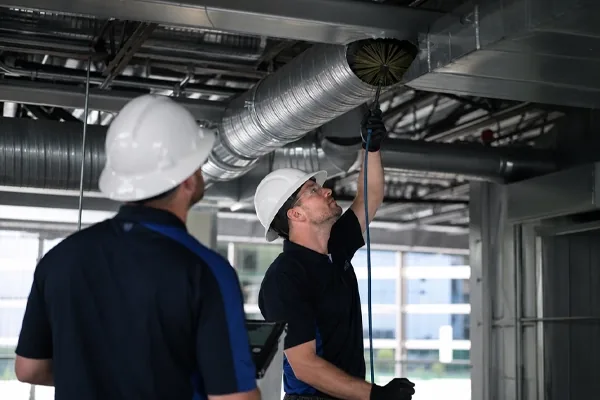
| Source removal cleaning | Mechanical agitation to dislodge contaminants combined with continuous HEPA-filtered negative-air collection, so debris is captured, not redistributed; component cleaning at coils, fans, and air handlers | Job-site practice you can observe: collection equipment running whenever agitation happens |
| Cleanliness verification | Post-cleaning verification that surfaces meet the standard's criteria — visual inspection at minimum, with defined surface-testing methods where visual assessment is insufficient | Post-cleaning photos at the same reference points, verification method named in the report |
| Documentation | Records of work performed, areas accessed and any left inaccessible, verification results | Final report suitable for a compliance or audit file |
The through-line is source removal: ACR's core demand is that contamination physically leaves the system into filtered collection. Spray-and-fog "treatments," deodorizing masking, or agitation without capture do not meet the model no matter what the invoice says.
Which NADCA Credentials Should Your Contractor Hold?
NADCA certifies individuals, and the two designations worth asking about by name:
- ASCS — Air Systems Cleaning Specialist. The core credential: examination on HVAC systems, contamination, and ACR-compliant cleaning practice. NADCA member companies are required to employ certified ASCS personnel — so "we're a NADCA member" implies a named, certified specialist you can ask for.
- CVI — Certified Ventilation Inspector. The assessment-side credential: qualifies the holder to inspect and evaluate HVAC system hygiene — the person whose judgment sets your cleaning scope and interval.
- Membership itself. NADCA membership binds the company to the association's code of ethics and standards. Verify it on NADCA's public directory rather than trusting a logo on a truck — logos outlive lapsed memberships.
- Certification currency. Credentials carry continuing-education and renewal requirements. Ask when the supervising tech's certification was last renewed, not just whether it exists.
Service-Tech Corporation has been a NADCA member since 1990.
Why Does the Standard Matter to a Buyer in 2026?
Because duct cleaning is a trust-asymmetric purchase: you cannot see the product. The work happens inside sheet metal you will never open, performed at night, and the difference between a real source-removal cleaning and a blower-and-fogger visit is invisible from the hallway. ACR converts that asymmetry into checkable claims — reference photos, named methods, verification criteria. It is also what makes duct cleaning defensible paper: when a food-safety auditor, infection-control committee, or insurer asks about ventilation hygiene, "cleaned to ACR by certified personnel, verification attached" is an answer; "a company came out in March" is not. Buying against the current edition matters for the same reason buying against any current standard does — it is the version your auditors and their consultants will reference.
What If Your Contractor Doesn't Follow ACR?
The failure pattern is consistent enough to describe: no pre-assessment (the quote arrives without anyone opening a duct), agitation without collection (dust redistributed downstream, often showing up at diffusers within weeks), "sanitizing" fog in lieu of removal, no post-cleaning photos, and a one-line invoice as the only record. The consequences are paying for work that did not happen, contamination pushed deeper into the system, and — in regulated environments — a compliance file with a hole where the evidence should be. Re-cleaning after a bad vendor costs more than hiring against the standard once.
How Do You Vet a Contractor Against NADCA Standards? The Checklist
Put these seven items in your RFQ and score bidders on them:
- Current NADCA membership, verified in the member directory — plus the named ASCS on your project
- Assessment before quotation, with photo documentation you keep either way
- Written scope naming included components and exclusions
- Source-removal methodology: mechanical agitation with continuous HEPA-filtered negative-air collection
- Post-cleaning verification method stated in advance, with same-point photo comparison
- Report deliverable defined: work performed, inaccessible areas, verification results
- References from facilities like yours — plants for plants, hospitals for hospitals, not a homeowner review page
What Does ACR-Compliant Cleaning Cost?
Standards-compliant work is priced from the assessment, which is the point: the scope is defined by documented conditions, not a square-footage guess. Service-Tech Corporation's commercial air duct cleaning starts from $1,375; industrial and multi-system projects are quoted after a site walk, with travel factored into the quote. The assessment documentation is yours regardless — useful leverage even if you bid the cleaning elsewhere.
TL;DR — NADCA Standards for Buyers
ACR (2025 edition current) obligates a contractor to assess before quoting, clean by source removal — agitation plus continuous HEPA-filtered collection — verify cleanliness at reference points, and document everything including inaccessible areas. ASCS and CVI credentials certify the people; membership binds the company; both are verifiable on NADCA's directory. Use the seven-point checklist in your RFQ, and treat any bidder without assessment photos or a named verification method as unpriceable. More duct-hygiene guides for Cleveland facilities are on our blog.
Frequently Asked Questions
Is following the NADCA ACR standard legally required?
No — ACR is an industry standard, not a statute. Its force comes from procurement and liability: specifying ACR in your RFQ makes it contractually binding, and in audited environments (food safety, healthcare) ACR-referenced documentation is what turns a cleaning invoice into usable compliance evidence.
What is the difference between ASCS and CVI certification?
ASCS (Air Systems Cleaning Specialist) certifies competence in performing ACR-compliant cleaning and is the credential NADCA member companies must hold on staff. CVI (Certified Ventilation Inspector) certifies the inspection side — assessing system hygiene and determining whether and where cleaning is needed. On larger projects you want both functions represented.
How can I verify a company's NADCA membership?
Check NADCA's public member directory rather than relying on a logo, and ask for the name and certification number of the ASCS who will supervise your project. Memberships lapse and logos linger; the directory and a named, current certificate holder are the reliable signals.
The Clauses That Change What Happens On Site
Three requirements do most of the work. Source removal: contamination is dislodged and extracted at the same moment, under continuous negative pressure with HEPA capture at 99.97% of particles at 0.3 micron. Verification: a swab sample weighed to no more than 0.75 mg per 100 cm² of surface, or a documented Surface Comparison Test. And access: a run that cannot be reached cannot be certified, so compliant access doors are part of bringing a system to standard. Around those, ASHRAE 180 sets the maintenance-programme basis and ASHRAE 62.1 treats filtration and ventilation as one system — which is why reassembly at MERV 8 or better is part of the job.