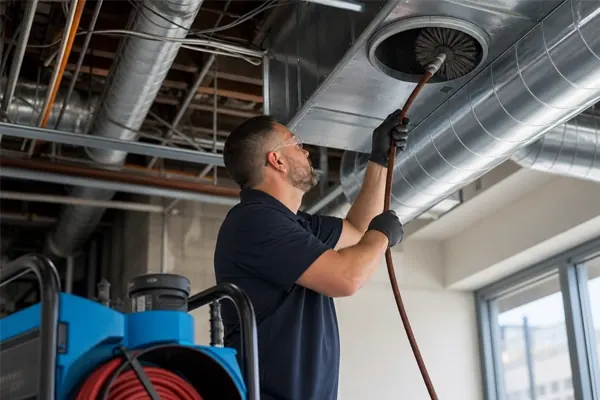
In plant-scale ductwork, the brushes stay in the truck. Technicians go inside. Here is the method almost nobody writes about, from a company whose crews do it.
Direct Answer: Manual entry air duct cleaning is source-removal cleaning performed by technicians physically working inside walk-in-scale ductwork and plenums — HEPA vacuums, scrapers, and lights in hand — because ducts that large cannot be honestly cleaned from the outside with brushes and air whips. It is a core method within Service-Tech Corporation's industrial air duct cleaning service, executed under confined-space safety procedures.
Why Is There Almost Nothing Written About Manual Entry?
Because the companies producing duct-cleaning content mostly do not do it. The method guides on this SERP — review-site explainers, NADCA's homeowner page, equipment-maker process documents — describe the residential and light-commercial toolkit: rotary brushes, air whips, and negative-air machines working through small access holes. That toolkit is correct for small duct. But large commercial and industrial buildings run trunk lines and plenums big enough for a person to walk or crawl through, and for those systems the honest method is different in kind, not degree. What follows is the practitioner's account.
Why Do Big Ducts Defeat Remote Cleaning Methods?
Remote methods rely on two things that stop working as duct dimensions grow. First, mechanical reach: a rotary brush or air whip is sized to contact the full perimeter of a small duct; in a walk-in trunk line it flails in the middle of a large volume, polishing a stripe and calling it a cleaning. Second, capture velocity: negative-air collection works by moving enough air through the duct to carry dislodged debris to the collection unit; in large cross-sections, achievable airflow produces low air velocity, and heavy debris — construction grit, compacted dust ridges, greasy or damp accumulation — simply falls to the duct floor and stays there.
The consequence of using the wrong method is a system that is "cleaned" on the invoice and loaded in reality: the floor of the trunk line still carries its ridge of debris, the corners and joint flanges keep their buildup, and the next inspection — or the next auditor with a flashlight at an access door — finds it. In dust-hazard plants, that residue is not embarrassment; it is fuel.
Rule of thumb from the field: once a duct is large enough that a technician can physically work inside it, it is large enough that a technician should — entry-scale cross-sections are exactly where remote tools lose perimeter contact and capture velocity. The precise threshold is judgment applied during assessment: dimensions, construction, load type, and access all factor in.
How Do the Methods Compare?
| Method | How It Works | Where It Belongs | Where It Fails |
|---|---|---|---|
| Manual entry | Technicians inside the duct: HEPA vacuums, scrapers, wire and hand brushes, direct visual verification | Walk-in trunk lines, plenums, large industrial and institutional duct | Small ducts humans cannot enter |
| Rotary brush | Motorized brush on flexible rod agitates duct perimeter toward collection | Small-to-medium round and rectangular duct | Large cross-sections (no perimeter contact); fragile liner; heavy or damp debris |
| Air whip / skipper | Compressed-air tools tumble debris toward negative-air collection | Small duct runs, branch lines, register drops | Large duct (no contact, low velocity); compacted or adhered accumulation |
| Negative-air-only ("vacuum truck") | Suction on the system while registers are agitated or blocked | As collection supporting agitation methods — never alone | Everything: without agitation, adhered contamination stays put in any duct size |
The honest system plan is usually hybrid: manual entry through trunk lines and plenums, mechanical methods down the branch runs, negative-air collection throughout — one continuous source-removal chain verified section by section, consistent with the NADCA ACR model.
What Does a Manual Entry Job Actually Look Like?
- 01
Assessment and entry planning
The system is inspected and mapped: which sections are entry-scale, where access doors exist or must be cut, what the accumulation is, and — decisive for safety — whether any section meets the definition of a confined space requiring permit-level controls.
- 02
Isolation and lockout
Fans locked out and tagged, dampers secured, the section isolated so nothing can energize or move air while people are inside the sheet metal.
- 03
Confined-space controls where required
Under OSHA's confined-space framework (29 CFR 1910.146), spaces with limited entry and exit that are not designed for continuous occupancy — a description that fits much walk-in duct — require hazard evaluation, and permit-required entries add atmospheric testing, a trained attendant stationed at the entry point, communication protocol, and a rescue plan before anyone goes in.
- 04
Entry and source removal
Technicians in appropriate PPE work through the duct with portable lighting, HEPA vacuums, scrapers, and brushes — removing accumulation from floor, walls, ceiling, joints, and turning vanes, the full perimeter remote tools cannot reach. Debris is bagged and passed out through access points; negative air holds the section under suction throughout.
- 05
Verification in place
The advantage nobody mentions: the technician is standing in the evidence. Cleanliness is verified visually at arm's length and photographed section by section — no borescope interpretation required — then access doors are closed, panels installed where the system lacked them, and the section returned to service.
When Is Manual Entry the Right Method?
The situations that call for it: plant-scale trunk lines and makeup-air ducts in manufacturing facilities; large institutional systems — hospitals, universities, arenas — with walk-in plenums and main runs; heavy accumulation of any kind (post-construction debris, years of loading, damp or compacted material) that remote agitation cannot lift; combustible-dust environments where verified, documented removal is a housekeeping obligation; and mixed systems where trunk-line entry plus mechanical branch cleaning is the only configuration that covers everything honestly. If your building has mechanical rooms with plenums you can stand in, some portion of your duct system is a manual-entry job — and a bidder proposing to clean it entirely with brushes through small openings is telling you they have not seen it.
Who Can Safely Do This Work?
Manual entry is as much a safety trade as a cleaning trade. Vet for: documented confined-space entry procedures and training — including attendant roles and rescue planning for permit-required entries; lockout/tagout discipline as routine practice; NADCA credentials anchoring the cleaning method itself (Service-Tech Corporation has been a NADCA member since 1990, with 66 years of industrial field work behind its procedures); and crews that can describe real entries — what the accumulation was, how the section was ventilated and controlled, what the verification photos showed.
What Does Manual Entry Cleaning Cost?
Manual entry work is quoted from assessment, priced by entry scope, access, contamination class, and the safety controls the entry classification requires. As a baseline reference, commercial air duct cleaning starts from $1,375; entry-scale industrial projects price above baseline in proportion to labor inside the duct. Estimates are free and follow a site walk — see our commercial air duct cleaning page for where the standard scope ends.
TL;DR — Manual Entry in Four Sentences
Manual entry duct cleaning puts technicians physically inside walk-in-scale ductwork with HEPA vacuums and hand tools, because large cross-sections defeat rotary brushes (no perimeter contact) and negative-air capture (velocity too low to carry debris). It is the honest method for trunk lines, plenums, heavy accumulation, and combustible-dust housekeeping — executed under lockout and OSHA confined-space controls, with cleanliness verified at arm's length and photographed section by section. Most large systems get a hybrid plan: entry through the trunks, mechanical methods down the branches. More duct methodology guides are on our blog.
Frequently Asked Questions
How big does a duct have to be for manual entry cleaning?
Big enough for a technician to physically work inside it — walk-in and crawl-scale trunk lines and plenums. The precise call is made at assessment: dimensions, duct construction, accumulation type, and access all factor in. The useful inverse rule: once a duct reaches entry scale, remote brushes and whips can no longer honestly clean it.
Is duct entry a confined space under OSHA?
Frequently, yes. Walk-in duct typically fits OSHA's confined-space definition — adequate to enter, limited entry and exit, not designed for continuous occupancy — and the employer must evaluate whether permit-required conditions exist. Permit entries add atmospheric testing, an attendant at the opening, communication, and rescue planning. Ask any bidder how they make that determination; hesitation is disqualifying.
Why not just clean large ducts with a bigger negative-air machine?
Because capture depends on air velocity, not just machine size. In a large cross-section, even high-CFM collection produces low velocity, and heavy or adhered debris falls to the duct floor instead of traveling to the collector. Suction supports the cleaning; inside large duct, removal has to happen by hand at the surface.
What Manual Entry Adds to the Verification
Entry changes the risk profile, not the acceptance criteria. The run is still held under continuous negative pressure with HEPA capture at 99.97% at 0.3 micron, still swabbed and weighed against 0.75 mg per 100 cm², and still borescoped where a technician cannot see. What entry adds is a confined-space procedure: the duct is purged and gas-tested, entry is permitted with an attendant stationed outside, and the atmosphere is monitored continuously rather than sampled once. Panels are reinstated and the system pressurized and leak-checked afterwards, because a run that has been opened for entry is a run that has to be closed properly.
The Numbers That Do Not Change on an Entry Job
Entry changes the procedure, not the specification. Capture stays at HEPA 99.97% of particles at 0.3 micron under continuous negative pressure. Acceptance stays at no more than 0.75 mg of residue per 100 cm² of surface, swabbed and weighed. Reassembly stays at MERV 8 or better with humidity held between 30–60%. ASHRAE 180 still sets the programme basis, and NFPA 90A and NFPA 90B still govern the installation. What entry adds is the confined-space overlay — purge, gas-test, permit, attendant and continuous monitoring — on top of all of it.