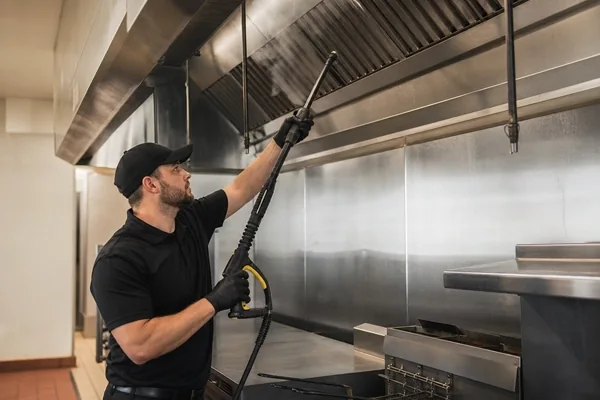
A local company that's been degreasing Cleveland kitchens since 1960 explains what an IKECA-member cleaning covers, why AHJs and insurers care, and how facility-scale kitchens differ from the franchise playbook.
Direct Answer: Cleveland restaurants and facilities can get NFPA 96 kitchen exhaust cleaning from Service-Tech Corporation's kitchen exhaust hood cleaning service — an IKECA-member operation headquartered in Cleveland since 1960, cleaning the full system (hood, duct, and fan) from $599 per cleaning, with the documentation your fire inspector and insurance carrier expect.
What Should a Complete Hood Cleaning in Cleveland Include?
The Cleveland market is crowded with franchise crews and pressure-washing generalists, and the quotes vary because the scopes vary. Here's the difference between an IKECA-standard cleaning and a "wipe and polish":
| System component | IKECA-standard cleaning | Basic "wipe and polish" |
|---|---|---|
| Hood canopy and filters | Degreased to bare metal | Wiped where visible |
| Plenum behind filters | Cleaned to bare metal | Often untouched |
| Horizontal and vertical duct | Full run, through access panels | Skipped or first few feet only |
| Exhaust fan (blades, housing) | Cleaned; grease containment serviced | Rarely climbed to |
| Missing access panels | Identified and reported | Ignored |
| Documentation | Sticker + photos + written report with exceptions | Sticker at most |
The fire load lives in the duct and fan — the parts you can't see from the cook line. If the quote doesn't name them, the cleaning doesn't include them.
Why Does IKECA Membership Matter to Your Inspector and Insurer?
IKECA (the International Kitchen Exhaust Cleaning Association) is the industry body behind kitchen exhaust cleaning standards that fire officials reference alongside NFPA 96. Working with an IKECA-member company means the crew's methods and documentation follow the standards your authority having jurisdiction (AHJ) actually evaluates against — bare-metal endpoints, access requirements, and reporting of areas not cleaned. Service-Tech is an IKECA member, and pairs that with NFPA 96 compliance cleaning for operators who need the compliance program, not just a cleaning date.
Insurers care for a blunter reason: after a grease fire, the carrier reviews the cleaning documentation trail. A file of dated reports with photos from a recognized-standard cleaner reads very differently than a drawer of stickers from the lowest bidder.
Beyond Restaurants: Who Else in Cleveland Needs This?
The franchise playbook targets restaurants. Cleveland's facility-scale kitchens are the underserved half of the market — and the half Service-Tech has always worked:
- Hospitals and healthcare campuses. Continuous food service, infection-control coordination, and life-safety documentation requirements.
- Universities and schools. Multiple hoods across dining halls and kitchens, cleaned to an academic calendar.
- Corporate cafeterias and event venues. Off-hours access, multi-tenant building coordination.
- Manufacturing plants with canteens. One vendor covering the kitchen exhaust alongside plant systems — hood work is one line of Service-Tech's broader portfolio, and crews already mobilized for facility work can carry the kitchen scope in the same visit.
Facility kitchens have longer duct runs, rooftop fans shared with complex mechanical systems, and stakeholders beyond the kitchen manager — scoping experience at that scale is the differentiator.
Local Company vs. National Franchise: What Actually Differs?
Cleveland's SERP is dominated by franchise location pages. The practical differences for an operator:
- 01
Accountability chain
With a local company, the crew, the estimator, and the owner answer to the same roof — no franchisor/franchisee split when something needs making right.
- 02
Continuity
Service-Tech has cleaned Cleveland kitchens for decades — family-owned 1960-2019, veteran-owned since 2019 — with 50+ technicians and a 4.9 rating across 111 Google reviews.
- 03
Scale range
The same organization handles a single-hood café and a hospital campus, so you don't outgrow your vendor.
- 04
Local response
Crews based at the Cleveland headquarters serve a 150-mile radius, with scheduling built around NE Ohio realities — winter rooftop work, overnight windows, lake-effect weeks.
TL;DR — Choosing a Hood Cleaner in Cleveland
A complete cleaning covers hood, plenum, full duct run, and fan to bare metal, with photo documentation and written exceptions — that's the IKECA-standard scope inspectors and insurers evaluate against. Franchises serve the restaurant strip; facility-scale kitchens (hospitals, campuses, plants) need a contractor built for their complexity. Service-Tech Corporation has done both from Cleveland since 1960, from $599 per cleaning, with free estimates.
Frequently Asked Questions
How Much Does Hood Cleaning Cost in Cleveland?
Service-Tech's kitchen exhaust hood cleaning starts from $599 per cleaning, covering full-system service — hood, duct run, and exhaust fan — rather than a per-hood wipe-down. The firm quote follows a free assessment of your system's hood count, duct length, fan access, and grease condition.
How Often Does My Cleveland Kitchen Need Cleaning?
NFPA 96 sets the frequency by cooking volume — from monthly for solid-fuel cooking to annually for low-volume kitchens, with most full-service restaurants on quarterly or semiannual cycles. Your Cleveland-area fire inspector enforces it, and your insurance carrier increasingly checks it. We'll classify your operation during the assessment.
What If My Previous Vendor Never Touched the Fan?
Common — and worth fixing before an inspection finds it. Expect the first full-system cleaning to run longer than your usual appointment while accumulated grease in the duct and fan is removed to bare metal, and expect a written report identifying any missing access panels. After that reset, you're on a normal schedule at normal cost.
The Sequence, Start to Finish
Lock out the electrical and isolate the section. Pull the baffle filters and soak them. Shroud the fan before any water moves. Scrape the hardened deposit mechanically, then degrease and hot-wash the surface, working from the hood plenum through the duct run to the rooftop termination. Squeegee the runoff to containment. Polish the accessible stainless, reinstate the filters and panels, and test-run the system before handing the kitchen back. Anything skipped in that sequence shows up as a surface that still holds a film — which is not compliance, regardless of appearance.