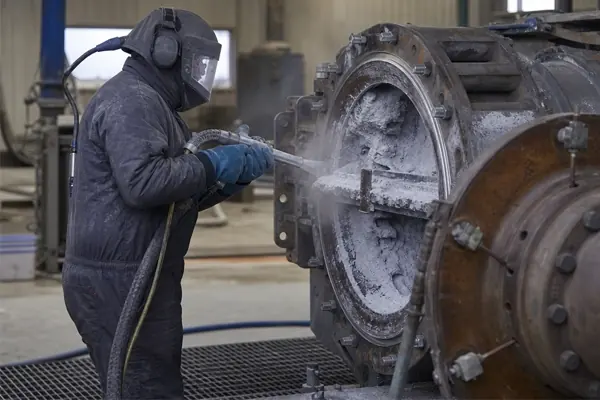
The honest answer from a crew that writes job safety analyses: there's no single "dry ice blasting standard" — there's a map of general OSHA rules a professional contractor must satisfy on your floor.
Direct Answer: Yes — dry ice blasting is fully compatible with OSHA requirements, but there is no dedicated OSHA "dry ice blasting standard." Compliance means satisfying the general standards that apply to the work: CO2 exposure limits, hearing and eye protection, lockout/tagout, and — when blasting inside tanks or ductwork — confined-space entry rules. Service-Tech Corporation runs its dry ice blasting services under a documented safety and training program built around exactly this map.
Which OSHA Standards Actually Apply to a Blast Job?
The compliance question resolves into a table a facility manager can hand to EHS:
| OSHA standard | What it governs | How it applies to dry ice blasting |
|---|---|---|
| 29 CFR 1910.1000 (air contaminants, Table Z-1) | CO2 exposure limits | Sublimated pellets become CO2 gas; work areas are ventilated and monitored against the PEL (verify current limits: 5,000 ppm 8-hr TWA is the commonly cited Table Z-1 value) |
| 29 CFR 1910.95 (occupational noise) | Hearing conservation | Blasting rigs produce high noise levels; hearing protection is mandatory in the work zone |
| 29 CFR 1910.132-138 (PPE) | Eye, face, hand, body protection | Flying contaminant fragments and cold-contact hazards require rated PPE |
| 29 CFR 1910.147 (lockout/tagout) | Hazardous energy control | Target equipment is locked out; electrical gear is de-energized before cleaning |
| 29 CFR 1910.146 (permit-required confined spaces) | Tank, duct, pit interiors | Blasting inside a confined space triggers entry procedures — atmosphere testing, attendant, rescue plan — with CO2 accumulation treated as the primary atmospheric hazard |
| 29 CFR 1910.134 (respiratory protection) | Respirators when required | Applied when contaminant (e.g., mold, lead paint fragments) or atmosphere demands it |
Vendors answering this question tend to stop at "wear PPE." The real discipline is recognizing that the sublimated pellet doesn't disappear — it becomes CO2 gas in your building's air, and managing that is the heart of compliance.
Why Is CO2 Exposure the Hazard That Matters Most?
CO2 is colorless, odorless, and heavier than air. In an open, ventilated plant, blasting-generated CO2 disperses without approaching limits. The risk profile changes in basements, pits, tanks, and small enclosed rooms, where gas can pool low and displace oxygen. That's why a professional crew treats ventilation planning and continuous CO2 monitoring as setup steps, not reactions — portable monitors in the work zone, mechanical ventilation where air exchange is poor, and work stoppage thresholds agreed in the JSA before blasting starts. The exposure benchmarks to verify against the current standard: OSHA's commonly cited Table Z-1 values are a 5,000 ppm 8-hour TWA, with elevated short-term exposure treated per the applicable limits — your EHS team should confirm current figures when reviewing the contractor's plan.
What Does a Professional Crew Actually Do on Site?
Here's what OSHA compliance looks like in practice on a Service-Tech blast job — the walkthrough version of a job safety analysis:
- 01
Pre-job JSA
Hazards identified per area: atmosphere, noise, energy sources, elevated work, contaminant characteristics.
- 02
Lockout/tagout
Target equipment locked out; electrical equipment verified de-energized before any cleaning begins.
- 03
Ventilation and monitoring
Work-zone air movement established; CO2 monitoring in enclosed or low-lying areas with defined stop-work levels.
- 04
PPE discipline
Hearing protection, sealed eye/face protection, and cold-rated gloves for anyone handling pellets; respiratory protection when the removed contaminant requires it.
- 05
Zone control
The blast zone is barricaded — noise and flying debris define a perimeter that plant personnel stay outside during operation.
- 06
Debris containment
Removed contaminant is vacuumed and handled according to what it is — routine debris, or regulated material such as mold or lead-bearing paint chips.
Who Is Responsible for What — You or the Contractor?
OSHA responsibility on a multi-employer worksite is shared, and clean division of duties is what keeps it clean:
- Contractor owns: crew training and PPE, safe equipment operation, CO2 monitoring of its work zone, JSA execution, and compliance of its own employees.
- Facility owns: accurate hazard disclosure (what's in the residue, what's energized, what's overhead), lockout coordination with plant systems, communicating the work to affected employees, and keeping unauthorized personnel out of the zone.
- Shared: the pre-job walkthrough where both sides agree the plan — the single highest-value safety meeting on the calendar.
A contractor who arrives without questions about your hazards isn't saving you time. Service-Tech has operated this way across industrial facilities since 1960 — safety planning is part of the industrial cleaning scope for every Cleveland-area job, not an upcharge.
TL;DR — Compliance in One Paragraph
Dry ice blasting is OSHA-compliant when the contractor maps the general standards onto the job: CO2 exposure management under 1910.1000, hearing conservation, PPE, lockout/tagout, and confined-space procedures where geometry demands them. The invisible hazard is sublimated CO2 pooling in enclosed spaces — solved by ventilation and continuous monitoring. Verify a bidder's JSA process and monitoring practice before they're on your floor; the pre-job walkthrough is where compliance is actually decided.
Frequently Asked Questions
Is Dry Ice Blasting Safe to Perform Indoors?
Yes, with ventilation planned to the space. Open plant floors rarely present CO2 accumulation risk; enclosed rooms, pits, and below-grade areas require mechanical ventilation and continuous monitoring. The determining factor is air exchange, and it's assessed during scoping — not discovered mid-job.
What Happens if Blasting Is Needed Inside a Tank or Duct?
That's confined-space work under 29 CFR 1910.146: atmosphere testing before and during entry, an attendant, rescue provisions, and CO2 treated as the primary atmospheric hazard since the process continuously generates it. It's routine for an equipped crew — and a serious red flag if a bidder shrugs at the question.
Does All This Safety Overhead Increase the Price?
Monitoring, PPE, and JSA discipline are built into professional operating cost — they're part of the baseline, not a line item. What does move the quote is scope-driven safety work like confined-space entry procedures, which is why those conditions are identified during the free estimate walkthrough rather than surfacing as change orders.
The Controls That Make It Compliant
Compliance rests on the enclosed-space controls rather than the medium. Sublimated CO2 is an asphyxiant and the gas is denser than air, so it settles into the lowest part of a space; forced ventilation is set up to exhaust from the low point before blasting begins, and oxygen and CO2 are metered continuously for the duration. Where the work is inside a vessel or pit it runs under a permit-required confined-space procedure with an attendant and a retrieval plan. Equipment being cleaned is de-energised, locked out and tagged; surrounding components are masked and openings shrouded. Hearing protection is standard — the nozzle is loud enough to require it.