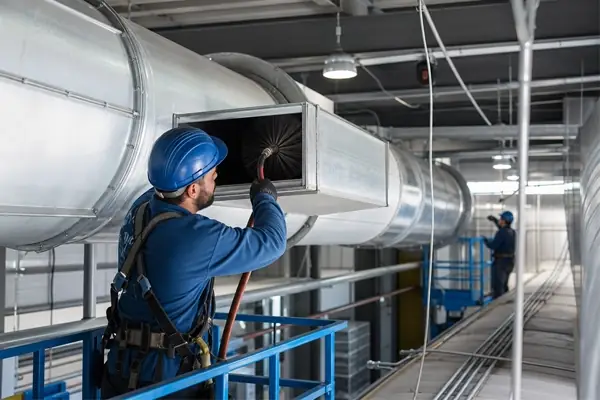
The residential cost articles ranking for this question will not price your plant. Here is how commercial and industrial duct work is actually quoted in Northeast Ohio.
Direct Answer: Commercial air duct cleaning from Service-Tech Corporation starts from $1,375, and industrial projects are priced after a site walk because the real cost drivers — system size, contamination class, access, containment, and scheduling — vary too much between facilities for a phone quote to be honest. Our commercial air duct cleaning page covers the baseline service; this guide explains what moves the number above it.
Why Do the Cost Articles You Just Read Not Apply to Your Facility?
The top results for duct cleaning cost are residential: per-vent and per-home figures aimed at homeowners. A facility with rooftop units, makeup air, long trunk runs, and a production floor is priced on entirely different variables. Applying a per-vent number to a plant produces estimates that are wrong by an order of magnitude — in either direction — and it is why experienced contractors decline to quote industrial work sight-unseen. This guide covers the three pricing models used for commercial and industrial work, the cost drivers behind them, and how to prepare so your quotes come back comparable.
The Three Pricing Models — and When Each Applies
| Pricing Model | How It Works | Where It Fits |
|---|---|---|
| Per-square-foot (building or duct area) | Rate applied to serviced area; scales with building size | Uniform commercial buildings — offices, schools — with conventional distribution and light, consistent loading |
| Per-system / per-unit | Each air handler, RTU, or exhaust system priced as a unit including its ductwork | Buildings with distinct, countable systems; multi-tenant properties; phased projects budgeted system by system |
| Time-and-materials / project quote | Scoped from assessment: labor, equipment, containment, disposal | Industrial work, heavy contamination, manual-entry duct, combustible dust, anything with unknowns behind the sheet metal |
Buyer's note: a per-square-foot rate on an industrial job is a red flag, not a convenience — it means the bidder priced your building without pricing your contamination. Conversely, demanding a project quote for a straightforward office building adds estimating overhead you will pay for. Match the model to the facility.
What Actually Drives the Price? The Cost-Driver Table
Hughes Environmental's five-factor piece is the strongest on the SERP; a working estimator's list is longer. Each driver below moves quotes meaningfully:
| Cost Driver | Low-Cost Case | High-Cost Case |
|---|---|---|
| System size and duct footage | Single AHU, short runs | Multiple AHUs, long trunk lines, makeup air |
| Contamination level and type | Light dust, recent cleaning history | Years of loading; oil mist, weld fume, or combustible dust requiring special handling |
| Access | Existing panels, reachable duct | Panel installation needed; high runs requiring lifts; confined-space entry |
| Ceiling height and lift work | Drop ceilings, ladder height | High-bay plants; boom or scissor lifts and the crew time they add |
| Containment requirements | Standard poly and negative air | Occupied healthcare or food zones needing engineered containment |
| Scheduling | Normal weekday hours | Nights, weekends, or shutdown-window work compressed into fixed dates |
| Rooftop and remote units | Ground-level mechanical rooms | Many RTUs, crane or roof-access logistics |
| Disposal | Ordinary debris | Contaminant-specific handling and disposal requirements |
| Documentation level | Standard report | Audit-grade packages: same-point photos, verification testing, compliance formatting |
Two drivers dominate industrial quotes in practice: contamination class (what the debris is changes method, PPE, containment, and disposal) and access (every hour a technician spends reaching duct is an hour not spent cleaning it — which is why a first cleaning that includes access-panel installation makes every subsequent cleaning cheaper).
Why Do Industrial Quotes Require a Site Walk?
Because the estimator is pricing what is inside the duct, and nobody can see that from a phone. On an STC estimate visit, the assessor walks the mechanical spaces and representative duct runs, opens or scopes access points to classify contamination, measures the access and lift problem, identifies containment-sensitive zones (production, food, clinical), and confirms scheduling constraints — shifts, shutdown windows, lockout coordination. The output is a scope you can hold the crew to: systems included, methods, containment plan, documentation deliverables, and price. A walk-through costs you an hour; it is the difference between a quote and a guess. Estimates are free, and travel is factored into quotes — there is no surcharge line.
What Makes a Cheap Quote Expensive?
Lowball bids on facility duct work are consistently cheap for one of three reasons: the scope quietly excludes the hard parts (fan and coil cleaning, high runs, panel installation), the method is agitation-without-collection that redistributes debris, or the crew is residential-grade and will discover mid-job that they cannot do the work — leaving you re-bidding with the system half-opened. Comparing bids, hold the scope constant first: same systems, same components, same documentation. Only then compare numbers. The lowest compliant bid is a good outcome; the lowest bid is usually not compliant with anything.
How Should You Prepare for a Duct Cleaning Estimate? The Pre-Quote Checklist
Gather this before the site walk and your quotes will come back faster, tighter, and comparable across bidders:
- System inventory: how many AHUs, RTUs, and exhaust systems, and which areas each serves (mechanical schedules or a maintenance-system export is ideal)
- Drawings if you have them: even old mechanical drawings shorten assessment time
- History: last cleaning date and report, known problem areas, any water or fire events
- Constraints: production schedules, clean zones, escort or badging requirements, hot-work and confined-space permitting procedures
- The driver: what prompted the project — audit finding, complaint, combustible dust, energy, renovation — because the driver defines the documentation the report must satisfy
- Decision criteria: whether you need audit-grade documentation, and who has to accept the report
What Should Cleveland Facilities Budget?
Published baseline: commercial air duct cleaning from $1,375. Above that baseline, honest industrial numbers come from the site walk. For scope definitions on the industrial side, see our industrial air duct cleaning service page.
TL;DR — Pricing Without the Folklore
Ignore residential per-vent figures. Commercial and industrial duct cleaning is priced by one of three models — per-square-foot for uniform commercial buildings, per-system for countable units, project quotes for industrial work — and the number is driven by contamination class, access and lift requirements, containment, scheduling, and documentation level far more than by square footage. Baseline: from $1,375 for commercial cleaning; industrial projects are quoted after a free site walk. Prepare a system inventory and your compliance driver before the walk, and compare bids on constant scope. More cost and compliance guides are on our blog.
Frequently Asked Questions
Why won't contractors quote industrial duct cleaning over the phone?
Because the price lives inside the ductwork: contamination type and depth, access, and containment needs cannot be assessed remotely, and a phone number would be either padded to cover unknowns or lowballed to win the job and change-ordered later. A site walk produces a scoped, holdable quote — and at Service-Tech Corporation the estimate is free.
Is duct cleaning priced per square foot?
Sometimes — per-square-foot pricing fits uniform commercial buildings like offices and schools. Industrial facilities are usually priced per system or as a scoped project, because contamination class and access drive cost more than floor area. Be wary of per-square-foot rates applied to plants; they price the building, not the problem.
How can I keep duct cleaning costs down over time?
Three levers: install access panels during the first cleaning so future work goes faster; maintain filtration (higher-efficiency, properly seated filters slow duct loading); and move to an inspection-first program so you buy cleaning when photos justify it rather than on a blanket calendar. Recurring-program clients also avoid the premium of emergency, audit-driven scrambles.
Which Steps Consume the Hours
Access first: every run and every air-handler plenum has to be opened, and a system without access doors at the expected intervals needs them fabricated and fitted before a brush goes in. Then method — brushes agitate bare metal quickly, compressed-air whips work lined runs slowly, and a liner found delaminating on survey moves the job to encapsulation or replacement. Extraction distance matters: the negative-air unit has to be repositioned as crews move, and each move is setup with no cleaning happening. Verification is billable too — swabbing and weighing a sample against the 0.75 mg per 100 cm² figure is the deliverable that proves the work.
The Figures Behind the Quote
- Verification is billable. Swabbing and weighing a sample against 0.75 mg per 100 cm² is a documented deliverable, and producing it takes time.
- Access drives everything. A system with compliant access doors runs 1–2 days on a typical floor plate; one without adds a day of fabrication before a brush goes in.
- Interval affects unit cost. A system on the NADCA guidance — annual on air handling units, every 1–2 years on ductwork — costs less per visit than one cleaned after a decade.
- The offsetting figure. The U.S. Department of Energy attributes 25–40% of commercial heating and cooling energy to contamination and airflow restriction, which is where the payback argument sits.
One More Cost Driver: Liner Condition
A lined run that delaminates under light pressure changes the job. Sealing or brushing a shedding liner accelerates the failure, so the survey decision is encapsulate or replace — and both are priced differently from cleaning. That decision is made on the walk-through, not mid-job, which is why a fixed quote for an unsurveyed lined system is a quote with a hole in it.