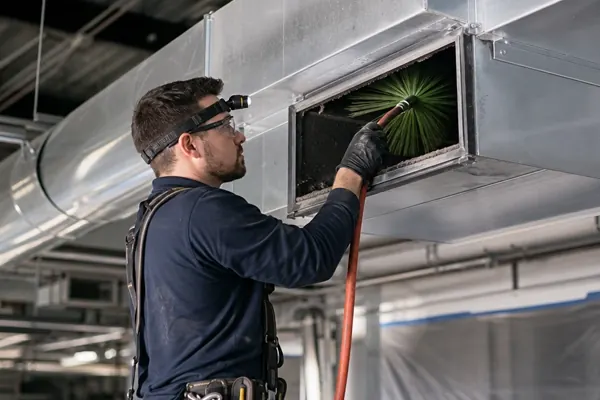
Franchise duct cleaners serve offices. Cleveland's plants — steel, auto, food, machining — need a contractor built for weld smoke, process exhaust, and combustible dust.
Direct Answer: Industrial air duct cleaning in Cleveland is the source-removal cleaning of plant ventilation systems — makeup air units, process exhaust, weld-smoke ducting, and HVAC serving production space — performed by crews equipped for heavy contamination, lift work, and confined-space entry. Service-Tech Corporation, a NADCA member since 1990 headquartered in the Cleveland area, provides industrial air duct cleaning for manufacturing and institutional facilities across Northeast Ohio.
What Counts as "Industrial" Duct Cleaning — and What Doesn't?
Search for duct cleaning in Cleveland and most results are residential franchises with a commercial page. That work — offices, retail, light HVAC dust — is real, but it is a different trade from industrial duct cleaning. The industrial tier begins where the contaminant stops being household dust:
- Weld smoke and metalworking fume condensed inside general-ventilation and fume-extraction ducting
- Oil mist from machining and forming operations, coating duct interiors in a combustible film
- Combustible process dust — wood, plastics, food powders, aluminum fines — where accumulation is a deflagration hazard, not a cosmetic one
- Process exhaust and makeup-air systems sized for plant volumes, with duct diameters large enough that technicians work inside them
- Production-environment constraints — cleaning scheduled around shifts, lockout/tagout on fans and dampers, containment so debris never reaches product
A crew built for residential work brings rotary brushes and a portable vacuum. An industrial crew brings plant-scale negative air machines, HEPA-filtered collection, lift equipment, confined-space procedures, and supervisors who have walked a foundry before. Asking a franchise duct cleaner to handle a stamping plant is not a price decision — it is a scope mismatch.
Why Do Cleveland Plants Need Industrial Duct Cleaning?
Northeast Ohio's industrial base — steel and metals processing, automotive supply, food and beverage manufacturing, plastics, machining — produces exactly the contaminant classes that load ductwork fastest. The drivers that put duct cleaning on a Cleveland plant's maintenance calendar:
- Combustible dust housekeeping. NFPA's combustible dust standards (the NFPA 652 requirements, now carried into the consolidated NFPA 660) treat hidden accumulation — including duct interiors and overhead surfaces — as a housekeeping obligation flowing from your dust hazard analysis.
- OSHA exposure and the general duty clause. Contaminated ducts re-entrain particulate into occupied air; where substance-specific permissible exposure limits or the general duty clause are in play, ventilation hygiene is part of the answer.
- Product contamination. In food, beverage, and coating operations, duct-borne debris shows up as audit findings and customer complaints long before it shows up as an OSHA issue.
- System performance. Loaded ducts and coils mean rising static pressure, starved airflow at the far ends of runs, and fans working harder for less air — a slow, invisible energy penalty.
- Post-construction and post-incident cleanup. Renovation debris, fire soot, and water events all end up in the ductwork, and reopening the space without addressing it recirculates the problem.
Which Industrial Systems Get Cleaned?
The generic "commercial duct cleaning" page never tells a plant engineer whether their specific systems are in scope. Here is the map:
| System Type | Typical Contaminant | Cleaning Approach |
|---|---|---|
| Plant HVAC / makeup air units and distribution | General dust, fiber, weld haze migration | Source removal under negative air; AHU and coil cleaning at the unit |
| Weld-smoke / fume-extraction ducting | Condensed metal fume, oily particulate | Manual and mechanical removal; HEPA-filtered collection |
| Process exhaust (ovens, coating lines, parts washers) | Process-specific residue, oil mist, VOC condensate | Method set by residue chemistry; degreasing where required |
| Dust-collection ducting and drops | Combustible or nuisance dust | Removal keyed to housekeeping thresholds; coordination with collector service |
| Large walk-in plenums and trunk ducts | Mixed accumulation over decades | Manual entry: technicians physically inside the duct with HEPA vacuums |
| Institutional systems (hospitals, schools, public buildings) | Dust, microbial concerns, renovation debris | NADCA ACR source removal with containment appropriate to occupancy |
Who Is Qualified to Do This Work?
Two credentials matter when you vet an industrial duct cleaner in Ohio. First, NADCA membership and its certifications — NADCA (the National Air Duct Cleaners Association) publishes the ACR standard that defines assessment, source-removal cleaning, and post-cleaning verification, and certifies individuals as Air Systems Cleaning Specialists (ASCS). Service-Tech Corporation has been a NADCA member since 1990. Second, industrial-site competence: confined-space entry procedures, lift and high-work capability, lockout/tagout discipline, and references from actual plants rather than office parks. Since 1960, STC has serviced 100,000+ facilities, with Cleveland manufacturing — steel, automotive, food processing — at the core of that history.
How Is an Industrial Duct Cleaning Performed?
The job follows the NADCA ACR source-removal model, adapted to plant conditions:
- 01
Assessment
Inspection of representative duct sections — access openings, photos or borescope imaging — to classify contamination, define scope, and set the containment and method plan.
- 02
Isolation and negative air
The work zone is contained, the system is locked out, and HEPA-filtered negative air machines put the ductwork under suction so dislodged debris moves to collection, not into your plant.
- 03
Source removal
Agitation methods matched to the duct and residue — manual scraping and vacuuming inside walk-in duct, mechanical brushing and air whips in smaller runs, degreasing where oil mist or residue chemistry requires it.
- 04
Component cleaning
Fans, coils, plenums, dampers, and registers cleaned at the unit; access panels installed where the system lacked them (a one-time fix that makes every future cleaning cheaper).
- 05
Verification and documentation
Post-cleaning inspection to ACR cleanliness criteria, with photo documentation and a report suitable for your compliance file — the same evidence discipline your auditors expect.
When Should Industrial Systems Be Cleaned?
There is no single interval — frequency follows contaminant load. High-load environments (foundry dust, weld smoke, oil mist, food powders) are typically on annual or shorter assessment cycles; cleaner production environments run longer. The professional model is inspection-driven: assess on a fixed schedule, clean when the assessment shows accumulation approaching actionable thresholds — combustible-dust housekeeping criteria in dust-generating plants, contamination-based criteria elsewhere. We cover this in depth in our facility-type frequency guide on the blog.
What Does Industrial Duct Cleaning Cost in Cleveland?
Commercial air duct cleaning from Service-Tech Corporation starts from $1,375, and industrial projects are quoted after a site walk — system size, contamination class, access and lift requirements, containment level, and off-hours scheduling all move the number. Travel is factored into quotes. Facilities comparing tiers should read our commercial air duct cleaning page to see where the commercial scope ends and industrial begins.
TL;DR — Industrial Duct Cleaning in Cleveland
Industrial duct cleaning is a different trade from franchise commercial work: weld smoke, oil mist, combustible dust, and process exhaust, handled with plant-scale negative air, confined-space-capable crews, and NADCA ACR source-removal methodology. Cleveland's manufacturing base generates exactly these loads, and the compliance drivers — NFPA combustible-dust housekeeping, OSHA exposure control, product-contamination risk — make duct condition a maintenance item, not a cosmetic one. Service-Tech Corporation, NADCA member since 1990 and serving Cleveland since 1960, quotes industrial work after a site walk, with commercial cleanings from $1,375.
Frequently Asked Questions
What is the difference between commercial and industrial duct cleaning?
Commercial duct cleaning serves offices, retail, and light-occupancy HVAC where the contaminant is ordinary dust. Industrial cleaning handles production environments — weld smoke, oil mist, combustible dust, process exhaust — requiring heavier negative-air equipment, confined-space entry capability, lockout/tagout discipline, and containment that protects product and workers.
Is duct cleaning required by OSHA or NFPA?
No regulation names "duct cleaning" outright, but the obligations arrive indirectly: NFPA combustible-dust standards make hidden dust accumulation a housekeeping issue flowing from your dust hazard analysis, and OSHA's substance-specific exposure limits and general duty clause reach ventilation systems that re-entrain contaminants into occupied air. Duct condition is evidence in both conversations.
How disruptive is industrial duct cleaning to production?
Less than most plant engineers expect when it is planned properly. Work is sequenced by zone, scheduled around shifts or shutdown windows, and performed under negative-air containment so debris never migrates to production areas. The site walk before quoting is where sequencing gets designed around your operation.
Verifying the Work
Ask for a number. A swab sample weighed against the NADCA Vacuum Test figure of 0.75 mg per 100 cm² of duct surface is the verification; a Surface Comparison Test result is the alternative. Alongside it: borescope images of runs beyond reach, the coil pressure drop before and after, and a component-level record naming every air handler, coil and run cleaned. The U.S. Department of Energy attributes 25–40% of commercial heating and cooling energy to contamination and airflow restriction, which is the figure that connects this work to an operating budget rather than a housekeeping line.
The Specification in Four Numbers
Source removal under continuous negative pressure with HEPA capture at 99.97% of particles at 0.3 micron. Verification at no more than 0.75 mg of residue per 100 cm² of duct surface. Reassembly at MERV 8 or better, with relative humidity held between 30–60%. And ASHRAE 180 as the maintenance-programme basis rather than a calendar date. Those four lines are the difference between a scope of work and a hope.