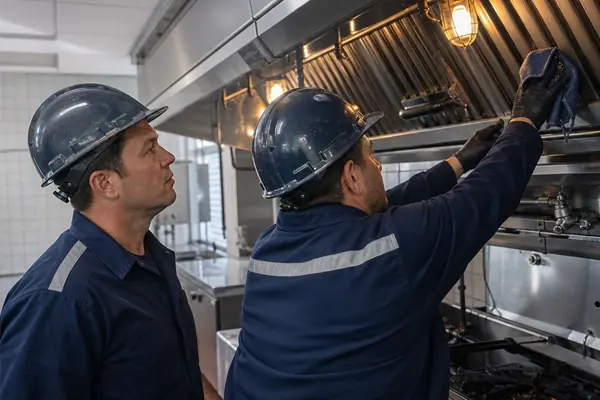
Fire marshals and insurers are asking sharper questions about who cleans your kitchen exhaust system. Here is what the IKECA credential actually means — explained by a member company.
Direct Answer: IKECA certification is a credential issued by the International Kitchen Exhaust Cleaning Association verifying that a company's technicians and supervisors have been trained, tested, and re-examined against the ANSI/IKECA standards for cleaning and inspecting commercial kitchen exhaust systems. In Ohio, it is the clearest third-party signal that a hood cleaner works to a written standard rather than a pressure washer and a guess — which is why Service-Tech Corporation maintains IKECA membership for its kitchen exhaust hood cleaning crews.
What Is IKECA?
IKECA — the International Kitchen Exhaust Cleaning Association — is the trade association for companies that clean and inspect commercial kitchen exhaust systems: hoods, grease filters, ductwork, and rooftop exhaust fans. Founded by contractors, it does two things that matter to a restaurant owner or facility director in Ohio.
First, it develops standards. IKECA is an ANSI-accredited standards developer, and its documents — most notably ANSI/IKECA C10 (cleaning) and ANSI/IKECA I10 (inspection) — define, in measurable terms, what "clean" means for a kitchen exhaust system.
Second, it certifies people. NFPA 96 requires exhaust systems to be cleaned by properly trained, qualified, and certified persons acceptable to the authority having jurisdiction (AHJ). NFPA 96 does not itself certify anyone — IKECA certification is one of the main ways a contractor demonstrates that its people meet the bar.
What Do the IKECA Certification Levels Mean?
Most "why IKECA matters" articles stop at the logo. The certification track behind it has distinct levels, and knowing the difference tells you who should actually be on your roof at 2 a.m.
| Designation | Who Holds It | What It Signifies |
|---|---|---|
| PECT — Professional Exhaust Cleaning Technician | Field technicians | Entry-level certification: core training and testing on exhaust cleaning methods, safety, and NFPA 96 basics |
| CECT — Certified Exhaust Cleaning Technician | Experienced technicians / crew leads | Demonstrated field experience plus examination on cleaning to the ANSI/IKECA C10 standard |
| CECS — Certified Exhaust Cleaning Specialist | Company supervisors / senior specialists | The senior cleaning credential: exam plus documented industry experience, with continuing-education requirements to maintain it |
| CESI — Certified Exhaust System Inspector | Inspectors | Certification to inspect systems to the ANSI/IKECA I10 standard rather than clean them |
Certifications are held by individuals, not just the company — and they expire. IKECA requires recertification on a recurring cycle, so a credential earned once a decade ago does not carry the company forever. When you vet a contractor, ask which designations their supervising personnel currently hold, not just whether the firm "is a member."
How Do IKECA Standards Differ From NFPA 96?
This is the part almost every competitor article skips, and it is the most useful thing an Ohio operator can understand.
NFPA 96 is the fire code standard. It tells you that your system must be inspected at set frequencies — monthly for solid-fuel cooking, quarterly for high-volume operations, semi-annually for moderate-volume, annually for low-volume — and that it must be cleaned to bare metal when contaminated. It is enforced by your local fire AHJ.
ANSI/IKECA C10 is the how document. Where NFPA 96 says "clean to bare metal," C10 defines acceptable methods, measurable cleanliness criteria (including how residual grease depth is evaluated), which areas of the system are in scope, and what the post-cleaning documentation must record. ANSI/IKECA I10 does the same for inspections — how to evaluate grease accumulation and decide whether cleaning is actually due.
In plain terms: NFPA 96 sets the legal obligation; the IKECA standards define competent execution of it. A contractor can hang an "NFPA 96 compliant" banner without ever committing to a measurable cleaning standard. An IKECA-certified crew is testable against one.
Why Are Ohio AHJs and Insurers Asking About Certification?
Three practical forces are converging on Ohio restaurant and facility operators:
- Fire marshals want a defensible qualification. NFPA 96's "certified persons acceptable to the AHJ" language pushes the qualification question onto local officials. An IKECA credential gives an inspector a recognized, national answer — which is why more Ohio jurisdictions accept it as the default proof of qualification.
- Insurers underwrite the exhaust system, not the dining room. Kitchen exhaust ducts are one of the highest fire-loss exposures in a restaurant. Carriers increasingly ask for cleaning documentation from a certified provider at renewal, and a missing or inadequate service history can complicate a claim after a fire.
- Liability flows backward through paperwork. After an exhaust fire, the service stickers and reports on file are evidence. Documentation produced to the ANSI/IKECA C10 reporting requirements — including areas not cleaned and why — protects the operator; a handwritten invoice reading "cleaned hood" does not.
- Landlords and franchisors are standardizing. Multi-unit operators and commercial landlords in Ohio increasingly write "IKECA member or equivalent" into vendor requirements to avoid vetting every local cleaner themselves.
Who Should Hold the Certification on Your Job?
A logo on the truck is not the same as a credential on the crew. The supervising person on your cleaning should hold a current IKECA designation appropriate to the work, and the company should be able to name its certificate holders on request. Service-Tech Corporation is an IKECA member and has cleaned commercial kitchen exhaust systems across Ohio as part of a service history spanning 100,000+ facilities since 1960 — and our crews work under a documented training program rather than ad-hoc field learning.
What Happens If You Hire an Uncertified Hood Cleaner?
The short-term risk is a failed fire inspection: if your AHJ does not accept the cleaner's qualifications, the cleaning may not satisfy your NFPA 96 obligation even though you paid for it. The longer-term risks are worse — partial cleanings that skip vertical duct runs and fan housings leave the exact fuel load that propagates a flare-up to the roof, and after a loss, an insurer will scrutinize who performed the work and to what standard. The lowest quote in the market is usually low because the scope is thin.
What Does Certified Hood Cleaning Cost in Ohio?
Service-Tech Corporation's kitchen exhaust hood cleaning starts from $599 per cleaning, with exact pricing set by system size, fan count, duct configuration, and accumulation level after a site assessment. Certification does not have to mean a premium price — it means the price you pay buys a documented, standard-referenced cleaning. Facilities with NFPA 96 obligations across multiple locations can pair cleanings with our NFPA 96 compliance cleaning program to keep frequencies and paperwork aligned across sites.
How to Vet a Hood Cleaning Contractor: The Questions That Matter
Before you sign, ask every bidder these questions and keep the answers in your compliance file:
- Which IKECA (or equivalent) certifications do your supervising technicians currently hold, and can you provide certificate numbers?
- Do you clean to ANSI/IKECA C10, and will your report document areas that were inaccessible or not cleaned?
- Does your scope include vertical duct runs, horizontal duct, the exhaust fan, and hinged fan service — or hood and filters only?
- Will you photograph the system before and after, and provide the photos with the report?
- Will you apply a service sticker with the date, company, and areas cleaned, as NFPA 96 requires?
- Can you provide a certificate of insurance naming my company?
A qualified contractor answers all six without hesitation. An unqualified one gets vague at question three.
TL;DR — IKECA Certification in One Minute
IKECA is the ANSI-accredited standards body for kitchen exhaust cleaning; its C10 and I10 standards define what a competent cleaning and inspection actually look like, and its PECT/CECT/CECS designations certify the people doing the work. NFPA 96 creates your legal cleaning obligation — IKECA certification is how a contractor proves it can meet that obligation in a way your fire marshal and insurer will accept. Ask for current individual credentials, C10-referenced reports, and full-system scope. Service-Tech Corporation is an IKECA member firm serving Ohio commercial kitchens since 1960; browse more kitchen exhaust guides on our blog.
Frequently Asked Questions
Is IKECA certification required by law in Ohio?
No Ohio statute names IKECA specifically. NFPA 96 — adopted through the Ohio Fire Code — requires cleaning by trained, qualified, and certified persons acceptable to the local authority having jurisdiction. IKECA certification is the most widely recognized way to satisfy that requirement, and many AHJs and insurers treat it as the default proof of qualification.
What is the difference between IKECA membership and IKECA certification?
Membership means the company belongs to the association and agrees to its code of ethics. Certification means named individuals have passed IKECA examinations (PECT, CECT, CECS, or CESI) and maintain them through recertification. When vetting a contractor, ask about both — a member firm should be able to name its current certificate holders.
Does an IKECA-certified cleaning cost more?
Not necessarily. Service-Tech Corporation's hood cleaning starts from $599 per cleaning, priced by system size and condition after a site assessment. What certification changes is scope and documentation quality — full-system cleaning with C10-referenced reporting — rather than the baseline price.
What the Certification Means on Site
Membership is a starting point; the work is what it commits you to. On a compliant job the section is isolated and the electrical locked out, baffle filters are pulled and soaked rather than wiped, the fan is shrouded before wash-down, and hardened deposit is scraped mechanically before any degreaser is applied. Surfaces are hot-washed, runoff is squeegeed to containment, accessible stainless is polished, and the system is reinstated and test-run. The deliverable is a dated report naming every component cleaned — hood, filters, duct run, fan housing, rooftop termination — which is the document a fire marshal or insurer actually asks for.