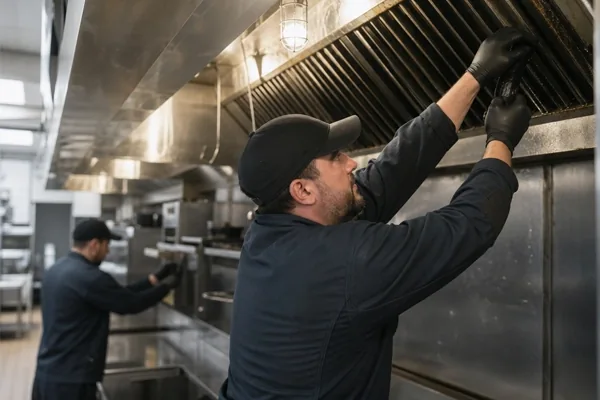
Everyone republishes the NFPA 96 frequency chart. Here's what the chart doesn't tell you: how your kitchen actually gets classified, why grease depth overrides the calendar, and what NE Ohio inspectors ask to see.
Direct Answer: NFPA 96 requires kitchen exhaust systems to be cleaned on a schedule set by cooking volume — commonly summarized as monthly for solid-fuel cooking, quarterly for high-volume operations, semiannually for moderate-volume, and annually for low-volume kitchens (verify your classification against the edition your fire authority enforces). Service-Tech Corporation's kitchen exhaust hood cleaning service classifies your operation during a free assessment and puts the system on the compliant cycle.
What Does the NFPA 96 Frequency Table Actually Say?
The frequencies come from NFPA 96's inspection table (Table 12.4 in recent editions — confirm the edition your AHJ adopts). Note the precise language: these are inspection frequencies — the system must be inspected at these intervals and cleaned when the inspection finds it needed. In practice, most operating kitchens hit the cleaning threshold at those same intervals:
| Cooking volume class | Typical venues | Inspection frequency |
|---|---|---|
| Solid fuel (wood, charcoal) | Wood-fired pizza, smokehouses, charbroilers over solid fuel | Monthly |
| High volume | Extended-hours operations, wok cooking, heavy fry lines, charbroiling | Quarterly |
| Moderate volume | Standard full-service restaurants | Semiannually |
| Low volume | Churches, day camps, senior centers, seasonal kitchens | Annually |
How Does an Inspector Actually Classify Your Kitchen?
The chart's categories look self-evident until your kitchen straddles two of them. Classification follows the cooking, not the cuisine label:
- Any solid fuel anywhere pushes you to monthly — a single wood-fired oven puts that system on the solid-fuel schedule even if the rest of the line is electric.
- "High volume" tracks grease production and operating hours, not covers. A modest-menu diner running a charbroiler and fryers 16 hours a day produces more duct grease than a white-tablecloth kitchen turning twice that revenue.
- Multiple systems classify separately. The hood over the fry line and the hood over the prep area can legitimately sit on different schedules.
- Real Cleveland examples: a Tremont wood-fired pizzeria — monthly; an overnight diner on a state route — quarterly; a brewery kitchen with a moderate fry load — semiannual; a church fellowship kitchen — annual.
Classify yourself in five minutes: What fuel do you cook over? How many hours a day does grease-producing equipment run? How much frying, charbroiling, or wok work? What does the filter look like one week after cleaning? Bring those answers to your cleaner — or let the assessment do it.
Why Is the Calendar the Floor, Not the Rule?
Here's what the chart-republishers skip: NFPA 96's real trigger is measured grease, not elapsed months. Professional cleaners evaluate grease depth in the system — the industry works to a depth-gauge criterion under the ANSI/IKECA C10 standard — and a system that hits the threshold gets cleaned regardless of the calendar. Two consequences for operators:
Your schedule can tighten.
A menu change — adding a charbroiler, extending hours, a new wok station — loads the duct faster than your old cycle assumed. The gauge catches what the calendar misses.
Your schedule can be defended.
Documented depth measurements from inspections are how you demonstrate to an AHJ that your frequency is right — data beats assertion at inspection time.
This is also the honest answer to "can we stretch to save money?" — the measurement decides, not the budget. As an IKECA member, Service-Tech runs this measurement-first approach as part of NFPA 96 compliance cleaning programs.
What Do Cleveland-Area Inspectors and Insurers Ask For?
Northeast Ohio fire authorities enforce NFPA 96 through the Ohio Fire Code, and at inspection time the questions are predictable: When was the system last cleaned, and by whom? Where's the service sticker? Can you produce the written report — including areas not cleaned? Insurance carriers increasingly mirror the same file request at renewal, and after any kitchen fire the cleaning records are among the first documents reviewed. The operational takeaway: treat the report and photo documentation as the product you're buying, with the cleaning as how it gets produced.
TL;DR — Your Schedule in Three Sentences
NFPA 96 puts kitchen exhaust systems on inspection cycles by cooking volume: solid fuel monthly, high-volume quarterly, moderate semiannual, low-volume annual. The calendar is the floor — measured grease depth is the real trigger, and menu or hours changes can tighten your class. Keep the sticker, photos, and written report on file; that documentation is what inspectors and insurers actually check.
Frequently Asked Questions
How Much Does It Cost to Stay on the Right Schedule?
Service-Tech hood cleanings start from $599 per cleaning, so a moderate-volume kitchen's baseline is two cleanings per year and a high-volume kitchen's is four. Multiply your class frequency by per-cleaning cost for your true annual budget — and remember an overdue first cleaning typically runs above baseline while the system is brought back to bare metal.
Do Filters Count as Cleaning the System?
No. Filter exchange or washing is routine kitchen maintenance you do weekly or more; NFPA 96 system cleaning means the hood, plenum, full duct run, and exhaust fan cleaned to bare metal by a qualified company. Shiny filters over a loaded duct is exactly the condition that fails inspections.
What If We Miss a Cleaning Cycle?
Get it scheduled before an inspection or a fire finds the gap. Expect the catch-up cleaning to take longer, and expect honest documentation — a professional report notes heavy accumulation rather than hiding it, which protects you going forward. Then set the recurring schedule so the gap can't recur.
Our Menu Changed — Does Our Frequency Change Too?
Very possibly. Adding solid fuel moves you to monthly immediately; adding fryers, charbroilers, or hours can move you up a class. Have the system inspected and grease depth measured after any significant menu or hours change rather than waiting for the old anniversary date.
What Sets the Interval in Practice
The schedule follows the measurement. A comb gauge is placed against the interior surface and read; anything at or above the trigger means the whole system, not the visible part. Between cleanings the practical checks are simple: whether the baffle filters are loading faster than they used to, whether the accessible stainless still polishes up, and whether the fan housing has begun to weep. When a clean is due, crews isolate the section, pull and soak the filters, shroud the fan, scrape the deposit mechanically, then degrease, hot-wash and squeegee the runoff to containment before reinstating.