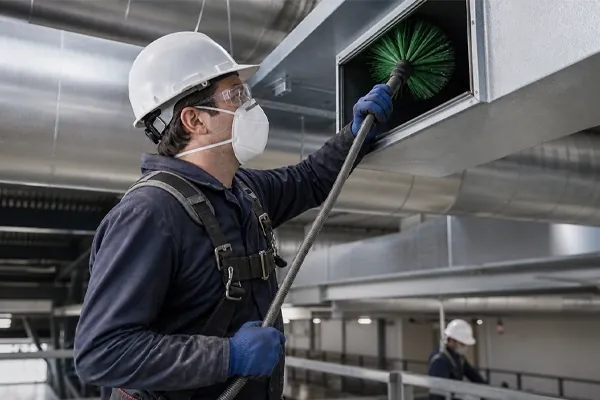
The honest answer is not a number — it is a method. Here is how facilities that get this right set their intervals, and a starting-point table by facility type.
Direct Answer: Industrial air ducts should be cleaned when inspection shows actionable accumulation — not on a blanket calendar. The professional model is inspection-first: assess systems on a fixed schedule (annually for most production environments, more often under heavy contaminant load) and clean when documented conditions require it, following NADCA's assessment-driven approach. Service-Tech Corporation's industrial air duct cleaning programs are built on exactly this inspect-then-clean cycle.
Why Do Blanket Frequency Rules Fail Industrial Facilities?
The frequency advice that dominates this search — "every 3 to 5 years" — is NADCA's consumer guidance for homes, repeated by franchise blogs. Applying it to a production facility fails in both directions. A foundry, weld shop, or flour-handling bakery can load ductwork to hazardous levels in months, and waiting for year three means running a fuel-lined or contaminated system in the meantime. Meanwhile, a clean-running office building with good filtration might genuinely not need cleaning at year five — and a calendar-only contract would have sold it two unnecessary cleanings by then.
The cost of getting it wrong is asymmetric. Over-cleaning wastes budget; under-cleaning accumulates risk: combustible-dust housekeeping findings, product-contamination complaints, hygiene issues in occupied zones, rising static pressure and energy draw, and — in dust-generating plants — a hidden deflagration fuel load that NFPA's combustible-dust standards treat as your responsibility to control.
What Is the Inspection-First Model?
NADCA's ACR standard is built around assessment, not calendars: inspect the system, document conditions, clean when conditions require it, verify the result. Operationalized for a Northeast Ohio facility, the cycle looks like this:
- 01
Baseline assessment
Representative openings across supply, return, and exhaust runs; photo or borescope documentation of accumulation at each point; identification of moisture, microbial, or dust-hazard conditions. This is where a qualified assessor — NADCA certifies individuals as Air Systems Cleaning Specialists (ASCS) and ventilation inspectors — earns their credential.
- 02
Interval assignment
Based on documented loading rate, each system gets its own inspection interval. Systems serving production zones typically justify annual inspection; heavily loaded process systems shorter; clean administrative systems longer.
- 03
Scheduled re-inspection
At each interval, the same reference points are re-photographed. Now you have a loading rate, not a snapshot — the single most useful number in duct-hygiene planning.
- 04
Condition-triggered cleaning
Cleaning happens when documented accumulation approaches actionable criteria — combustible-dust housekeeping thresholds in dust-generating plants, contamination and hygiene criteria elsewhere — with post-cleaning verification closing the loop.
The payoff: every dollar of cleaning is tied to a photograph that justified it, and your compliance file shows a defensible method instead of a vendor's habit.
What Drivers Actually Set Industrial Cleaning Frequency?
Consumer guidance never mentions the variables that dominate industrial loading rates:
- Process type. Welding, grinding, powder handling, and cooking load ducts orders of magnitude faster than office occupancy. The contaminant's character (combustible, oily, hygroscopic) matters as much as its quantity.
- Particulate load and capture efficiency. How much escapes source capture (fume arms, collector hoods) into general ventilation determines what your ducts swallow daily.
- Filtration quality. Higher-efficiency filters (MERV rating) slow downstream duct loading dramatically; poor or bypassed filtration turns ductwork into the filter.
- Runtime. A system running continuously across shifts moves multiples of the air — and the particulate — of an 8-hour building on the same calendar.
- Environment and season. Northeast Ohio adds salt-season grit, spring pollen loads on intakes, and humid summers that turn dust accumulation into microbial substrate in cooling systems.
- System history. Post-construction debris, past water events, and previously skipped sections all accelerate the apparent loading rate at the next inspection.
Frequency Starting Points by Facility Type
These are starting points for setting inspection intervals — the assessment sets your actual schedule:
| Facility Type (NE Ohio Examples) | Typical Loading Profile | Starting-Point Approach |
|---|---|---|
| Office / administrative buildings | Low: occupant dust, fiber | Inspect on a multi-year cycle; clean on documented condition |
| Schools and universities | Low-moderate: high occupancy, seasonal schedules | Inspect regularly (break windows); clean on condition |
| Hospitals and healthcare | Moderate load, high consequence | Frequent inspection; cleaning tied to infection-control and renovation projects |
| Food processing plants | Moderate-heavy: organic dust, washdown humidity | Annual or shorter inspection; cleaning aligned to audit calendar |
| Machining / metalworking | Heavy: oil mist, metal fines | Annual or shorter inspection; expect regular cleaning of process-adjacent runs |
| Foundries, weld-intensive plants | Very heavy: fume, dust, thermal load | Short-cycle inspection; cleaning as a recurring maintenance line |
| Woodworking / plastics / powder handling | Very heavy and combustible | Inspection keyed to dust hazard analysis; housekeeping thresholds govern |
How Can Facility Managers Run Their Own Annual Check?
Between professional assessments, a maintenance team can watch the leading indicators:
- Pull and photograph one supply and one return register per zone annually — same registers every year, so photos compare like-for-like.
- Track filter loading: if filters are reaching their pressure-drop change point faster each quarter, the system's dust budget is rising.
- Log static pressure at the air handler each season; a creeping baseline with clean filters points at duct and coil loading.
- Look for dust plumes or streaking at diffusers, and for accumulation on the fan and in the AHU cabinet during routine PMs.
- After any construction, treat affected systems as due for inspection regardless of the calendar.
Any two of these trending upward is a reason to move the professional assessment forward.
What Does Staying on Schedule Cost?
Inspection-first programs cost less than fear-based cleaning because you only buy cleaning the photos justify. Service-Tech Corporation's commercial air duct cleaning starts from $1,375; industrial cleanings and multi-system programs are quoted after a site walk, and recurring-inspection contracts spread predictable cost across the year. Facilities on the commercial side of the line can scope against our commercial air duct cleaning service.
TL;DR — Set Intervals by Inspection, Not Folklore
The "every 3-5 years" rule is residential guidance and fails industrial facilities in both directions. Run the inspection-first cycle: baseline assessment with photos, per-system intervals (annual or shorter for production environments), re-inspection that yields a loading rate, and cleaning triggered by documented condition — combustible-dust thresholds where they apply. Watch filter loading, static pressure, and diffuser dust between assessments. Service-Tech Corporation, a NADCA member since 1990, runs assessment-driven duct programs across Northeast Ohio — more scheduling and compliance guides are on our blog.
Frequently Asked Questions
Is there a legal requirement for how often industrial ducts must be cleaned?
No regulation sets a universal interval. Obligations arrive by condition: NFPA combustible-dust standards make accumulation a housekeeping issue in dust-generating plants, food-safety audit schemes examine overhead and air-handling hygiene, and OSHA exposure rules reach systems that recirculate contaminants. An inspection-driven program with documentation answers all three.
What does NADCA actually recommend for commercial buildings?
NADCA's framework is assessment-based: inspect systems regularly — commercial air handlers and high-load environments more frequently than light-duty buildings — and clean when documented conditions require it, to the ACR standard's cleanliness and verification criteria. The widely quoted multi-year cleaning rule is consumer guidance for homes, not a commercial or industrial standard.
How do I know if my facility is overdue right now?
Fast checks: pull a return register and photograph the duct interior; look above the filters in your AHU cabinet; review whether filters are loading faster than last year; check static-pressure trend. Visible heavy accumulation, microbial growth, or any measurable dust layer in a combustible-dust plant means schedule an assessment now rather than at the next planned interval.
How the Interval Is Actually Determined
Survey, don't schedule blind. Crews borescope the runs, swab and weigh a sample against the NADCA acceptance figure, read the pressure drop across the coil face, and press the liner to see whether it has begun to delaminate. Those four readings tell you whether this is a routine clean or a restoration. When work proceeds, brushes agitate bare metal, whips handle lined runs, contamination is extracted under continuous negative pressure, the plenum and fan housing are opened, fins are straightened, and the system is reinstated and pressurized. The interval then follows from the loading rate you measured, not from a calendar.
The Readings That Set the Interval
- Gravimetric. Swab and weigh against 0.75 mg per 100 cm² — the loading rate between two samples is your real interval.
- Coil pressure drop. Measured against design, this quantifies restriction a visual check cannot see.
- Programme basis. ASHRAE 180 rather than a fixed date; NADCA's guidance is annual on air handling units and every 1–2 years on ductwork as a starting point.
- Filtration. MERV 8 or better on reassembly, with humidity held between 30–60%, both of which slow the next cycle of loading.