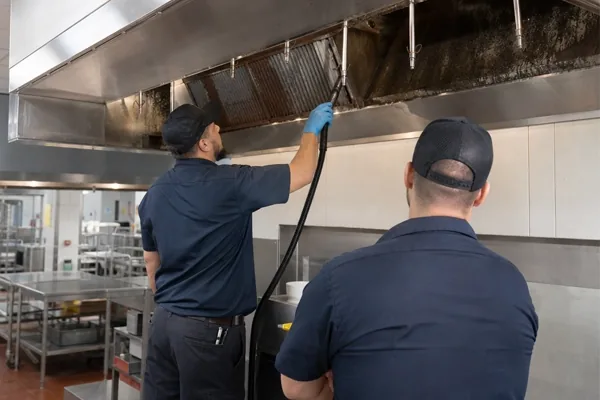
Cleveland's healthcare campuses run kitchens that never close and surveys that never end. Here's how hood cleaning happens anyway — overnight windows, infection-control coordination, and paperwork built for the Environment of Care file.
Direct Answer: Hospitals schedule kitchen exhaust cleaning in coordinated overnight windows between meal services, with infection-control precautions and containment protecting patient environments, and receive documentation that feeds directly into the facility's life-safety compliance file. Service-Tech Corporation's kitchen exhaust hood cleaning team has serviced institutional kitchens from Cleveland since 1960 — the scale of work healthcare campuses require.
Why Is Hospital Hood Cleaning a Different Job Than Restaurant Work?
A hospital kitchen is a high-volume operation embedded in a life-safety-regulated, infection-controlled, continuously occupied building. Four differences drive everything:
- The kitchen barely closes. Patient tray lines, cafeterias, and on-call service compress cleaning into short overnight gaps — often a few hours between late service and breakfast prep.
- The building never closes. Work happens adjacent to patient floors, so noise, odors, and air-handling impacts must be planned, not discovered.
- Infection control has authority. Containment, debris paths, and crew movement through the building are governed by the facility's infection-control expectations, ICRA-style — coordination the contractor must respect, not resent.
- Everything gets surveyed. Fire-protection documentation is reviewed by accreditation surveyors and the AHJ, so records aren't a courtesy — they're the deliverable.
Cleveland is a healthcare anchor market — major hospital campuses, plus community hospitals and senior-care facilities across Cuyahoga County — which makes facility-scale hood competence a regional necessity, not a niche.
How Does Hood Cleaning Documentation Feed the Environment of Care File?
Accreditation surveys (Joint Commission and CMS life-safety reviews) evaluate kitchen fire protection against NFPA 96-based expectations. When a surveyor reaches the kitchen exhaust question, the facilities team needs to produce: the cleaning schedule matched to cooking volume, dated service reports with areas-not-cleaned exceptions, before/after photo documentation, and evidence that identified deficiencies (missing access panels, inaccessible sections) were corrected. A contractor who delivers survey-ready paperwork after every visit — the standing practice behind Service-Tech's NFPA 96 compliance cleaning — turns that binder check into a non-event. The cheap-vendor sticker-only alternative turns it into a finding.
What Does Infection-Control Coordination Actually Involve?
The NY-market competitor content names the issue; here's the working version a Cleveland facilities director can hold a vendor to:
- 01
Pre-work review with infection control
Scope, route, and containment plan reviewed against the facility's ICRA-style precautions before the first visit.
- 02
Contained work zones
Poly containment where cleaning interfaces with occupied corridors; debris and equipment move on agreed paths at agreed hours.
- 03
Air-handling awareness
Coordination with facilities on exhaust fan shutdowns and any temporary airflow effects, so negative/positive pressure relationships in adjacent areas aren't disturbed unannounced.
- 04
Crew conduct
Badging, check-in, and conduct protocols per facility policy.
- 05
Clean handback
Work areas returned sanitized and inspection-ready before the morning shift — the kitchen staff should notice nothing except the service report.
What Does an Overnight Service Window Look Like?
A sample timeline for a hospital kitchen with late service ending at 9:00 p.m. and breakfast prep starting at 4:30 a.m.:
| Window | Activity |
|---|---|
| 9:00-10:00 p.m. | Crew check-in, containment setup, equipment staging, lockout of fans and appliances in scope |
| 10:00 p.m.-2:00 a.m. | System cleaning: hoods and plenums to bare metal, duct runs through access panels, rooftop fan service |
| 2:00-3:00 a.m. | Detail work, access panel reinstallation, grease containment service |
| 3:00-4:00 a.m. | Teardown, sanitizing wipe-down of work areas, debris removal on the agreed path |
| 4:00-4:30 a.m. | Walkthrough with the overnight facilities contact; documentation package initiated |
Multi-hood campuses are sequenced across scheduled nights — tray-line system one night, cafeteria the next — so no meal service is ever without a functioning exhaust system. That sequencing is precisely where an institutional contractor differs from a restaurant crew: Service-Tech fields 50+ technicians from its Cleveland headquarters, sized for campus-scale programs.
TL;DR — Hospital Hood Cleaning in Brief
Hospital exhaust cleaning is restaurant-grade work performed under healthcare constraints: overnight windows between meal services, infection-control coordination, air-handling awareness, and survey-ready documentation that feeds the Environment of Care file. Sequenced multi-night programs keep food service uninterrupted. Choose a contractor sized and disciplined for institutions — Cleveland's healthcare campuses have used Service-Tech's crews for exactly this since the company's founding era.
Frequently Asked Questions
Our Kitchen Never Fully Closes — Can the System Still Be Cleaned?
Yes. The system is cleaned in sections during the lowest-activity window, with cooking shifted off the affected line for those hours and multi-system campuses sequenced across nights. What it requires is planning with your food-service director — which is exactly what the pre-work walkthrough is for.
How Often Do Hospital Kitchens Need Exhaust Cleaning?
Most hospital kitchens are high-volume operations under NFPA 96 — typically a quarterly cycle — though each system is classified by its actual cooking profile, and a low-volume satellite kitchen may sit on a longer interval. Classification happens at the initial assessment and gets revisited when service lines change.
What Does a Hospital Hood Cleaning Program Cost?
Service-Tech hood cleanings start from $599 per cleaning, with campus programs quoted per system after a free assessment of hood counts, duct routing, fan access, and scheduling constraints. Healthcare pricing is program pricing: predictable per-visit numbers across the year's cycle rather than one-off quotes.
How the Work Is Sequenced Around Continuous Service
A hospital kitchen never fully closes, so the system is cleaned in sections. Crews isolate one leg at a time, pull and soak its baffle filters, shroud the fan, then scrape and degrease from the hood plenum through to the duct before hot-washing and squeegeeing the runoff to containment. Each section is reinstated and running before the next comes down, and the accessible stainless is polished so the next inspection starts from a documented baseline. Access doors are the constraint: a leg without them cannot be cleaned or inspected, and fitting them is planned work rather than an upsell.