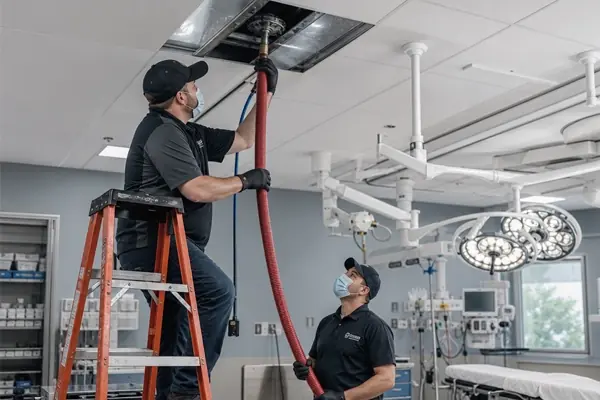
In a hospital, duct cleaning is an infection-control project that happens to involve ductwork. Here is how the work runs under ICRA discipline — and what your infection preventionist will require.
Direct Answer: Hospital air duct cleaning is performed as an infection-control-managed project: scoped with the facility's Infection Control Risk Assessment (ICRA), executed behind containment barriers under HEPA-filtered negative air, and documented for the environment-of-care file. It is a specialized branch of industrial air duct cleaning that Service-Tech Corporation performs for healthcare facilities across Northeast Ohio.
Why Does Duct Hygiene Matter More in Healthcare Than Anywhere Else?
Because the air system serves people whose defenses are already down. Dust liberated during maintenance work is a recognized vector for opportunistic pathogens — fungal spores mobilized from disturbed dust are the classic risk to immunocompromised patients, which is why healthcare treats any dust-generating work near patient areas as an infection-control event. Ductwork sits on both sides of that equation: contaminated systems can distribute what they carry, and cleaning them is itself dust-generating work that must be contained. Add the compliance layer — ventilation requirements for healthcare occupancies (ASHRAE 170), CDC environmental infection control guidance, Joint Commission environment-of-care expectations — and duct condition in a hospital is never just a maintenance line. It is survey material.
What Standards Govern Healthcare HVAC Hygiene? The Stack, Explained
National duct-cleaning pages list these acronyms; here is what each one actually does to your project:
| Standard / Framework | What It Governs | What It Means for Duct Cleaning |
|---|---|---|
| ASHRAE 170 (Ventilation of Health Care Facilities) | Air-change rates, pressure relationships, filtration levels by space type | Cleaning must preserve pressure relationships — isolating a duct serving a protective-environment or airborne-isolation room is coordinated, not casual |
| CDC environmental infection control guidance | Dust control during construction/maintenance, protection of at-risk patients | The reason dust-generating duct work is treated as an ICRA event, with barriers and negative air |
| ICRA (Infection Control Risk Assessment) | Project-by-project risk classification and required precautions | Sets the precaution level for your specific cleaning — the operational rulebook for the job |
| Joint Commission environment of care / life safety | Survey accountability for the physical environment, including utility systems | Your documentation from the cleaning is what answers a surveyor's ventilation-hygiene question |
| NADCA ACR | Assessment, source-removal method, cleanliness verification | The technical how of the cleaning itself, inside the ICRA envelope |
The takeaway for facility directors: the duct cleaner works inside your infection-control framework, not alongside it. A contractor who leads the conversation with equipment specs instead of asking for your ICRA process has not done this work before.
How Does ICRA Shape the Actual Job?
ICRA classifies projects by the dust-generating activity and the risk group of nearby patients, and the resulting precaution class dictates the physical controls. Applied to duct cleaning:
| Situation | Typical Precaution Level | Duct-Cleaning Controls in Practice |
|---|---|---|
| Work in unoccupied administrative zones | Lower precaution classes | Standard containment: poly barriers, negative-air capture, clean work practices |
| Occupied general patient areas | Elevated precautions | Sealed barrier enclosures, HEPA-filtered negative air maintaining inward airflow, covered debris transport, tacky mats, daily work-zone hygiene |
| Adjacent to high-risk populations (oncology, transplant, ICU, NICU) | Highest precaution classes | Anteroom-style access, continuous negative-pressure monitoring of the enclosure, sequenced work with infection prevention sign-off at each phase, air handling isolated and verified before any duct is opened |
Three field realities the national pages gloss over: precaution class is set by the hospital's infection preventionist, not the contractor — the crew's job is to execute it without shortcuts; pressure relationships are patient-safety controls, so fan shutdowns and damper isolation get planned with facilities engineering in writing; and the enclosure comes down only after the work zone passes inspection — teardown is the step where a sloppy crew undoes a clean job.
What Makes Healthcare Duct Cleaning Different From Standard Commercial Work?
- The containment is the product. In an office, containment protects the cleaning result; in a hospital, containment protects patients — the cleaning result is secondary to never liberating dust into occupied space.
- Coordination triangle. Every phase runs through facilities engineering (system isolation, pressure), infection prevention (precautions, sign-offs), and nursing units (patient logistics, timing). The contractor's scheduling discipline matters as much as its cleaning method.
- Off-hours by design. Work near patient care happens in the windows the units define, sequenced zone by zone — a hospital is never "shut down."
- Verification is two-layer. NADCA ACR cleanliness verification for the duct interior, plus infection-prevention release of the work zone. Both go in the file.
When Do Hospitals Actually Clean Ducts?
Not on a blanket calendar. The triggers that put healthcare duct cleaning on the schedule: renovation and construction (protecting or remediating systems in project zones — the most common driver), documented contamination findings from inspection or IAQ investigation, water events and mold findings anywhere air handling is implicated, survey preparation when environment-of-care documentation shows gaps, and system-performance projects (coil and AHU hygiene recovering capacity). The underlying program should be inspection-first: scheduled assessments with photo documentation, cleaning scoped where conditions require it — the same NADCA ACR model we describe across our duct content, executed under ICRA discipline. Routine lighter-duty buildings on a campus (medical office, administration) can run as standard commercial air duct cleaning scopes.
Who Is Qualified for Hospital Duct Work in Cleveland?
Cleveland is one of America's dense healthcare markets — major hospital systems, satellite campuses, surgery centers, and long-term-care networks across Northeast Ohio. Vetting a duct contractor for that environment comes down to three questions: Can they show NADCA credentials and ACR-based method statements? (Service-Tech Corporation has been a NADCA member since 1990.) Can they describe ICRA execution specifically — barriers, negative-air monitoring, infection-prevention sign-offs — from jobs they have actually run? And can they staff the coordination burden: pre-job meetings, off-hours phasing, and documentation to environment-of-care standard?
What Does Hospital Duct Cleaning Cost?
Healthcare projects are quoted after a site walk with facilities engineering — precaution level, enclosure and monitoring requirements, phasing, and off-hours windows drive cost well above the commercial baseline (from $1,375) that applies to ordinary occupied buildings. Estimates are free, and the assessment documentation feeds your environment-of-care file whichever way you bid the cleaning.
TL;DR — Healthcare Duct Cleaning in Five Lines
In hospitals, duct cleaning is an infection-control project: ASHRAE 170 pressure relationships preserved, CDC dust-control logic applied, precaution class set by your ICRA, and the work executed behind sealed, negatively pressurized enclosures with infection-prevention sign-off at each phase. Triggers are renovation, contamination findings, water events, and survey prep — managed most effectively by an inspection-first program. Hire for ICRA fluency and coordination discipline, not equipment lists. Service-Tech Corporation serves Northeast Ohio healthcare from its Cleveland headquarters — more facility guides are on our blog.
Frequently Asked Questions
Can hospital ducts be cleaned while patient areas are occupied?
Yes — that is the norm, because hospitals never fully close. The work is phased zone by zone behind sealed containment under HEPA-filtered negative air, scheduled into windows the nursing units define, with the precaution level set by the facility's ICRA process and infection prevention signing off on containment before any duct is opened.
Does ASHRAE 170 require duct cleaning?
ASHRAE 170 governs ventilation design — air changes, filtration, pressure relationships — rather than mandating cleaning. Its role in a cleaning project is as a constraint: isolating systems for cleaning must not compromise required pressure relationships in spaces like airborne-isolation or protective-environment rooms, which is why fan and damper work is planned with facilities engineering in writing.
What documentation should a healthcare duct cleaning produce?
Two layers: the NADCA ACR-style technical record (assessment findings, methods, post-cleaning verification photos at reference points, exceptions) and the infection-control record (ICRA precaution class, containment and negative-air logs, infection-prevention sign-offs, work-zone release). Together they answer both a Joint Commission surveyor and your own IP committee.
The Method, Under Infection Control
Everything turns on containment. The system is held under continuous negative pressure through HEPA filtration for the whole time the interior is disturbed, so contamination is dislodged and extracted rather than released into a corridor. Runs beyond reach are borescoped before work and swabbed afterwards, weighed against the NADCA acceptance figure. The air-handler plenum, drain pan and fan housing are opened — in a humid plant room these foul faster than the duct they feed. A liner that delaminates under light pressure is encapsulated or replaced, coil fins are straightened back to plane, and each zone is reinstated and pressurized before the next comes down.