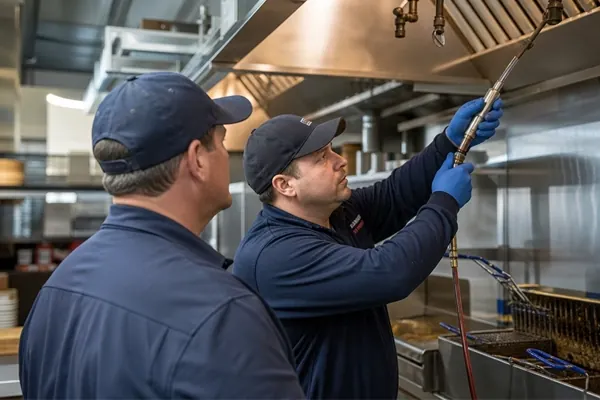
A duct fire does not start in the duct. It starts at the cooking line and climbs — and the only thing that stops the climb is removing the fuel.
Direct Answer: Grease fire prevention in a restaurant is layered — trained staff, clean filters, a working suppression system — but the foundational layer is removing the fuel: regular professional kitchen exhaust hood cleaning that strips accumulated grease from the hood, ductwork, and fan before a cooking flare-up can ignite it. Every other defense assumes the fire stays small; a clean exhaust system is what keeps it small.
What Actually Happens in a Duct Grease Fire?
Most prevention articles list tips. It is more useful to understand the mechanism, because every prevention layer maps to a stage of it. Here is the anatomy of a kitchen exhaust fire, as seen by the people who remove the fuel load for a living:
- 01
Vapor becomes fuel
Every hour of cooking sends grease-laden vapor up through the filters. Baffle filters capture some of it; the rest condenses on the cool metal of the hood plenum and duct interior. Over weeks it builds into a layer of polymerized grease — effectively a solid fuel lining your exhaust path.
- 02
A flare-up reaches the filters
A charbroiler flare, an overheated fryer, or a pan fire sends flame or superheated air into the hood. Grease deposits do not need direct flame contact — accumulated grease can ignite once surfaces reach its autoignition range, commonly cited at roughly 600–700°F.
- 03
The duct becomes a chimney
Once duct grease ignites, the exhaust fan does exactly what it is designed to do: pull air — and now fire — through the duct at high velocity. A vertical duct run turns into a flue, spreading fire from the cooking line toward the roof in seconds.
- 04
The fire exits at the fan
The rooftop fan and its grease-loaded housing ignite, exposing roofing materials and adjacent structures. Fires that reach this stage frequently involve the building itself, not just the kitchen — and duct interiors are largely unreachable by handheld extinguishers or hose streams.
Cooking equipment is the leading cause of fires in eating and drinking establishments in national fire-data reporting, and the exhaust system is the path that turns a contained cooking fire into a structural one. In Cleveland's older building stock — where many restaurants operate in mixed-use buildings with residential floors above — that vertical spread risk is not theoretical for your neighbors either.
The Layered Defense Model: Four Layers Between You and a Loss
Fire-protection companies writing on this topic understandably emphasize suppression hardware. Working from the fuel side, the defense stack looks like this — in order of operation:
| Layer | What It Does | Who Owns It |
|---|---|---|
| 1. Fuel removal — professional exhaust cleaning | Strips grease from hood, duct, and fan so a flare-up has nothing to climb | Certified hood cleaning contractor, on your NFPA 96 schedule |
| 2. Capture — baffle filters | Intercept grease vapor before it enters the duct; must be intact and cleaned frequently | Kitchen staff (cleaning) + contractor (condition checks) |
| 3. Suppression — wet-chemical system | Knocks down a fire at the appliance and hood before it enters the duct | Licensed fire-protection company, semi-annual service |
| 4. People — trained staff and closing routines | Prevent the flare-up from happening or escalating: fryer discipline, no overloaded charbroilers, correct extinguisher use | Owner and managers, daily |
The layers are not interchangeable. A suppression system protects the appliance zone; it cannot clean your duct after the fact. Filters cannot capture what has already condensed downstream. If layer one is neglected, a fire that beats layers two through four has a fuel-lined path through your building.
How Often Does NFPA 96 Require Exhaust Cleaning?
NFPA 96 — the standard your Cleveland fire inspector enforces — sets inspection frequency by cooking volume, and cleaning whenever the inspection finds the system contaminated:
| Cooking Operation | Inspection Frequency |
|---|---|
| Solid-fuel cooking (wood- or charcoal-fired ovens, grills, smokers) | Monthly |
| High-volume cooking (continuous overnight operation, charbroiling, wok cooking) | Quarterly |
| Moderate-volume cooking (most full-service restaurants) | Semi-annually |
| Low-volume cooking (churches, seasonal kitchens, day camps, senior centers) | Annually |
Two things Cleveland operators regularly get wrong: first, these are minimums, and a busy charbroiler-heavy kitchen can load a duct faster than its class suggests; second, the class is set by what you cook, not how big you are — a small wood-fired pizza operation is on the monthly schedule. If you are unsure of your class or your last report is thin, our NFPA 96 compliance cleaning service aligns your frequency, documentation, and access panels with what the AHJ expects.
Who Is Responsible for What? The Prevention Responsibility Matrix
Fires happen in the gaps between "I thought the cleaner did that" and "I thought the kitchen did that." Put this matrix on the office wall:
| Task | Frequency | Owner |
|---|---|---|
| Wipe down hood exterior and visible surfaces | Daily | Kitchen staff |
| Clean baffle filters (dish machine or soak) | Daily to weekly, by volume | Kitchen staff |
| Check filters are seated, undamaged, correct type | Weekly | Manager |
| Keep cooking clear of unattended fryers/charbroiler overload | Every shift | Line staff |
| Inspect and clean hood, duct, and fan to bare metal | Per NFPA 96 class (see table) | Certified exhaust cleaning contractor |
| Service wet-chemical suppression system | Semi-annually | Licensed fire-protection company |
| Verify sticker, report, and photos after each service | Each cleaning | Owner / GM |
Staff-side diligence extends the life of every professional cleaning; professional cleaning removes what staff-side work can never reach.
What Does a Grease Fire Cost a Cleveland Restaurant?
The direct loss is only the opening number. A kitchen exhaust fire typically brings closure during investigation and repairs, lost staff wages and customers who build new habits, health-department re-inspection before reopening, and an insurance process that scrutinizes your cleaning documentation. If the service history is missing or shows hood-only cleanings when the duct carried the fire, that conversation gets harder. Prevention, by contrast, is a scheduled line item: professional hood cleaning from $599 per cleaning, on a calendar you control.
What Should Cleveland Operators Do This Month?
- Pull your last hood cleaning report. If it lacks duct and fan photos or documents no inaccessible areas, re-bid the work.
- Confirm your NFPA 96 frequency class against what you actually cook — especially if you have added a charbroiler, wok range, or smoker since the schedule was set.
- Look above one baffle filter with a flashlight: glaze or buildup on the plenum means you are past due regardless of the calendar.
- Verify your suppression service and exhaust cleaning are both current and stickered — inspectors check both, and each assumes the other is working.
Service-Tech Corporation has cleaned commercial kitchen exhaust systems in Northeast Ohio since 1960 and serves Cleveland restaurants, institutions, and food-service facilities as an IKECA member firm.
TL;DR — Grease Fire Prevention in Five Lines
A duct grease fire is a cooking flare-up that finds fuel: condensed grease lining your exhaust system, igniting at roughly 600–700°F and climbing the duct to the roof. Defense is layered — staff discipline, clean filters, serviced suppression — but layer one is fuel removal on your NFPA 96 schedule: monthly for solid fuel, quarterly for high-volume, semi-annual for moderate, annual for low-volume operations. Assign the responsibility matrix, verify every cleaning with photos and a report, and treat the duct as the fire path it is. More kitchen fire-safety guides are on our blog.
Frequently Asked Questions
Can a suppression system replace hood cleaning?
No. A wet-chemical suppression system protects the appliance and hood zone at the moment of ignition; it does not reach fire inside duct runs, and it does nothing about accumulated fuel. NFPA 96 requires both a serviced suppression system and exhaust cleaning at set frequencies — they are complementary layers, not alternatives.
How do I know my restaurant's NFPA 96 cleaning frequency?
It is set by cooking type: monthly for solid-fuel cooking, quarterly for high-volume operations like continuous overnight cooking, charbroiling, or wok cooking, semi-annually for moderate-volume cooking, and annually for low-volume kitchens. Your cleaning contractor should confirm your class during a site assessment and note it on your report.
Does daily filter cleaning by my staff count as hood cleaning?
It counts as good practice, not compliance. Staff can and should clean baffle filters and visible surfaces, but NFPA 96 requires the full exhaust system — hood plenum, ductwork, and fan — to be inspected and cleaned by trained, qualified, and certified persons. The duct interior is exactly the part staff cleaning never touches.
What Prevention Looks Like as Physical Work
Fire prevention in an exhaust system is a cleaning specification, not a policy. Electrical is locked out and the section isolated; filters are pulled and soaked, the fan shrouded, and the deposit scraped to bare metal before degreasing and hot-washing the surface. Wash water carrying dissolved grease is squeegeed to containment rather than left to reach the roof drain, and the run is reinstated and tested. The parts that actually start fires — the horizontal duct run and the fan housing — are the parts a cut-rate clean skips, because they are the ones the customer cannot see.