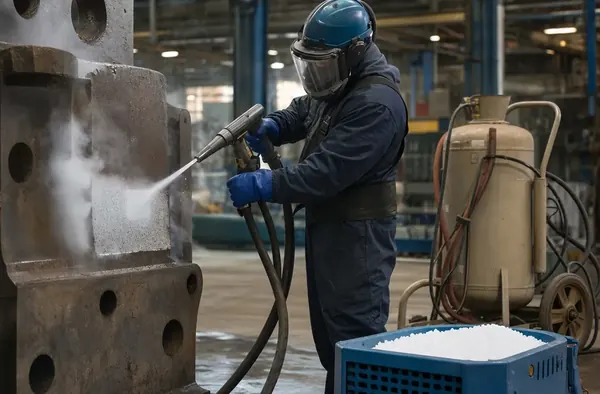
A contractor's decision framework — including the cases where we'd tell a Cleveland plant manager that abrasive blasting is honestly the better buy.
Direct Answer: Choose dry ice blasting when equipment must be cleaned in place, when the substrate can't tolerate abrasion, or when secondary waste is expensive to manage (electrical gear, food lines, tooling); choose sandblasting when you need aggressive removal of heavy rust or coatings and a profiled surface ready for repainting. Service-Tech Corporation provides dry ice blasting across Ohio, Florida, and Arkansas — and will tell you plainly when abrasive blasting is the better fit.
How Do the Two Methods Compare Side by Side?
| Factor | Dry ice blasting | Sandblasting (abrasive media) |
|---|---|---|
| Abrasiveness | Non-abrasive; soft CO2 pellets | Aggressive; erodes contaminant and substrate surface |
| Secondary waste | None — pellets sublimate to gas | Large volumes of spent media mixed with contaminant |
| Surface profile | Leaves substrate as-is | Creates anchor profile for coatings |
| Electrical safety | Non-conductive, moisture-free | Conductive dust risk; grit intrusion into gear |
| In-place cleaning | Yes — routine around machinery | Usually requires teardown, masking, or a blast room |
| Cleanup and re-entry | Vacuum removed contaminant; fast restart | Sweep/collect media, protect adjacent equipment |
| Removal speed on heavy scale | Slower | Faster |
| Food-adjacent use | Food-grade CO2 pellets; dry process | Generally unsuitable near production |
What's the Real Difference in Waste — and What Does It Cost?
This is the line item the generic comparisons skip. Every pound of abrasive media you blast becomes a pound-plus of waste: spent media mixed with whatever you removed. On a facility-scale job that's not bags — it's drums or tons that must be swept, contained, characterized, and disposed of. And in Ohio, characterization matters: media that captured lead-bearing paint or oily residue may require handling as regulated waste, with testing and disposal pricing to match.
Dry ice blasting deletes that entire line: the pellets sublimate, so disposal covers only the contaminant itself. When you compare bids, put three numbers side by side — blasting labor, media/pellet cost, and waste handling plus cleanup labor. The third number is where sandblasting quotes quietly grow and where dry ice quotes end.
When Is Dry Ice Blasting the Clear Winner?
- Equipment that stays put. Robotic weld cells, production lines, molds in the press, panels in the plant — dry ice cleans in place; abrasive work usually means teardown or a blast room.
- Electrical and controls. Non-conductive, moisture-free cleaning of de-energized switchgear and panels; grit in electrical gear is a failure mode, not a cleaning outcome.
- Food and beverage plants. Dry, residue-free, no media migration into product zones — compatible with a sanitation-window schedule.
- Dimension-critical surfaces. Mold cavities, machined faces, and tooling keep their tolerances; abrasive media removes metal along with dirt.
- Occupied or waste-sensitive sites. No media cloud settling over the plant, no tonnage to haul.
When Would We Recommend Sandblasting Instead?
Service-Tech sells dry ice blasting, so weigh this section accordingly — it's where the recommendation runs against our own service line:
- 01
You need a coating-ready profile
Paint systems spec an anchor pattern in the steel. Dry ice cannot etch one; abrasive media is the correct tool, full stop.
- 02
Heavy rust, mill scale, or thick multi-layer coatings
CO2 removes surface contamination efficiently, but thick scale is a grinding match dry ice loses on speed and cost.
- 03
The part can go to a blast shop
If the component is removable anyway and waste handling is simple, commodity abrasive blasting is often cheaper per square foot.
- 04
Outdoor structural steel headed for recoating
Weathered steel being prepped for a full paint system is classic abrasive territory.
The honest framing: dry ice blasting is a cleaning technology; sandblasting is a surface preparation technology. Facilities usually need cleaning far more often than they need re-profiling.
How Should a Facility Manager Decide?
Run the decision in this order:
- 01
Does the surface need a profile for recoating?
Yes → sandblasting. No → continue.
- 02
Can the equipment be removed and taken to a blast facility economically?
No (must clean in place) → dry ice. Yes → continue.
- 03
Is the substrate abrasion-sensitive (tooling, machined faces, wiring, food surfaces)?
Yes → dry ice. No → continue.
- 04
Price the waste stream
Get both quotes with disposal and cleanup itemized; on contaminated-media jobs, dry ice frequently wins the total even at a higher day rate. Service-Tech dry ice projects start at a $2,000 minimum engagement with free estimates.
Both methods can appear in one facility's year — blast-room work for parts headed to paint, CO2 work for everything that can't leave the floor. Dry ice blasting is part of Service-Tech's broader industrial cleaning portfolio for Cleveland-area plants, so mixed scopes can be planned under one vendor.
TL;DR — The Decision in Three Lines
Sandblasting is surface preparation: choose it for heavy scale removal and coating-ready profile. Dry ice blasting is in-place cleaning: choose it for equipment that can't leave the floor, substrates that can't take abrasion, and any job where waste disposal and cleanup would dominate the invoice. Compare bids on total cost — labor, media, waste, downtime — not on hourly rate.
Frequently Asked Questions
Is Dry Ice Blasting as Fast as Sandblasting?
On adhered surface contamination — grease, adhesives, residue, mold — the speeds are comparable and dry ice wins the total timeline by skipping cleanup and drying. On heavy rust or thick coatings, sandblasting removes material faster. Speed follows the job, which is why we scope before quoting.
Can Dry Ice Blasting Remove Paint Like Sandblasting Does?
It can remove paint and overspray, particularly weakly adhered or brittle coatings, but it will not leave the etched profile a new coating system requires. If the job is strip-and-repaint structural steel, abrasive blasting is the right specification.
What If My Job Has Both Kinds of Surfaces?
Common in practice — a line with heavy-scale frames next to abrasion-sensitive tooling. Scope them separately: profile work to an abrasive process, in-place cleaning to CO2. Service-Tech can assess the split at a free site walkthrough and price the dry ice scope directly.
The Comparison in Published Figures
| Dry ice | Silica sand | |
|---|---|---|
| Hardness | 1.5–2 on the Mohs scale | About 7 — harder than mild steel and aluminium |
| Effect on the substrate | Non-abrasive; the medium fails first | Cuts a profile as it cleans |
| Medium temperature | −109 °F, embrittles the deposit | Ambient |
| What happens on impact | Sublimates, expanding up to 800 times | Fractures and abrades, then falls |
| Waste to collect | The removed contaminant only | Spent media, characterised and disposed |
| Enclosed-space control | Ventilate and monitor; CO2 gas settles low | Respiratory protection and containment |
Sand wins when a profiled surface for coating is the goal. Dry ice wins everywhere the substrate has to survive intact — and the disposal line is usually what decides a plant's total cost (dry ice figures per Cold Jet).
Two More Figures That Decide It
Beyond hardness, two numbers usually settle the choice. Dry ice sublimates at −109 °F and expands up to 800 times in a few milliseconds, so the phase change lifts the deposit and there is no medium left to collect — against a spent-grit stream that has to be characterised and disposed of after every sand job. And on the surface itself: silica sand at roughly 7 on the Mohs scale is harder than the mild steel and aluminium it is fired at, while dry ice at 1.5–2 is softer than both. That is the whole reason one method resurfaces a part and the other preserves it (dry ice figures per Cold Jet).