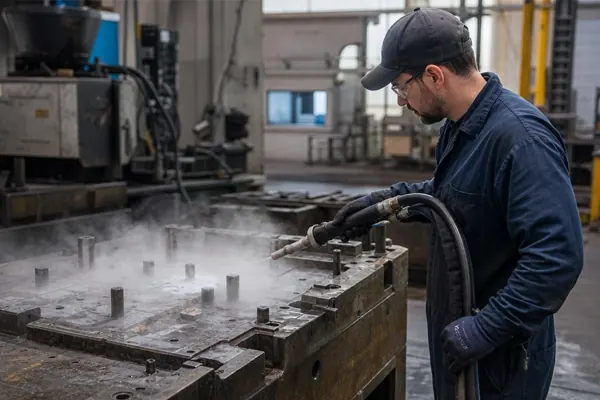
Most mold content is written about attics. This is about production areas, warehouses, and ductwork in the humid Great Lakes climate — where the method's no-chemical, no-moisture profile earns its keep.
Direct Answer: Yes — dry ice blasting is one of the most effective physical removal methods for mold on structural surfaces because it reaches into wood grain and irregular geometry that sanding and scraping miss, adds zero moisture to an already moisture-compromised space, and leaves no chemical residue in production environments. Service-Tech Corporation performs contained, HEPA-managed mold removal via dry ice blasting for Cleveland-area facilities.
Why Is Facility Mold a Different Problem Than Attic Mold?
The ranking content on this topic follows water-damaged houses. An industrial mold problem behaves differently:
- Scale. Roof deck and joist growth across a warehouse bay, not a closet — removal speed per square foot decides feasibility.
- Surfaces. Structural steel, wood decking, concrete, and ductwork interiors — mixed substrates that each punish a one-method approach.
- Occupancy. Production may need to continue in adjacent zones, which makes containment and negative air the heart of the plan, not an add-on.
- Cause profile. Facility mold usually traces to condensation dynamics, humidity load, or envelope leaks in the Great Lakes climate — Cleveland's humid summers and freeze-thaw cycles keep the moisture pressure on.
- Consequences. Product contamination risk, indoor air quality complaints, and audit findings — not just a resale inspection.
Because facility mold so often shows up in and around air systems, this work naturally pairs with duct system cleaning under Service-Tech's industrial cleaning programs — remediating the growth and cleaning the conveyance system that spread the spores in one engagement.
How Does Dry Ice Blasting Compare to Sanding, Soda Blasting, and Chemicals?
| Factor | Dry ice blasting | Sanding / scraping | Soda blasting | Chemical treatment |
|---|---|---|---|---|
| Reaches wood grain and irregular surfaces | Yes — gas-expansion action works into texture | No — flat-surface tool | Yes | Surface wetting only |
| Adds moisture | None | None | None | Yes — into a moisture problem |
| Secondary waste | Removed mold only (HEPA-captured) | Dust + abrasive | Large soda volumes to clean up | Chemical runoff/residue |
| Residue in production space | None | Dust | Alkaline residue (can harm nearby surfaces/processes) | Chemical film |
| Speed at facility scale | Strong | Slow, labor-heavy | Moderate | Fast to apply, doesn't remove growth |
| Removes the growth physically | Yes | Partially | Yes | No — kills but leaves material in place |
The last row matters more than buyers expect: dead mold is still allergenic material and still an audit finding. Physical removal is the standard remediation frameworks point toward, with chemical biocides as an adjunct rather than the fix.
Where Does Blasting Fit in a Full Remediation Protocol?
Dry ice blasting is the removal step, not the whole remediation. A defensible industrial project — consistent with the IICRC S520 framework professional remediators work to — runs like this:
- 01
Assessment and moisture correction
Find and fix the water or humidity source first; blasting mold while the cause persists buys a repeat project.
- 02
Containment
Poly isolation of the work zone, negative air with HEPA filtration, and controlled entry/exit so spores don't migrate to production areas.
- 03
Removal by blasting
CO2 pellets strip growth from steel, wood, and concrete — including joist edges, fastener heads, and grain texture that defeat sanding — with no added moisture.
- 04
HEPA recovery
Dislodged material is captured by HEPA vacuuming within containment; debris leaves in sealed bags.
- 05
Cleaning and verification
HEPA vacuum and damp-wipe of the zone, then post-remediation verification per your protocol — visual, and third-party testing where your program requires it.
- 06
Documentation
Photos, scope records, and disposal notes for your EHS file and any downstream audit.
Why Does This Matter Now in Cleveland?
Humid summers, condensation-prone roof decks, and buildings that alternate between heating and cooling seasons make Northeast Ohio facilities structurally friendly to mold — especially warehouses with marginal ventilation and any space downstream of a roof leak. The operational trigger is usually one of three: an IAQ complaint cluster, a customer or insurance audit, or discovery during another project. A facility-scale removal method that works dry, contains its own debris, and doesn't chemical-load a production environment is the difference between a scheduled remediation and a disruptive one — and it's why blasting-based removal has become the industrial default within Service-Tech's industrial cleaning practice.
TL;DR — The Industrial Mold Answer
Dry ice blasting physically removes mold from structural steel, wood, and concrete — including the grain and geometry sanding misses — without adding moisture or chemicals to a production environment. Run it inside a real protocol: fix the moisture source, contain with negative air, blast, HEPA-recover, verify, document. For Cleveland facilities in a mold-friendly climate, it turns remediation into a contained, schedulable project instead of a plant disruption.
Frequently Asked Questions
Does Dry Ice Blasting Kill Mold or Just Remove It?
Its job is removal — physically stripping the growth from the substrate, which is what remediation standards prioritize. Removal beats kill-in-place because dead mold left on surfaces remains allergenic and remains visible to auditors. Where your protocol calls for an antimicrobial step afterward, it's applied to a surface that's actually clean.
Will Blasting Spread Spores Through My Facility?
Not when the job is containment-first: poly isolation, negative air with HEPA filtration, and HEPA vacuum recovery at the point of work. Blasting outside containment is the amateur error — it's also why mold work should go to crews that treat containment as step one, not an option.
What Does Industrial Mold Removal Cost?
Mold projects fall under Service-Tech's dry ice blasting line, starting at a $2,000 minimum engagement, with the quote driven by affected area, containment complexity, access, and verification requirements — scoped free on a walkthrough. Pairing removal with duct system cleaning in one program is common and mobilization-efficient.
The Mechanism, and Its Limits
Dry ice removes mould growth from a surface mechanically: the pellet arrives at −109 °F, embrittles and shrinks the growth so it fractures off, and sublimates on impact — expanding up to 800 times in milliseconds — lifting the material clear without water. That matters because moisture is what fed the growth in the first place. At 1.5–2 on the Mohs scale the medium does not abrade the substrate. Two limits are worth stating plainly: it removes what is on the surface, not what has penetrated porous material, and because sublimated CO2 gas settles low, an enclosed space is ventilated and monitored throughout. Removal without fixing the moisture source is a temporary result.