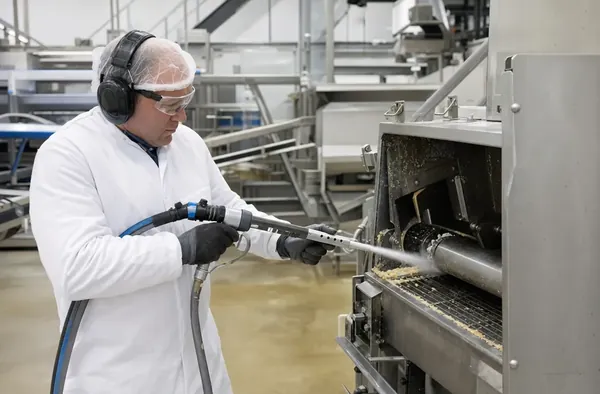
No water, no chemical residue, no drying time — how CO2 cleaning fits inside a sanitation window, written for the plant sanitation manager who owns the master schedule.
Direct Answer: Food processing plants choose dry ice blasting because it removes baked-on production residue without water, chemicals, or abrasive media — so dry zones stay dry, allergen changeovers leave nothing behind, and equipment returns to production as soon as removed debris is vacuumed away. Service-Tech Corporation delivers dry ice blasting to Ohio food manufacturers, with food plant sanitation projects starting at a $1,375 minimum.
What Makes CO2 Cleaning Compatible With a Food Plant?
Dry ice blasting uses food-grade CO2 pellets that strike the surface, embrittle and fracture the residue, and sublimate to gas on impact. Nothing wet touches the equipment, nothing chemical needs rinsing, and no blasting media remains to migrate into product zones. The equipment industry notes CO2's regulatory acceptance as a cleaning medium in food environments; what a sanitation manager verifies on the floor is simpler — after the blast, there is contaminant in the vacuum and clean metal on the line.
Why Do Wet Methods Fight Your Sanitation Program?
Chemical washdown and steam are proven tools, but each carries a built-in conflict with modern food-plant realities:
| Factor | Dry ice blasting | Steam / hot water | Chemical washdown |
|---|---|---|---|
| Moisture introduced | None | Significant | Significant |
| Residue left behind | None | Water | Chemical film requiring rinse |
| Dry-zone compatible | Yes | No | No |
| Electrical / control panels | Yes (de-energized) | No | Limited |
| Allergen changeover fit | Dry removal, vacuum capture | Water spreads residue | Rinse validation required |
| Downtime profile | Blast, vacuum, inspect, restart | Drying hours before restart | Apply, dwell, rinse, dry |
Moisture is the quiet enemy: it feeds microbial growth in the harborage points wet cleaning can't reach afterward, and it rules out cleaning anywhere near electrical cabinets, control panels, and dry-ingredient zones. A dry process deletes that entire category of risk.
How Does Dry Ice Blasting Fit an SQF or BRC Audit?
Auditors don't score cleaning methods; they score control and documentation. Dry ice blasting slots into a GFSI-style program (SQF, BRC) as a documented deep-cleaning task on the master sanitation schedule:
- Master sanitation schedule entry. Blast cleaning of ovens, conveyors, mixers, or framework becomes a scheduled MSS task with defined frequency, not an ad-hoc fix.
- Method documentation. The contractor's scope, containment plan, and post-clean photos become the verification records your program requires.
- Allergen program support. Dry removal with HEPA vacuum capture supports changeover cleaning where water-based methods complicate validation.
- Contractor control. Crews working under your GMP, hygiene, and zoning rules — a conversation to have at scoping, not on blast day.
Which Ohio Food Manufacturers Does This Fit?
Northeast Ohio's food cluster — dairies, bakeries, snack producers, and beverage plants concentrated around the Cleveland area — shares one operating constraint: production schedules leave short, fixed sanitation windows, often overnight. That constraint is exactly where dry ice blasting outruns wet methods: no dwell time, no rinse cycle, and no drying hours means the whole window goes to actual cleaning. Typical high-value targets are baked-on oven and pan residue, conveyor framework and drive components, mixer exteriors and framework, and dust or residue accumulation on overhead structure — the deep-cleaning tasks that defeat a nightly washdown crew. Service-Tech runs this work as part of its industrial cleaning portfolio, and has serviced food facilities among the 100,000+ facilities cleaned since 1960.
How Do You Prep a Line for a Blast During a Sanitation Window?
A checklist the sanitation manager can lift directly:
- 01
Walk the scope in advance
Estimator and sanitation lead agree on exactly which equipment, which contaminant, and which finish standard — before the window opens. The estimate is free.
- 02
Lock the window
Confirm start/stop times, including lockout-tagout of target equipment and de-energizing any electrical items in scope.
- 03
Define the zones
Mark what's product-contact-adjacent, what needs masking or poly containment, and where the vacuum recovery perimeter sits.
- 04
Brief both crews
Your sanitation team and the blast crew coordinate — who cleans what, in what order, and who signs off.
- 05
Verify and document
Post-blast inspection against the agreed standard, photos into the sanitation record, equipment released back to production.
TL;DR — The Case in Brief
Dry ice blasting gives food plants a deep-cleaning method with no water, no chemical residue, and no drying downtime — compatible with dry zones, allergen changeovers, and de-energized electrical equipment, and documentable within SQF/BRC-style programs. For Ohio manufacturers running tight overnight sanitation windows, the practical win is time: the entire window goes to cleaning instead of dwell, rinse, and dry. Service-Tech prices food plant sanitation from a $1,375 minimum with free estimates.
Frequently Asked Questions
Is Dry Ice Blasting Approved for Food Plants?
CO2 is widely accepted in the food industry as a cleaning medium, and crews use food-grade pellets with vacuum capture of removed residue. Method acceptance in your plant runs through your food safety plan — which is why scope, zoning, and documentation are agreed with your QA team before work begins.
Can It Be Used in Dry-Ingredient and Allergen-Sensitive Areas?
That's where it shines. The process introduces no moisture and leaves no cleaning-agent residue, so dry zones stay dry, and removed material — including allergen residue — is captured by HEPA vacuum rather than pushed around by water. Changeover verification stays your program's call; the method just stops adding variables to it.
What Does Food Plant Cleaning With Service-Tech Cost?
Food plant sanitation projects start at a $1,375 minimum, with the final quote scaled to scope, containment, and the sanitation window — priced free after a walkthrough. Dry ice blasting engagements more broadly start at a $2,000 minimum; bundling both in one mobilization is often the efficient buy.