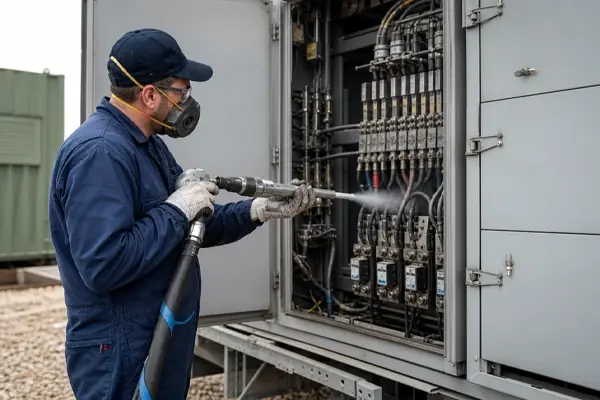
Non-conductive is not the same as "blast it live." A practitioner's honest guide to cleaning switchgear, MCCs, transformers, and control panels — including the jobs we turn down.
Direct Answer: Yes — dry ice blasting is the preferred deep-cleaning method for electrical equipment because CO2 is non-conductive and the process introduces zero moisture, but professional practice is to clean de-energized equipment under lockout/tagout. Service-Tech Corporation's dry ice blasting services clean switchgear, MCC buckets, transformers, and control panels during planned outages across Ohio, Florida, and Arkansas.
Non-Conductive vs. "Safe on Energized Equipment" — What's the Honest Distinction?
Marketing pages lean hard on "non-conductive," and the physics is real: solid CO2 is a dielectric medium, and the process leaves no conductive residue or moisture. But a blast job is more than the medium — it's a metal nozzle, a human operator, dislodged conductive dust, and vibration, all near buswork. That's why the practitioner's answer splits in two:
- The medium is electrically safe. No moisture, no conductive media, no residue — the reason dry ice displaced solvents and can reach places compressed-air-and-rag never could.
- The work is performed de-energized. Equipment is locked out and verified dead before cleaning, consistent with NFPA 70E's principle that work proceeds on de-energized equipment unless infeasible — and cleaning is virtually never infeasible to schedule. Claims of routine energized blasting deserve skepticism, not admiration.
The honest pitch isn't "we can blast it live." It's "we can clean gear thoroughly enough, and dry enough, that your outage window is all it takes."
Why Does Moisture-Free Cleaning Matter So Much for Electrical Gear?
Contamination on electrical equipment — dust, oil mist film, carbon tracking residue — degrades insulation performance and traps heat. The traditional cleanup options all fight the equipment:
| Method | The electrical problem it creates |
|---|---|
| Water / steam | Moisture in windings and insulation; drying delays; re-test before re-energize |
| Solvent wipe-down | Residue films, limited reach into buckets and buswork, disposal burden |
| Compressed air alone | Redistributes conductive dust instead of removing it |
| Abrasive media | Conductive grit embedded in insulation — a failure seeded, not cleaned |
| Dry ice blasting | None of the above: dry, residue-free, contaminant captured by vacuum |
Because nothing wet touches the equipment, insulation resistance isn't compromised by the cleaning itself — gear can be inspected, megger-tested, and returned to service within the same outage.
What Electrical Equipment Is Cleanable — and What Do We Decline?
| Equipment | Cleanable with dry ice? | Conditions |
|---|---|---|
| Switchgear and buswork | Yes | De-energized, locked out; vacuum recovery of dislodged dust |
| MCC buckets | Yes | Buckets racked out where design allows; parameters tuned to components |
| Transformers (dry-type exteriors, radiators) | Yes | De-energized; careful standoff around bushings and connections |
| Control panels and PLC cabinets | Yes | Power off; sensitive boards shielded; low-aggression parameters |
| Motors (frames, fan covers, exteriors) | Yes | De-energized; bearings and openings protected |
| Energized equipment of any class | Declined | Rescheduled to an outage window — the professional answer |
| Sealed electronics / fragile boards under load | Case-by-case | Evaluated at walkthrough; sometimes hand-cleaning is the right call |
A contractor willing to say "no" at the walkthrough is the one to trust with your switchgear. This work is part of Service-Tech's industrial cleaning portfolio, and it's a natural bundle with plant-wide outage work for Cleveland-area facilities.
How Does a Switchgear Cleaning Actually Run?
- 01
Walkthrough during operation
Estimator and your electrical lead identify gear, contamination, outage constraints, and any equipment that stays energized elsewhere in the room. Free estimate follows.
- 02
Outage coordination
Cleaning is scheduled into your planned outage; scope is sequenced so the highest-priority gear is cleaned first if the window compresses.
- 03
Lockout and verification
Equipment locked out and verified de-energized before covers open.
- 04
Blast and recover
Low-aggression parameters, tuned standoff, HEPA vacuum capturing dislodged dust as it's freed — not after it settles back inside the gear.
- 05
Inspect, test, close
Visual inspection, your team's electrical testing, covers on, locks off — gear back in service the same window.
TL;DR — The Straight Answer
Dry ice blasting is the right way to deep-clean electrical equipment: non-conductive, moisture-free, residue-free, with contaminant captured rather than relocated. The professional line is bright — the medium is electrically safe, and the work is still done de-energized under lockout/tagout, per NFPA 70E thinking. Switchgear, MCCs, transformer exteriors, and control panels are routine; energized blasting is a decline. Plan it into an outage window and the gear comes back clean, dry, and testable within that same window.
Frequently Asked Questions
Why Not Just Blow It Out With Compressed Air?
Compressed air relocates conductive dust — into bearings, deeper into buckets, onto adjacent gear — and leaves the oily film that binds new dust in place. Dry ice removes the film and the dust, and the vacuum recovery captures it, which is the difference between cleaning equipment and redistributing its problems.
What If Our Equipment Can't Be De-Energized?
Then cleaning waits for a window when it can be — and a good contractor helps you plan that window rather than improvising around live buswork. Critical facilities handle this with sequenced outages: clean half the lineup on one window, half on the next. We'd rather lose a job than blast energized gear.
What Does Electrical Equipment Cleaning Cost?
It falls under Service-Tech's dry ice blasting line, which starts at a $2,000 minimum engagement; a full electrical-room scope (switchgear lineup, MCCs, panels) is quoted free after a walkthrough. Bundling the electrical room with other outage cleaning is the usual way plants maximize the mobilization.
What "Safe on Electrical" Requires in Practice
The medium being non-conductive is necessary, not sufficient. Panels and switchgear are de-energised, locked out and tagged before anything is blasted. Components that must not be hit are masked, and cable entries are shrouded so dislodged debris does not migrate. Sublimated CO2 gas is denser than air and settles into the lowest part of the room, so an enclosed switchroom is ventilated with forced air exhausting from the low point, and oxygen and CO2 are metered continuously rather than checked once at the door. The pellets embrittle and fracture the deposit off the substrate at −109 °F, and because they leave as gas there is nothing conductive left behind to sweep out of a live cabinet afterwards.