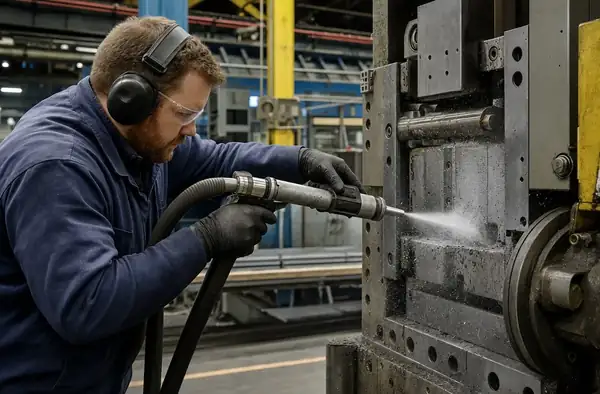
In-place cleaning, no secondary waste, and shorter shutdowns — the case Northeast Ohio plant managers are acting on, from a Cleveland industrial cleaner founded in 1960.
Direct Answer: Cleveland-area manufacturers are switching to dry ice blasting because it cleans production equipment in place — no disassembly, no water, no chemical residue, and no spent blasting media to dispose of — which turns multi-day cleaning shutdowns into hours. Service-Tech Corporation provides dry ice blasting services across Northeast Ohio from its Cleveland headquarters, with projects starting at a $2,000 minimum engagement.
What Makes Dry Ice Blasting Different From the Methods Cleveland Plants Already Use?
Dry ice blasting propels soft CO2 pellets at the contaminated surface with compressed air. On impact, the pellet's cold makes the contaminant brittle, the impact fractures it, and the pellet instantly sublimates — flashes from solid to gas — popping the contaminant off the surface. The pellet itself disappears. What's left on your floor is only the removed contaminant, which vacuums up.
For a working plant, three consequences matter more than the physics:
- No secondary waste. Sandblasting a production line generates a large volume of contaminated spent media that must be swept, contained, and disposed of. Dry ice leaves none.
- No moisture. Unlike steam or pressure washing, there is nothing to dry, nothing to rust, and no washdown water to manage — which is why electrical gear and food lines are the classic applications.
- Non-abrasive on substrates. Dry ice is far softer than sand or grit media, so machined surfaces, molds, and wiring survive cleaning that abrasive media would erode.
Which NE Ohio Industries Are Switching — and Why?
The Cleveland-Akron corridor remains one of the country's dense manufacturing regions, and the switch to CO2 cleaning maps to the region's actual industry mix:
| NE Ohio industry | Traditional method | Why plants switch to dry ice |
|---|---|---|
| Automotive suppliers (stamping, molding, weld cells) | Solvent wipe-downs, media blasting with teardown | Cleans tooling and robotic cells in place; no grit embedded in machined surfaces |
| Food and beverage plants | Chemical washdown, steam | No water or residue in dry zones; fits inside a sanitation window |
| Plastics and rubber molders | Manual scraping of molds | Removes release-agent buildup without dimensional wear on mold cavities |
| Foundries and heavy industry | Grit blasting, manual chipping | No spent-media disposal; reaches equipment that can't be moved to a blast room |
The common thread is downtime. Every traditional method carries a hidden second job — disassembly, drying, or media cleanup — and that second job is usually what stretches a cleaning from a shift into a shutdown.
What Does a Cleveland-Area Blast Job Actually Look Like?
A typical Service-Tech dry ice blasting project in Northeast Ohio runs as a planned, contained operation, not a guy with a hose:
- 01
Site assessment and quote
An estimator walks the equipment, identifies contaminant and substrate, and scopes access, containment, and scheduling. The estimate is free.
- 02
Scheduling around production
Work is planned for your maintenance window — nights, weekends, or a planned shutdown — so blasting never competes with production.
- 03
Setup and containment
The crew stages the blasting rig and industrial compressor, establishes ventilation appropriate to CO2 work, and masks or contains adjacent areas as the scope requires.
- 04
Blasting and recovery
Technicians work the surfaces systematically; dislodged contaminant is vacuumed and removed. Because there's no media pile and nothing to dry, equipment can typically be inspected and returned to service the same window.
What Does Dry Ice Blasting Cost in the Cleveland Market?
Service-Tech dry ice blasting projects start at a $2,000 minimum engagement, which covers mobilizing a trained crew, the blasting rig, compressor, and CO2 pellets to your site. Beyond the minimum, the quote scales with contaminant, substrate, access, containment, and hours of operation — not with a per-square-foot rate card. Travel is factored into the quote across the 150-mile service radius from the Cleveland office, so plants from Lorain to Youngstown see one number, not a number plus mileage.
Why Choose a Multi-Service Cleveland Contractor Over a Blasting-Only Specialist?
Most dry ice blasting providers serving Cleveland do one thing. That's fine — until your facility also needs its ductwork, kitchen exhaust, or cooling tower handled, and you're managing three vendors, three insurance files, and three sets of site-safety onboarding. Service-Tech delivers dry ice blasting as part of a full industrial cleaning scope: one vendor, one mobilization, one accountability chain — from a company that has been cleaning Northeast Ohio facilities since 1960, holds a 4.9 rating across 111 Google reviews, and fields 50+ technicians. For plant managers, the practical win is bundling: a crew already on site for duct or tower work can add a blast scope at a fraction of a standalone mobilization. Learn more about our Cleveland operations.
TL;DR — The Switch, Summarized
Dry ice blasting wins in NE Ohio manufacturing because it deletes the hidden second job in every cleaning: no disassembly, no drying time, no spent-media disposal. Auto suppliers, food plants, molders, and foundries are using it to compress cleaning shutdowns into maintenance windows. Service-Tech Corporation delivers it from Cleveland with a $2,000 minimum engagement, free estimates, and the option to bundle blast work with duct, hood, and tower cleaning under one vendor.
Frequently Asked Questions
Does Dry Ice Blasting Require a Full Plant Shutdown?
Usually not. Because the process is dry and generates no media spray beyond the work zone, crews typically isolate and contain the target area while surrounding production continues. Full-line work is scheduled into your existing maintenance windows.
Is Dry Ice Blasting Safe for Machined and Delicate Surfaces?
Yes, when parameters are set correctly. CO2 pellets are much softer than abrasive media, and pressure and pellet size are tuned to the substrate — aggressive enough to lift the contaminant, gentle enough to leave tooling, molds, and wiring unmarked.
How Far From Cleveland Does Service-Tech Travel for Blast Work?
Service-Tech serves a 150-mile radius from every office, which from Cleveland covers essentially all of Northeast Ohio and beyond — Akron, Canton, Youngstown, Mansfield, and the lake counties — with travel factored into the project quote.
The Numbers Behind the Method
Three published properties explain the result. The pellet arrives at −109 °F, which embrittles and shrinks the deposit so it fractures off rather than being scrubbed away. It sublimates on impact, expanding up to 800 times within milliseconds, and that phase change does most of the lifting. And at 1.5–2 on the Mohs scale it is softer than the steel or aluminium beneath, so the substrate keeps its finish — where silica sand, at around 7, cuts a profile as it cleans (dry ice figures per Cold Jet). Because the CO2 gas is denser than air and settles low, enclosed spaces are ventilated and the atmosphere monitored throughout.