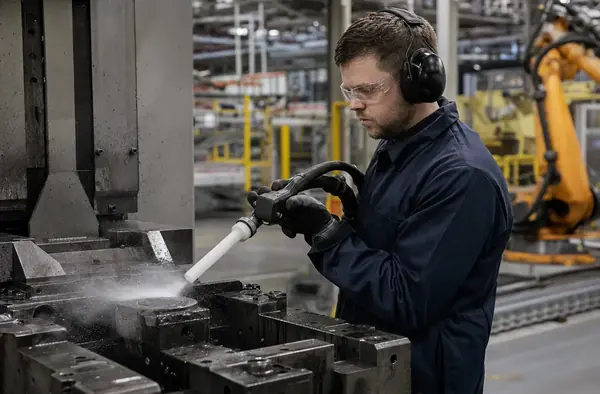
Adhesive, sealant, and paint-booth residue — removed from tooling and weld cells in place, without masking, without media, and without missing an OEM delivery window.
Direct Answer: Automotive manufacturers use dry ice blasting to strip adhesive, sealant, weld spatter, and paint-booth residue from tooling and production equipment in place — no disassembly, no abrasive damage to machined surfaces, no media cleanup — which is why Northeast Ohio's tier 1 and tier 2 suppliers schedule it into maintenance windows instead of extended shutdowns. Service-Tech Corporation provides dry ice blasting to automotive plants across the Cleveland-Akron corridor from its Cleveland headquarters.
Where Does Dry Ice Blasting Work Inside an Automotive Plant?
The equipment makers publish OEM-scale case studies; here's the same application map organized the way a supplier's maintenance planner thinks:
| Plant area | Contaminant | What blasting achieves |
|---|---|---|
| Paint booths and grates | Overspray buildup | Restores surfaces and airflow without solvent soak or scraping |
| Robotic weld cells | Weld spatter, sealant drift | Cleans fixtures and dress packages in place — no cell teardown |
| Molds and dies (plastics, rubber, stamping) | Release agents, outgassing residue, adhesive | Cleans in the press at operating temperature, preserving tolerances |
| Dispensing and sealing lines | Cured adhesive and sealant | Removes buildup from nozzles, fixtures, and framework |
| E-coat and conveyor systems | Drips, overspray, process residue | Cleans chain, hangers, and framework without media contamination |
| Control panels and drives | Dust, oil mist film | Moisture-free cleaning of de-energized electrical equipment |
Why Do Adhesives and Sealants Respond So Well to CO2?
Adhesive removal is dry ice blasting's signature automotive application for a physical reason: polymers embrittle in extreme cold. At roughly -109°F, the pellet stream drops the adhesive below its brittle point, the impact fractures it, and the sublimation burst pops the fragments off the substrate — while the steel or aluminum underneath, which doesn't embrittle at these temperatures, is unaffected. Cured structural adhesives, sealant drift, and release-agent glaze that resist scraping and solvents come off layer by layer without loading the surface with grit.
Two practical bonuses the spec sheets undersell: no solvent purchase and disposal on the back end, and no masking marathon — because the process doesn't erode substrates, machined locating surfaces and sensor faces don't need to be protected the way they would against abrasive media.
How Does In-Place Cleaning Change the Downtime Math?
For a supplier on OEM delivery schedules, cleaning method is really a downtime decision. The teardown path — disassemble the cell or pull the tooling, clean it on a bench, reassemble, re-qualify — costs production hours at every step, and the re-qualification step carries scrap risk. The in-place path is shorter: lockout the cell, blast, vacuum the debris, inspect, release.
Scope during production.
The estimator walks the cells while they run; the plan and free estimate are ready before the window opens.
Clean during the window.
Weekend or between-shift work; the crew brings rig, compressor, and pellets, and works cell by cell.
Restart without re-qualification drama.
Tooling never moved, so datums never moved — inspection confirms clean, and the line resumes.
Why Does This Matter Specifically to NE Ohio's Supply Chain?
The Cleveland-Akron-Lordstown corridor carries one of the country's dense automotive supplier concentrations — stamping, molding, and assembly-support plants feeding OEM programs. Supplier economics amplify the downtime argument: margins are set by program contracts, delivery penalties are real, and most plants can't bank inventory to cover an extended cleaning shutdown. A cleaning method that lives inside existing maintenance windows isn't a nicety — it's the only kind that fits the calendar. Service-Tech serves these plants from its Cleveland headquarters with a 150-mile radius, as part of an industrial cleaning portfolio that can also cover the plant's ducts, exhaust, and towers in the same vendor relationship. More dry ice blasting guides live on the blog.
TL;DR — For the Maintenance Planner
Dry ice blasting removes adhesive, sealant, spatter, and overspray from automotive tooling and cells in place: cold embrittles the polymer, impact fractures it, sublimation lifts it — and the substrate, datums, and schedule survive intact. For NE Ohio suppliers, that converts cleaning from a shutdown project into a maintenance-window task. Scoped free, priced from a $2,000 minimum, delivered from Cleveland.
Frequently Asked Questions
Can You Blast Robotic Cells Without Damaging Sensors and Cables?
Yes — parameters are the point. Pellet size, pressure, and standoff distance are tuned per surface, and sensitive components are shielded or worked around rather than blasted at production settings. The crew's walkthrough identifies sensor faces, cable dress, and connectors before the first pellet flies.
Does the Equipment Have to Be Powered Down?
Production equipment in scope is locked out and electrical equipment is de-energized before cleaning — standard practice for crew and equipment safety. The scheduling impact is minimal because the work is planned into windows where the cell is down anyway.
What Does Automotive Blast Work Cost?
Service-Tech dry ice blasting projects start at a $2,000 minimum engagement, with quotes scaled to contaminant, cell count, access, and window length — scoped free on a walkthrough. Multi-cell programs and bundled scopes (booth + cells + panels in one mobilization) price more efficiently than one-off visits.