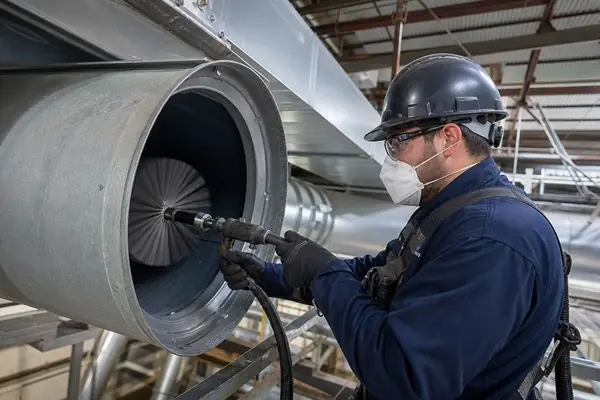
The internet compares residential to commercial and stops. If you run a plant, warehouse, or processing facility, the tier that matters is the one nobody writes about.
Direct Answer: Commercial air duct cleaning serves occupied buildings — offices, retail, schools — where the contaminant is ordinary dust; industrial air duct cleaning serves production environments where ducts carry weld smoke, oil mist, process residue, or combustible dust, and requires heavier extraction equipment, confined-space-capable crews, and compliance-grade documentation. If your building has a production floor, you likely need industrial air duct cleaning, not a scaled-up office service.
Why Does the SERP Only Compare Residential and Commercial?
Because most duct cleaning companies grew out of residential work, their content compares the two markets they serve — homes and offices — and treats "commercial" as the top tier. For a facility manager in Cleveland's manufacturing corridor, that framing hides the decision that actually matters: within non-residential work there are two distinct tiers, and hiring the wrong one wastes money in one direction and creates risk in the other.
The Three Tiers Compared
| Residential | Commercial | Industrial | |
|---|---|---|---|
| Typical buildings | Homes, small multifamily | Offices, retail, schools, medical office | Manufacturing plants, food processing, foundries, warehouses with process activity |
| Contaminant | Household dust, pet dander | Occupant dust, fiber, renovation debris | Weld fume, oil mist, combustible dust, process residue, heavy particulate |
| System scale | Single furnace/AC, small ducts | Rooftop units, AHUs, VAV distribution | Makeup air, process exhaust, dust-collection ducting, walk-in trunk ducts and plenums |
| Access method | Floor registers, small cuts | Access panels, ceiling work, some lift work | Manual entry into ducts, lift and high work, confined-space entry procedures |
| Extraction equipment | Portable vacuum units | Truck-mounted or large portable negative air with HEPA | Plant-scale HEPA negative air machines, industrial compressors, specialty collection |
| Scheduling constraint | Homeowner convenience | After-hours to avoid occupants | Shift coordination, lockout/tagout, shutdown windows, production containment |
| Documentation | Invoice | Service report | ACR-referenced report with photos suitable for compliance and audit files |
| Governing framework | NADCA consumer guidance | NADCA ACR | NADCA ACR plus NFPA combustible-dust housekeeping, OSHA exposure context |
What Defines the Industrial Tier the SERP Ignores?
Four markers reliably separate an industrial job from a commercial one — use them to classify your own facility:
- The contaminant is process-generated. If what lines your ducts came from what you make — weld smoke, machining oil mist, flour or plastics dust, coating overspray — you are in the industrial tier regardless of building type. Combustible dust in particular changes everything: accumulation in ducts is a deflagration hazard governed by NFPA's dust standards, and removal method and documentation must reflect that.
- The system is plant-scale. Makeup-air units, process exhaust runs, and trunk ducts large enough that the only honest way to clean them is a technician physically inside with a HEPA vacuum — what the trade calls manual entry.
- The work environment is controlled. Lockout/tagout on fans and dampers, confined-space entry permits where duct dimensions and configuration require them, and containment engineered so dislodged material never reaches product or production areas.
- The paperwork has an audience. Industrial reports get read — by EHS, by food-safety auditors, by insurers. Photo documentation and exception reporting are deliverables, not extras.
How Do Equipment and Crews Differ?
The visible difference on job day is the hardware and the habits. A commercial crew arrives with negative-air collection, rotary brushes, and air whips sized for VAV distribution — appropriate tools for occupant-dust systems. An industrial crew adds plant-scale HEPA-filtered negative air machines rated for large duct volumes, industrial compressors driving heavier agitation tools, degreasing capability for oil-mist and residue chemistry, lift equipment for high runs, and — critically — people: technicians trained for confined-space entry with attendants and rescue planning, supervisors who run lockout/tagout as routine, and crew discipline built for active plants rather than empty offices. Equipment lists are easy to pad in a proposal; crew capability is what you should interview for. Ask a bidder when their technicians last physically entered a duct, and what their confined-space procedure is. The answer sorts the tiers fast.
Which Tier Does Your Cleveland Facility Need? A Decision Guide
Walk this sequence — it resolves nearly every facility:
- 01
Does any part of the building generate process contaminants?
Welding, machining, grinding, powder handling, cooking at scale, coating, woodworking. Yes → industrial tier for the systems serving those areas. No → continue.
- 02
Do any ducts serve dust-collection or process-exhaust functions?
Yes → industrial tier for those systems, whatever the rest of the building needs.
- 03
Are any duct sections walk-in scale?
Trunk lines and plenums a person can enter need manual-entry cleaning — an industrial-tier capability even in an otherwise commercial building (hospitals and universities hit this constantly).
- 04
Is the driver compliance or audit-facing?
Combustible-dust housekeeping, food-safety audits, healthcare infection-control projects → industrial-tier documentation even where contamination is moderate.
- 05
None of the above?
Your building is a commercial-tier job: standard occupied-building HVAC hygiene under the NADCA ACR model — see our commercial air duct cleaning service.
Mixed facilities are the Cleveland norm: an office block on the front of a production building. The correct answer is a split-scope quote — commercial methods for the office systems, industrial methods for the plant systems — from one contractor who can do both, so the tiers meet in one report.
How Does Pricing Differ Between the Tiers?
Commercial air duct cleaning from Service-Tech Corporation starts from $1,375; industrial projects are quoted after a site walk because the cost drivers are project-specific — contamination class, duct scale and access, containment level, lift requirements, and shutdown-window scheduling. The honest general rule: industrial work costs more per system because it carries more equipment, more procedure, and more documentation, and any bidder quoting a plant over the phone without a walk-through is guessing with your compliance file.
TL;DR — The Difference in Four Sentences
Commercial duct cleaning handles occupant dust in offices, schools, and retail; industrial duct cleaning handles process-generated contamination — weld fume, oil mist, combustible dust — in plant-scale systems, with confined-space-capable crews, plant-scale HEPA extraction, and audit-grade documentation. Classify your facility by contaminant source, system scale, and who reads the report, not by square footage. Mixed office-plus-plant buildings should be quoted as split scopes by one contractor. Service-Tech Corporation, a NADCA member since 1990, performs both tiers across Northeast Ohio from its Cleveland headquarters — more duct cleaning guides are on our blog.
Frequently Asked Questions
Is a warehouse commercial or industrial for duct cleaning purposes?
It depends on what happens inside. A distribution warehouse moving sealed goods is usually a commercial-tier job. A warehouse with charging stations producing dust, packaging lines, woodworking, or any powder or process activity moves toward the industrial tier for the systems serving those areas. The contaminant source decides, not the building label.
Can one contractor handle both commercial and industrial duct cleaning?
Yes, if it genuinely carries both capability sets — plant-scale negative air, confined-space entry procedures, lockout/tagout discipline, and audit-grade reporting alongside standard commercial methods. Mixed facilities benefit from one contractor quoting a split scope so both tiers land in a single coordinated report.
Does industrial duct cleaning cost more than commercial?
Generally yes on a per-system basis, because it carries heavier equipment, more procedural overhead (permits, lockout, containment), and compliance-grade documentation. Commercial cleanings from Service-Tech Corporation start from $1,375; industrial projects are quoted after a site walk because contamination class and access drive the price.
Where the Physical Methods Diverge
Both follow source removal, but the tooling and the tolerances differ. Commercial work is mostly bare metal and lined runs in occupied buildings: brushes agitate, whips handle liner, and the negative-air unit extracts under HEPA capture at 99.97% at 0.3 micron. Industrial work adds process residue, heavier gauge duct, and often manual entry, where a technician works inside the run rather than through an access door. Both are swabbed and weighed against the NADCA figure of 0.75 mg per 100 cm²; both borescope what cannot be reached; both open the plenum and fan housing. The difference is that an industrial system frequently needs encapsulation or resurfacing decisions a commercial one does not.
The Figures Both Jobs Share
- The same acceptance test. 0.75 mg per 100 cm² on the NADCA Vacuum Test applies whether the building is an office or a foundry.
- The same capture requirement. HEPA at 99.97% of particles at 0.3 micron, under continuous negative pressure.
- Different intervals. Annual on air handling units against every 1–2 years on ductwork; industrial systems with process loading move faster than that.
- Different reassembly. MERV 8 or better is the commercial baseline; an industrial system is filtered to its process, not to a table.
- The shared economic figure. The U.S. Department of Energy attributes 25–40% of commercial heating and cooling energy to contamination and airflow restriction.