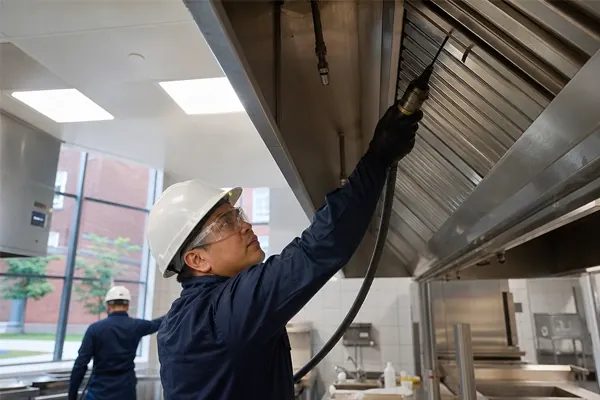
A campus is not one restaurant — it is a dozen kitchens on four schedules with one facilities contact. Here is how Cleveland institutions keep them all compliant.
Direct Answer: University campuses should manage hood cleaning as one multi-site program, not a dozen separate vendor calls: a single certified contractor covering every venue, cleanings mapped to the academic calendar and each kitchen's NFPA 96 frequency class, and consolidated reporting the fire marshal and risk office can audit. Service-Tech Corporation provides that model through its commercial kitchen exhaust hood cleaning service for Cleveland-area institutions.
What Makes Campus Hood Cleaning Different From a Restaurant?
A standalone restaurant has one hood system, one schedule, and one owner watching it. A university has residential dining halls, retail food courts, faculty clubs, athletics concessions, catering kitchens, and sometimes teaching kitchens — each with its own exhaust system, cooking profile, and NFPA 96 frequency class, spread across buildings of different ages with wildly different duct configurations and roof access.
That produces three problems restaurant-focused advice never addresses: fragmented compliance (five venues current, two overdue, nobody holding the master schedule), mismatched frequency classes (the charbroiler-heavy grill in the student center is quarterly while the low-volume faculty club kitchen is annual), and audit exposure — when the campus fire marshal or the institution's insurer asks for cleaning documentation, "each dining vendor handles their own" is not an answer that survives scrutiny.
Cleveland-area institutions — from major universities and their satellite campuses to K-12 districts running central and building kitchens — face exactly this multi-kitchen, one-facilities-contact structure.
Which NFPA 96 Frequency Class Does Each Campus Venue Fall Into?
Frequency follows cooking type, and a campus usually spans the full table:
| Campus Venue Type | Typical Cooking Profile | NFPA 96 Inspection Frequency |
|---|---|---|
| Wood-fired pizza or smoker station | Solid-fuel cooking | Monthly |
| Main dining hall grill lines, wok stations, high-throughput operations | High-volume cooking | Quarterly |
| Full-service retail venues, catering kitchens | Moderate-volume cooking | Semi-annually |
| Faculty club, chapel or seasonal kitchens, low-use satellite venues | Low-volume cooking | Annually |
The practical implication: a blanket "every kitchen twice a year" policy is simultaneously over-servicing your low-volume venues and under-servicing your grill lines. A program contract should assign each venue its own class after an initial site assessment — and revisit classes when dining concepts change, because swapping a salad concept for a charbroil concept moves that hood from semi-annual to quarterly.
How Do You Schedule Cleanings Around the Academic Calendar?
This is the operational detail generic hood-cleaning pages miss entirely: on a campus, when matters as much as how often. A sample annual program calendar for a Cleveland institution:
| Window | What Gets Cleaned | Why This Window |
|---|---|---|
| Winter break (mid-Dec–mid-Jan) | Residential dining halls — full-system cleanings | Halls are dark; crews work days instead of overnight; no service disruption |
| Spring break | Quarterly-class venues due; catch-up deficiencies from winter reports | Short closure window fits quarterly touch |
| Pre-season (Aug) | Athletics concessions and stadium kitchens | Systems verified before the first home event, not after |
| Summer break (May–Aug) | Everything else: retail venues, faculty club, teaching kitchens; access-panel installs and fan repairs | Longest window for capital-adjacent work; buildings accessible |
| Fall/spring terms | Quarterly-class venues on their in-term dates — overnight work | High-volume venues cannot wait for breaks; NFPA 96 does not pause for finals |
Two scheduling rules from field experience: quarterly-class venues will need in-term overnight cleanings, so require a contractor that actually staffs overnight campus work; and put athletics concessions on the calendar by season, not by NFPA class alone — a system that sat idle since November should be inspected before it runs a sold-out opener.
Who Manages the Program — Facilities or the Dining Vendor?
Both models exist, and the failure mode is the seam between them. When a contract dining provider (self-op or a national food-service company) "handles hood cleaning," the institution still owns the building, the fire code liability, and the insurance relationship — so facilities should, at minimum, hold copies of every service report, control the master schedule, and set the vendor-qualification standard (IKECA membership or equivalent certification, full-system scope, photo documentation). The cleanest structure Cleveland institutions use: facilities holds the hood-cleaning contract directly and back-charges or coordinates with dining, so one office sees every sticker and every deficiency note.
How Do Universities Bid Hood Cleaning? The Procurement Angle
Public institutions in Ohio typically must competitively bid service contracts above statutory thresholds, and private institutions usually run RFPs for multi-site work anyway. What belongs in a campus hood-cleaning RFP — and what facilities directors most often leave out:
- Venue-by-venue scope schedule — every hood system listed with its NFPA 96 class, rather than "campus dining facilities" as one line
- Certification requirements — IKECA membership or equivalent, with named, currently certified supervising technicians
- Documentation deliverables — before/after photos including duct interiors and fans, exception-documented reports, stickers per NFPA 96, and a consolidated compliance summary to facilities each term
- Certificates of insurance at institution-required limits, naming the institution, before mobilization
- Academic-calendar scheduling commitment — break-window work for residential dining, overnight capability in term
- Deficiency handling — how missing access panels, damaged filters, and fan issues get reported, priced, and closed out
- Prevailing wage and campus-access compliance — background-check, badging, and any applicable public-work wage requirements stated up front
A bid that cannot itemize by venue and class is a bid that was priced by guesswork — and it will be re-priced, in change orders, on your budget.
How Is Campus Hood Cleaning Priced?
Multi-site programs are priced from the venue schedule: system count and size, frequency class per venue, access difficulty, and whether work falls in break windows (day rates) or term time (overnight). Service-Tech Corporation's kitchen exhaust hood cleaning starts from $599 per cleaning, with program pricing set after a campus walk-through of every venue — the same site-assessment discipline we apply to single restaurants, multiplied across the schedule. Travel is factored into quotes.
What If One Kitchen Falls Behind?
The overdue venue is the one that shows up in the fire marshal's file and the insurer's post-loss review. A missed quarterly on a grill line is not a paperwork lapse — it is an extra term of grease load on a high-volume system, often in a building where students sleep upstairs. Program-level tracking exists precisely so no single venue can silently fall through: one master schedule, one report archive, one contractor accountable for the whole map. Institutions pairing cleanings with broader code documentation can add our NFPA 96 compliance cleaning program to keep classes, access panels, and records aligned campus-wide.
TL;DR — Campus Hood Cleaning in Five Lines
Treat campus hood cleaning as one program: every venue inventoried, each assigned its NFPA 96 class (monthly solid-fuel, quarterly high-volume, semi-annual moderate, annual low-volume), and cleanings mapped to the academic calendar — dining halls over breaks, concessions before season, quarterly venues overnight in term. Facilities should hold the master schedule and every report even when a dining vendor operates the kitchens. Bid it with a venue-by-venue scope schedule and certification, documentation, and insurance requirements written in. Service-Tech Corporation has served institutional kitchens across Northeast Ohio since 1960 — see our Cleveland service page or more guides on the blog.
Frequently Asked Questions
Can all campus kitchens be cleaned on the same schedule?
No — NFPA 96 sets frequency by cooking type, so a single campus typically spans monthly (solid fuel), quarterly (high-volume grill and wok lines), semi-annual (moderate-volume venues), and annual (low-volume kitchens) classes. A program contract assigns each venue its own class after assessment instead of applying one blanket interval.
Should hood cleaning happen during breaks or during the term?
Both. Residential dining halls and low-frequency venues are ideally cleaned during winter and summer breaks when buildings are dark, but quarterly-class venues fall due mid-term and must be cleaned overnight — NFPA 96 frequencies do not pause for the semester. Your contractor needs both day break-window capacity and in-term overnight capability.
Who should hold the hood cleaning contract — the university or its dining vendor?
The institution owns the buildings, the fire-code liability, and the insurance relationship, so facilities should at minimum control the master schedule, vendor qualifications, and the report archive. Many institutions hold the contract directly and coordinate with the dining vendor, ensuring one office sees every service record and deficiency.
How a Campus Job Is Actually Run
A dining hall gives you one window, usually between close and prep. Crews isolate the section being worked, pull and soak the baffle filters rather than wiping them in place, shroud the fan before wash-down, and scrape the hardened deposit mechanically before any degreaser goes on. Runoff is squeegeed to containment instead of the nearest drain, accessible stainless is polished, and everything is reinstated and test-run before the kitchen reopens. Where a duct run has no access panel, doors are fitted on a separate visit — nobody cleans what they cannot reach.