No OSHA rule says "clean your ducts." The real levers are the general duty clause, substance-specific exposure limits, and NFPA's combustible-dust standards — here is how they actually reach your ductwork.
Direct Answer: OSHA has no specific indoor-air-quality or duct-cleaning standard for manufacturing — the compliance pressure on dirty ductwork comes indirectly, through substance-specific permissible exposure limits, the general duty clause, and NFPA combustible-dust housekeeping requirements that insurers and fire officials enforce. Duct condition is evidence in all three conversations, which is why plants build cleaning into their programs through services like Service-Tech Corporation's industrial air duct cleaning.
What Does OSHA Actually Require? The Framing Most Articles Get Wrong
Plenty of duct-cleaning marketing implies an "OSHA IAQ standard" exists. It does not — OSHA has never promulgated a general indoor-air-quality rule — and a facility manager who repeats that claim in a budget meeting will lose credibility with their own EHS team. The real regulatory levers are narrower and, in practice, stronger:
- Substance-specific PELs. OSHA's air-contaminant limits (the 29 CFR 1910.1000 Z-tables and substance-specific standards for materials like hexavalent chromium in weld fume or respirable crystalline silica) cap what workers may breathe. Ventilation systems that re-entrain settled contaminants back into work areas work against your exposure controls — and exposure monitoring results near supply outlets are exactly the kind of evidence that turns a duct question into a citation question.
- The general duty clause. Section 5(a)(1) of the OSH Act requires a workplace free from recognized hazards. Recognized industry standards — NFPA's combustible-dust documents chief among them — are how "recognized" gets defined. A dust-laden ventilation system in a plant that grinds, welds, or handles powders is a textbook general-duty exposure.
- NFPA combustible dust (652, now consolidated into NFPA 660). Not OSHA rules, but enforced through fire officials, insurers, and OSHA's general-duty mechanism. They require a dust hazard analysis (DHA) and housekeeping that controls accumulation on all surfaces — explicitly including hidden ones like duct interiors, with action commonly keyed to accumulation layers as thin as a thirty-second of an inch over meaningful areas.
- Ventilation design standards (ANSI/ACGIH industrial ventilation practice). These govern how systems should perform; fouled ducts degrade the capture and containment performance your exposure-control plan assumes.
The honest summary: nobody will cite you for "dirty ducts." They will cite you for exposures, recognized dust hazards, or a DHA follow-through gap — and your ductwork will be the exhibit.
What Do Cleveland's Manufacturing Processes Actually Put in Ductwork?
Northeast Ohio's plant mix produces distinct contaminant classes, each with its own duct consequence:
| Process (NE Ohio Examples) | Duct Contaminant | Compliance Driver | What It Does in the Duct |
|---|---|---|---|
| Welding and thermal cutting (auto supply, fabrication) | Condensed metal fume, oily haze | Substance-specific PELs (e.g., hexavalent chromium in stainless work); general duty | Fine adherent film that re-entrains easily; loads general ventilation far from the source |
| Machining and forming | Oil mist, metal fines | PELs for mineral-oil mist; fire loss history | Combustible oily coating on duct interiors; fouls coils and filters fast |
| Foundry and metals processing | Silica-bearing and metallic dust | Respirable crystalline silica standard; general duty | Heavy, abrasive loading; settles in horizontal runs and low-velocity sections |
| Plastics, woodworking, composites | Combustible dust | NFPA 652/660 housekeeping via DHA | Hidden accumulation = deflagration fuel; duct interiors named in the DHA |
| Food and powder handling | Organic combustible dust | NFPA dust standards + sanitation schemes | Dual finding: fire code and food-safety audit in the same duct |
| Coating and finishing | Overspray residue, VOC condensate | PELs; fire code | Sticky residue that binds subsequent dust into compacted layers |
The pattern worth noticing: in every row, the duct is downstream evidence of how well source capture is working. Cleaning restores the baseline; fixing chronic loading usually also means a conversation about capture and filtration.
When Does Duct Condition Become a Compliance Problem?
Four scenarios recur across Cleveland plants:
- 01
The DHA names your ducts and nobody follows through
Dust hazard analyses routinely flag duct interiors and overhead surfaces; the finding sits in the report while housekeeping handles floors. The gap between the DHA and the housekeeping program is where citations and insurer findings live.
- 02
Exposure monitoring turns up a mystery
Sampling shows elevated results in areas away from any source — because the ventilation system is redistributing settled contaminant. The industrial hygienist's report puts your ducts in writing.
- 03
The insurer walks the plant
Property carriers' loss-control engineers increasingly check combustible-dust housekeeping, including above ceilings and at duct access points. Findings become recommendations; ignored recommendations become premium and coverage conversations.
- 04
Something happens
A small fire, a puff event, a product-contamination episode — and the investigation opens the ductwork. Post-incident is the most expensive possible time to learn what your ducts contained.
The inexpensive version of all four is the same: documented inspection on a schedule, cleaning when conditions require it, records that show the program existed before anyone asked.
How Does Duct Cleaning Fit Into a Combustible-Dust Housekeeping Program?
For dust-generating plants, duct cleaning is not an IAQ nicety — it is DHA follow-through. The integration checklist:
- Name duct interiors explicitly in the written housekeeping program, with inspection points and frequency — silence about hidden surfaces is the most common program gap
- Key action to accumulation criteria from the applicable NFPA standard rather than to visual disgust; thin layers over large areas are the hazard, not visible piles
- Use cleaning methods rated for the dust. Combustible dust demands appropriately rated vacuums and grounded, spark-conscious practice — never dry sweeping or compressed-air blowdown that suspends a dust cloud
- Document removal, not just inspection: photos before and after, quantities where practical, exceptions noted — the record is the compliance product
- Close the loop to the DHA: cleaning results feed the next DHA revision, and chronic re-loading triggers the capture-and-filtration conversation upstream
Service-Tech Corporation executes this work under NADCA ACR source-removal methodology — a NADCA member since 1990 — with the containment, lockout, and confined-space discipline manufacturing systems require, including manual entry through walk-in trunk lines.
Who Should Do the Work — and What Does It Cost?
Vet industrial bidders on four points: NADCA credentials and ACR method statements; combustible-dust competence (ask how they equip and ground for it — the answer separates industrial crews from office cleaners immediately); plant discipline (lockout/tagout, confined-space procedures, shift coordination); and documentation quality your EHS team can file. Pricing follows a site walk: commercial air duct cleaning starts from $1,375 as the baseline, and manufacturing systems quote above it based on contamination class, access, and containment. Estimates are free; travel is factored into quotes. Mixed campuses can scope office-side systems against our commercial air duct cleaning service.
TL;DR — The Compliance Truth in Five Lines
There is no OSHA duct-cleaning rule: the levers are substance-specific PELs, the general duty clause informed by recognized standards, and NFPA combustible-dust housekeeping (652/660) that reaches hidden surfaces including duct interiors. Cleveland's process mix — weld fume, oil mist, silica dust, plastics and food powders — loads ducts in ways that show up in exposure monitoring, insurer walkthroughs, and DHA follow-through gaps. Put duct interiors in the written housekeeping program, inspect on schedule, clean by documented source removal, and keep the records. Service-Tech Corporation has done this work for Cleveland manufacturers since 1960 — more compliance guides are on our blog.
Frequently Asked Questions
Will OSHA cite a plant for dirty air ducts?
Not for the dirt itself — for what it implicates: exposures above substance-specific limits, or a recognized combustible-dust hazard under the general duty clause. In practice the citation path runs through exposure monitoring results, a dust hazard analysis finding without follow-through, or a post-incident investigation. Documented duct housekeeping is how plants stay off all three paths.
Do NFPA combustible dust rules really apply to ductwork?
Yes — the housekeeping requirements cover dust accumulation on all surfaces, and hidden surfaces like duct interiors, cable trays, and above-ceiling spaces are called out precisely because they are where unmanaged accumulation hides. Action thresholds are keyed to thin layers over meaningful areas, and your dust hazard analysis should name the duct systems in scope.
Is duct cleaning worth it if our source capture is poor?
Do both, in order: clean the ducts to remove the existing hazard and establish a documented baseline, then address capture and filtration so the loading rate drops. Cleaning alone in a plant with failing source capture buys time, not resolution — a good assessment will tell you honestly which situation you have.
How the Work Is Physically Done
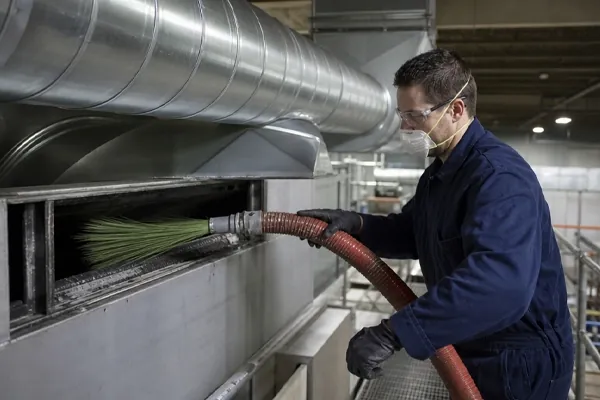
Contamination is dislodged and extracted simultaneously: brushes agitate bare metal, compressed-air whips work lined runs, and the system stays under continuous negative pressure with HEPA capture throughout, so what comes loose leaves the building instead of settling on the plant floor. Crews borescope the runs first, swab and weigh a sample against the NADCA acceptance figure, and open the plenum, drain pan and fan housing rather than stopping at the grilles. A delaminating liner is encapsulated or replaced. Coil fins are straightened, panels reinstated, and the system pressurized and tested before it is handed back.