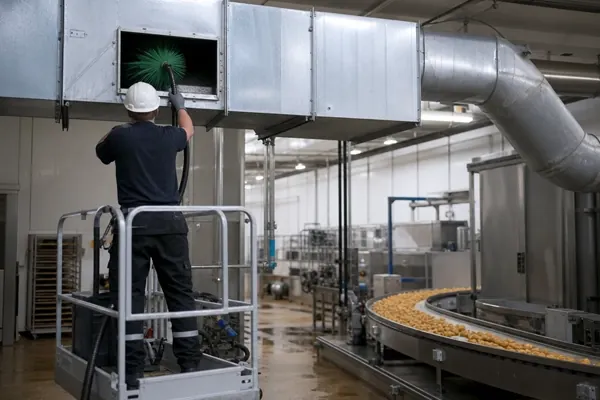
The SERP explains duct design and FDA air rules. Nobody explains the service itself — how cleaning actually gets executed inside a running food plant. That is this article.
Direct Answer: Air duct cleaning in a food processing plant is a sanitation-controlled version of NADCA-standard source removal: food-safe methods and containment designed so nothing dislodged reaches product zones, scheduling built around production and washdown windows, and documentation formatted for your FSMA and audit files. Service-Tech Corporation performs this work across Ohio's food industry as part of its industrial air duct cleaning service.
Why Is There a Service-Provider Gap on This Topic?
Search this question and you will find mechanical contractors explaining hygienic duct design, filter vendors explaining FDA air requirements, and janitorial firms explaining floor-level sanitation. What is missing is the practitioner's account of the service: what a duct-cleaning crew actually does inside a food plant, how the work coexists with production, and what paper it must leave behind. That gap exists because few duct cleaners work in food environments — the containment, scheduling, and documentation burden filters out generalists.
Where Does Duct Condition Show Up in Your Compliance Stack?
Ductwork is rarely named outright in food regulation — it arrives through four doors, and knowing which door matters for your plant tells you what your cleaning documentation must satisfy:
| Framework | What It Requires | How Ducts Enter the Finding |
|---|---|---|
| FDA / FSMA (21 CFR Part 117, subpart B) | Current good manufacturing practice: adequate ventilation, plant maintained in sanitary condition, protection of food from contamination including drip and condensate | Dusty or condensate-bearing ducts over exposed product zones; ventilation blowing contaminants toward food-contact surfaces |
| GFSI audit schemes (SQF, BRCGS) | Documented environmental and overhead sanitation programs, maintenance hygiene, risk-based cleaning schedules | Auditor observes overhead accumulation or asks for the air-handling cleaning schedule and records — and there aren't any |
| Customer audits | Customer-specific sanitation expectations, often stricter than the schemes | Duct grilles and returns photographed during plant tours; corrective-action requests naming air handling |
| NFPA combustible dust (652/660) | Housekeeping control of dust accumulation, including hidden surfaces, driven by your dust hazard analysis | Flour, sugar, starch, and powder-handling ducts as unmanaged fuel — a fire-code finding inside a food-safety facility |
The practical translation: your duct program needs a written schedule, execution records with photos, and a method statement showing food-safe practice — because the finding is almost never "ducts are dirty"; it is "no program exists."
What Makes Food-Plant Duct Cleaning Different From Standard Industrial Work?
Four disciplines separate a food-plant duct job from the same work in a machine shop:
- Containment is absolute, not incidental. Negative-air capture with HEPA filtration, physical isolation of the work zone from production and exposed product, and sequencing that never opens duct above uncovered lines. In a machine shop, escaped dust is rework; in a food plant it is potential adulteration.
- Chemistry is restricted. Degreasers and cleaning agents must be appropriate for food-facility use, applied so no residue migrates to food-contact surfaces, with product documentation available for your chemical-control program.
- The crew follows plant GMPs. Captive or covered clothing, tool control, no wood or glass in production zones, hygiene-zone discipline moving between raw and RTE areas — a crew that has to be taught your GMPs on arrival is a crew that will generate its own audit finding.
- Verification is documented like sanitation, not like HVAC. Post-cleaning photos at reference points, sign-offs usable in your master sanitation schedule, and exception notes for anything inaccessible — written for an auditor's eyes, not a maintenance file.
How Does the Work Get Executed Around Production?
The scheduling problem is the real craft. A working sequence for an Ohio plant:
- 01
Pre-job sanitation planning
Scope walked with QA and maintenance together: which systems serve which hygiene zones, where exposed product runs, what the washdown calendar allows. The cleaning plan is written into those constraints — zone by zone, never plant-wide-at-once.
- 02
Scheduling into dark windows
Work lands in sanitation windows, weekend shutdowns, or seasonal breaks. Systems over exposed-product areas are cleaned only when lines below are down, cleared, or protected — and the plan documents which condition applied.
- 03
Isolation and lockout
Fans locked out, duct sections isolated, work zones barriered with negative air holding the pressure gradient toward the cleaning containment, away from production.
- 04
Source removal with food-safe methods
Mechanical agitation and HEPA-filtered collection; restricted-chemistry degreasing where grease or residue requires it; debris bagged and removed through agreed routes — never through production corridors during runs.
- 05
Verification, release, and records
Post-cleaning inspection with photos, work-zone teardown and cleaning, QA walkthrough before the zone is released back to production, and a documentation package delivered for the sanitation and audit files.
What About Ohio's Food-Manufacturing Base Specifically?
Ohio runs one of the country's larger food-manufacturing footprints — dairies, bakeries, meat and poultry processors, snack and beverage plants — concentrated along the same corridors Service-Tech has served since 1960. Two Ohio-relevant notes from field experience: bakery and powder-handling environments should treat duct interiors as part of their combustible-dust housekeeping program, not just their sanitation program; and washdown-intensive plants load ducts differently than dry plants — humidity plus organic dust is a microbial substrate, which moves duct inspection onto the same risk-based calendar as your environmental monitoring.
Who Should Perform Food-Plant Duct Cleaning?
Three qualifications, in order: NADCA credentials (the ACR standard is your method baseline — Service-Tech Corporation has been a NADCA member since 1990); demonstrable food-environment experience (ask how the bidder handles hygiene zones, chemical control, and QA release — generalists reveal themselves in one conversation); and documentation practice that matches your audit scheme. A cheap generalist crew inside a food plant is not a savings; it is an adulteration risk with a mop.
What Does It Cost?
Food-plant duct projects are quoted after a site walk with QA and maintenance, because hygiene zoning, containment level, and scheduling windows drive cost more than duct footage. Commercial air duct cleaning starts from $1,375 as a baseline reference; food-production systems price above it in proportion to the containment and documentation burden. Estimates are free, and travel is factored into quotes. Comparable non-food facilities can scope against our commercial air duct cleaning page.
Audit-Prep Checklist: Air-Handling Items to Verify Before Your Next Audit
- A written, risk-based duct and air-handling cleaning schedule exists in your sanitation program
- Last cleaning records on file: report, photos, method statement, chemical documentation
- Overhead and grille condition visually acceptable in exposed-product zones — walk it with a flashlight before the auditor does
- Condensate and drip control verified at duct penetrations and diffusers above product
- Dust-generating areas: duct interiors named in the combustible-dust housekeeping program
- Inaccessible sections documented, with access-panel remediation on the capital or maintenance plan
TL;DR — Food-Plant Duct Cleaning in Five Lines
Duct condition reaches food plants through FSMA's sanitation and ventilation provisions, GFSI audit schemes, customer audits, and combustible-dust housekeeping — and the finding is usually "no program," not "dirty duct." The service itself is NADCA source removal under food-plant discipline: absolute containment, restricted chemistry, GMP-compliant crews, zone-by-zone scheduling into sanitation windows, and QA-released, audit-formatted documentation. Build the written schedule, keep the records, and hire crews with food-environment history. Service-Tech Corporation has served Ohio food manufacturers since 1960 — more compliance guides are on our blog.
Frequently Asked Questions
Does FDA require food plants to clean their air ducts?
Not by naming ducts — FSMA's current good manufacturing practice provisions (21 CFR Part 117, subpart B) require adequate ventilation, sanitary plant conditions, and protection of food from contamination, including drip and condensate. Duct condition becomes an FDA issue when accumulation or condensate threatens product zones, and an audit issue when no documented program exists.
Can duct cleaning happen while the plant is producing?
Zone by zone, yes — with isolation, negative-air containment holding pressure away from production, and hard rules about never opening duct above exposed product. Systems over open lines are cleaned only in sanitation windows or shutdowns. The sequencing is designed with QA in the pre-job planning stage, not improvised on the night.
What documentation should a duct cleaning leave in my audit file?
A service report identifying systems cleaned and methods used, before-and-after photos at reference points, documentation for any chemicals applied, exception notes for inaccessible sections, and a QA release record. Formatted well, it slots directly into your master sanitation schedule records and answers the auditor's question before it is asked.
The Physical Method Inside a Running Food Plant
Source removal to the NADCA ACR standard means the contaminant is dislodged and extracted at the same moment: rotary brushes agitate bare metal, compressed-air whips work lined runs more gently, and the system is held under continuous negative pressure through HEPA capture at 99.97% of particles at 0.3 micron so nothing released reaches a product zone. Crews borescope runs beyond arm's reach before quoting, swab and weigh a sample against the ACR acceptance figure of 0.75 mg per 100 cm², and open the air-handler plenum, drain pan and fan housing — the components that foul fastest. A liner shedding under light pressure is encapsulated or replaced, never brushed. Coil fins are straightened back to plane, and every panel is reinstated and the system pressurized before handover.
The Figures to Write Into a Food-Plant Specification
- Acceptance. No more than 0.75 mg of residue per 100 cm² of duct surface on the NADCA Vacuum Test, documented.
- Capture. HEPA at 99.97% of particles at 0.3 micron on the collection unit, running continuously while the interior is disturbed.
- Interval. Annual on air handling units and every 1–2 years on supply and return ductwork, with ASHRAE 180 as the programme basis.
- Reassembly. MERV 8 or better, with relative humidity held between 30–60% so the system does not re-foul biologically.
- Cleanliness target. One of SMACNA's three levels, named in the scope, so "clean" is specifiable rather than argued about after the fact.
- Code context. NFPA 90A and NFPA 90B govern the installation the cleaning has to leave intact.