800.992.9302

(Updated August 19, 2026)
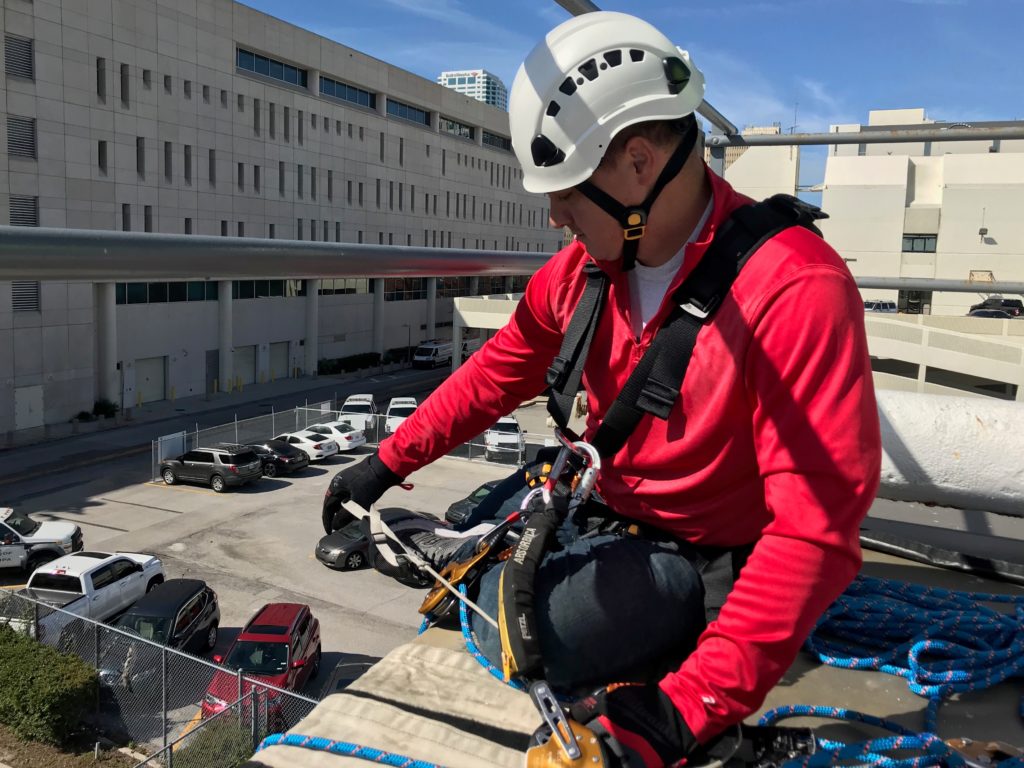
A few weeks ago, six of our Florida-office technicians underwent very specialized Fall Protection Training that goes above and beyond OSHA (Occupational Safety and Health Administration) standards.
Quick Answer: Rope access services use ropes, harnesses, and SPRAT/IRATA-trained technicians to safely reach elevated or hard-to-reach equipment — like rooftop ductwork, cooling towers, and high-rise exhaust systems — without scaffolding or lifts. Service-Tech's technicians are trained above OSHA standards to reach equipment other crews can't.
Rope access services are a method of reaching elevated or hard-to-access equipment using ropes, harnesses, and anchor points instead of scaffolding, ladders, or aerial lifts. Technicians work on a primary rope with a fully independent backup rope, so there are always two separate systems supporting them at height. Because there's no rigging or structure to build, a rope access team can typically be working within hours rather than the days it takes to erect scaffolding.
Service-Tech offers our full range of rope access and facility services to commercial and industrial clients who need equipment reached safely, quickly, and without shutting down the surrounding area.
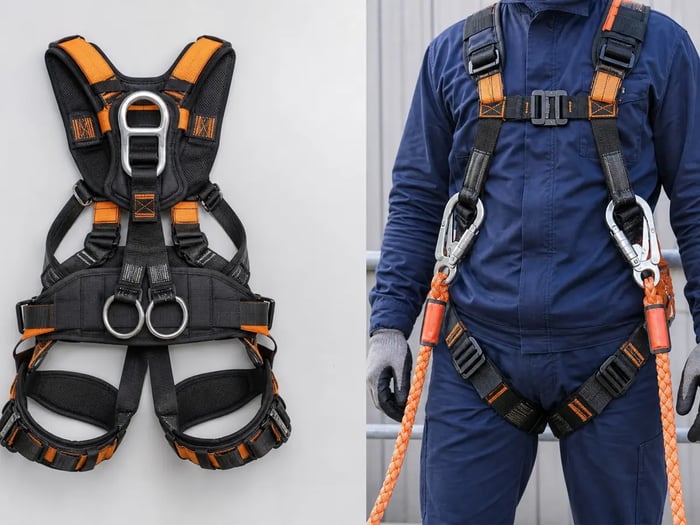
Service-Tech retained nationally known experts to teach our crew new, additional safe practices to reach equipment that is difficult to access.
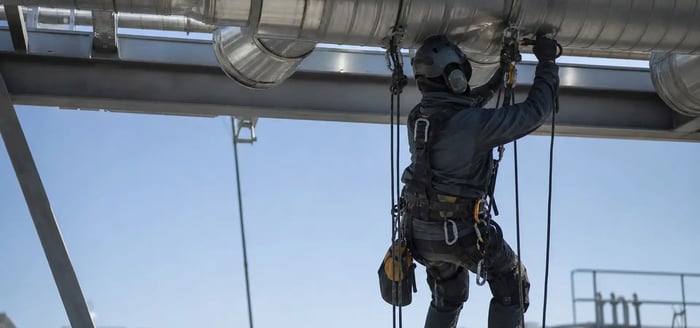
These new Fall Protection skills increase our capabilities in servicing:
Overhead HVAC ductwork |Exposed rooftop ductwork | Dryer vents on high-rise buildings | Hard to reach kitchen and laundry exhaust systems | Cooling towers | Overhead cleaning and painting | Roof fans/ventilators
For facility managers deciding how to reach elevated equipment, the choice usually comes down to three methods: scaffolding, aerial lifts, or rope access. Each has a place, but rope access is often the fastest and least disruptive option for hard-to-reach spots.
| Method | Setup Time | Disruption | Relative Cost |
| Rope Access | Hours | Minimal — small footprint | Lower |
| Scaffolding | Days | High — blocks access, needs permits | Higher |
| Aerial Lifts | Same day | Moderate — needs ground clearance | Moderate |
Worth Knowing: Because rope access technicians can reach equipment without building any structure first, facilities typically see lower total costs and far less downtime compared to scaffolding — especially for one-off or recurring maintenance on equipment that's only accessible a few times a year.
Rope access isn't limited to one type of job. Once a technician is trained and certified, the same ropes-and-harness system can reach almost any elevated point on a facility, including:
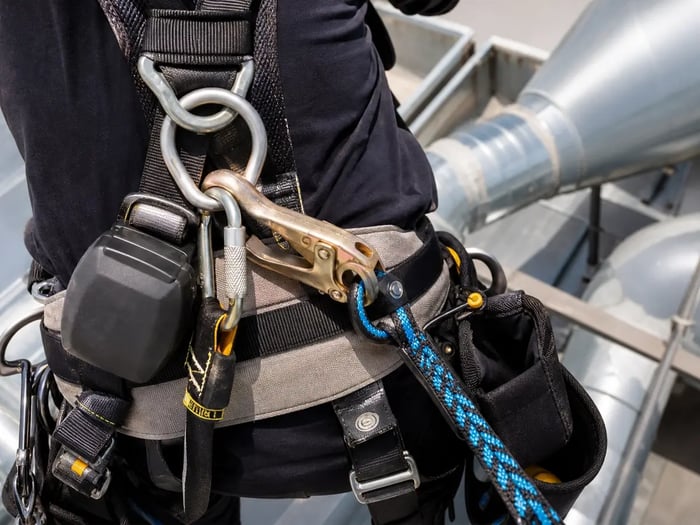
Overhead HVAC ductwork, exposed rooftop ductwork, cooling towers, high-rise dryer vents, and kitchen and laundry exhaust systems are all common jobs for our rope access crews. If your facility has hard-to-reach spots to maintain, rope access is very likely a safer and faster option than scaffolding or lifts.
To learn more about Fall Protection standards and regulations in different industries, click here: https://www.osha.gov/SLTC/fallprotection/.
Ready to get a quote? Service-Tech provides free estimates for rope access services at commercial and industrial facilities nationwide. Request a free estimate or call 866.770.6170.
Paul Keller, Jr.
Project Estimator/Sales/Florida and Southern U.S.
Pkeller2@service-techcorp.com
800.539.7007
Scaffolding requires structural assembly, permits, and days of setup and teardown, which shuts down the surrounding area the whole time. Rope access services use ropes, harnesses, and anchor points instead, so a certified rope access technician can be working within hours with far less disruption to your facility.
Yes. Rope access services follow strict international safety standards, including SPRAT and IRATA certification requirements, and use redundant fall protection systems with a primary rope and a fully independent backup. Reputable providers train technicians above OSHA's minimum standards, not just to them.
Technicians should hold SPRAT (Society of Professional Rope Access Technicians) or IRATA (Industrial Rope Access Trade Association) certification, which requires supervised hours, written exams, and rescue skills at each level before advancing. Service-Tech's crews train beyond OSHA fall protection minimums specifically to reach equipment other methods can't.
Rope access services typically cost significantly less than scaffolding for the same job, since there's no rigging, permitting, or multi-day setup and teardown. The exact savings depend on the height, duration, and complexity of the work, so a facility walkthrough is the most accurate way to compare.
Rope access services are used for overhead HVAC ductwork, exposed rooftop ductwork, cooling towers, dryer vents on high-rise buildings, hard-to-reach kitchen and laundry exhaust systems, roof fans and ventilators, and overhead cleaning and painting — essentially any equipment that's difficult or unsafe to reach with a ladder or lift.
Minimize machine downtime and maintain a clean and safe environment for your employees with an HVAC system cleaning partner backed by a history built on hard work, integrity and a commitment to excellent service. Let’s talk about a cleaner, healthier environment.
