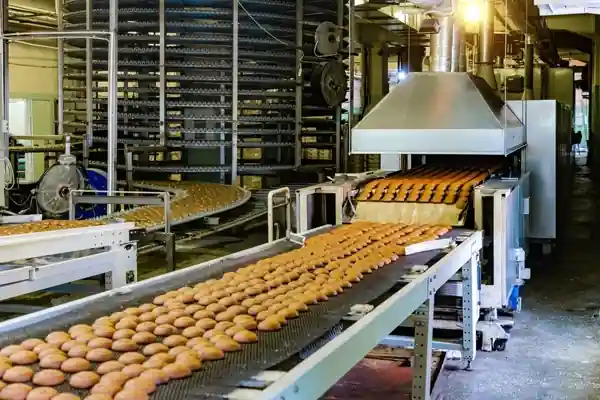
Direct Answer: Industrial oven cleaning is the professional removal of carbonized residue, grease condensate, product buildup, and coating overspray from the interior, conveyors, heating zones, and exhaust paths of production ovens. Left in place, that buildup flakes onto food and coated parts, lowers heating efficiency, and adds fuel inside a hot enclosure. Most plants schedule a deep clean quarterly to annually, depending on run hours and product, and sooner if flaking, smoke, or quality defects show up. Service-Tech cleans ovens dry, using dry ice blasting and mechanical removal, so no water reaches the elements and no chemical residue is left behind.
If you're noticing contamination in your factory's food products or defects in your manufactured goods, a dirty industrial oven may be to blame. As your oven has extended use the food, graphite, condensation, and other baked elements inevitably make their way into its inner parts.
What Are the Signs Your Industrial Oven Needs Cleaning?
In a commercial or industrial setting, a variety of ovens are used for baking food products in mass or curing the ink on manufactured goods, as well as in other purposes. As these ovens are used, condensation builds up and excess product like food and graphite makes its way into the oven machinery.
These are hard-to-reach places and often you will not know they need cleaning until you notice the food and manufactured products you put into your oven beginning to become defective. Watch for these warning signs:
- Black specks or flakes on product: carbonized residue detaching from walls, ceilings, or conveyors and landing on food or finished parts.
- Smoke or a burnt odor at heat-up: residue on or near heating elements burning off as the oven comes to temperature.
- Uneven bake color or cure: buildup insulating surfaces and blocking airflow, so the oven no longer holds its temperature profile.
- Rising reject rates: contamination or defects that cluster after oven runs.
- Visible buildup on conveyors, belts, or exhaust openings: a sign the hidden areas behind the panels are worse.
As such, to avoid these product damages, having regularly scheduled maintenance is optimal. Depending on use, manufacturers often need their ovens cleaned quarterly or yearly. Waiting too long to clean can lead to lost revenue due to damaged products.
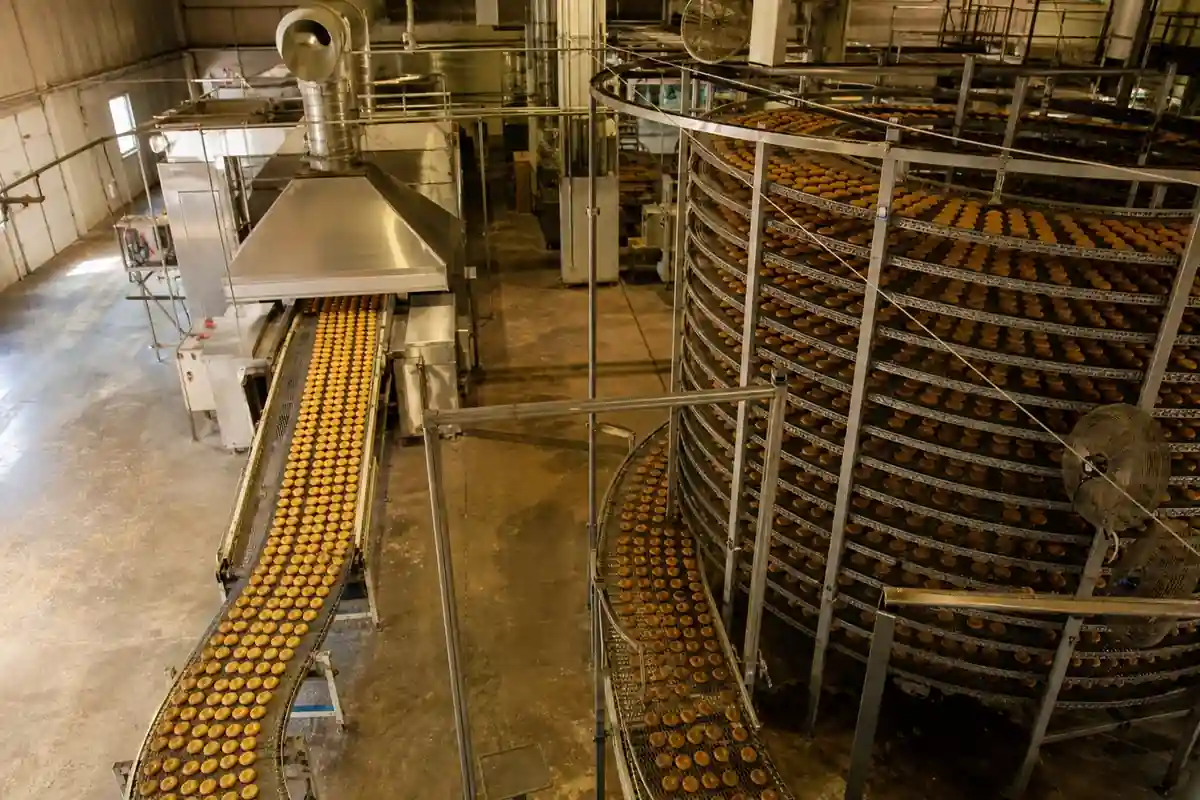
How Often Should an Industrial Oven Be Cleaned?
There is no single schedule for every plant. A professional industrial oven cleaning program is usually built around run hours, the product you bake or cure, and how quickly residue builds up between cleanings. The intervals below are common starting points:
| Usage pattern | Typical deep-cleaning interval | Clean sooner if… |
|---|---|---|
| Continuous or multi-shift production (bakery, coating, or curing lines) | Quarterly | Flaking, smoke at heat-up, or rising rejects appear between cleanings |
| Moderate, single-shift production | Semiannually | The product mix changes or buildup is visible on conveyors |
| Light or seasonal use | Annually | The oven sat idle with residue inside, or before restarting a line |
| Any oven after a smoke event, quality excursion, or major product changeover | At the next shutdown window | Always: these events shouldn't wait for the calendar |
These intervals are general guidance. Your oven manufacturer's recommendations, your insurer, and what inspections find inside the oven should set the actual schedule. Many plants with several ovens rotate them through a recurring program so each one is cleaned during a planned shutdown.
Need industrial oven cleaning? Service-Tech's crews deep-clean ovens dry, inside the maintenance window you already have. Request a free estimate or call 440-735-1505.
How Is an Industrial Oven Professionally Cleaned?
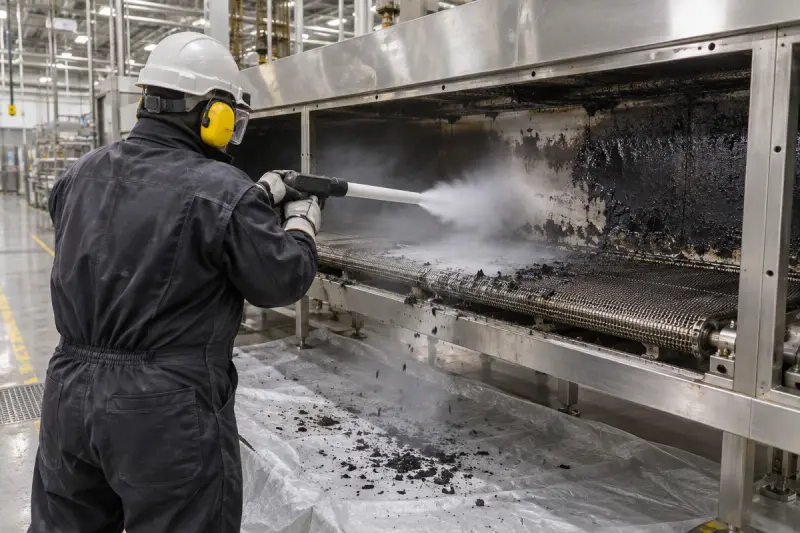
Professional oven cleaning service teams will use various methods to clean your ovens. These will be dependent on the type of oven you have and the types of products you bake in them. For example, chemical cleaners can leave residue that is not suitable for food ovens or cure environments, which is why Service-Tech relies on dry, residue-free methods like dry ice blasting to remove buildup such as graphite waste from manufactured products.
Your service team will need to remove the panels from the oven to access the various components that have gathered product waste and condensation. Dry ice blasting, scraping, and vacuuming are then used on the oven components to get them fully cleaned. Steaming and pressure washing are avoided, because water can damage heating elements, insulation, and refractory.
NOTE: "Industrial ovens have sensitive components that can be damaged if not cleaned and maintained properly. DO NOT attempt to clean your oven in-house without a specialized and experienced crew."
Once cleaned, your service team will reassemble the oven and it will be ready for use again.
Read More – A Complete Guide to Industrial Cleaning
Why Do Professionals Use Dry Ice Instead of Water or Chemicals?
Dry ice pellets lift carbonized and baked-on residue through cold shock and impact, then turn to gas, so there is nothing left to rinse or dry. If you're new to the method, here's how dry ice cleaning works.
- No water near elements or refractory: wet methods can soak insulation, corrode elements, and stress refractory when the oven reheats.
- No chemical residue: nothing is left behind to contaminate the next batch of food or the next cure.
- No blast media to clean up: unlike sand or soda, dry ice leaves no grit lodged in joints, elements, or airflow paths.
- Faster return to service: with nothing to dry or flush, the oven can be closed up and reheated once cleaning and inspection are finished.
Which Safety and Food-Safety Rules Apply to Industrial Oven Cleaning?
Oven cleaning sits where fire safety, worker safety, and food safety overlap. The exact requirements depend on your oven, your industry, and the authorities that oversee your plant, but three frameworks commonly come up:
- Fire safety: NFPA 86, the standard for ovens and furnaces, covers safe operation and maintenance of this equipment, and residue buildup is a fire load that regular maintenance should keep in check. Confirm the edition your insurer and local fire authority use.
- Worker safety: an oven interior is an energy-fed, often confined workspace. Crews should isolate burners, fans, conveyors, and controls under your plant's lockout/tagout procedures before anyone enters, and follow confined-space entry procedures where the configuration requires them.
- Food safety: in food plants, FDA's current good manufacturing practice rules generally require food-contact surfaces to be cleaned as often as needed to protect against contamination, so oven cleaning usually belongs in your wider food plant sanitation program.
A written scope and photo record from each cleaning gives your maintenance file the documentation auditors and insurers often ask for.
What Should You Ask Before Hiring an Oven Cleaning Contractor?
Every oven cleaning bid should answer these questions before work is scheduled:
- What is your energy isolation and entry procedure, step by step?
- Will you use water, steam, or chemicals inside the oven, and why?
- How do you protect food-contact or cure surfaces from residue and blast media?
- Can the job fit inside our planned shutdown or maintenance window?
- Will we get a written scope and photo report for our maintenance file?
Why Choose Service-Tech for Professional Oven Cleaning?
With industrial ovens, you can't afford to not service them properly. These are powerful and complicated pieces of equipment that are the lifeblood of your manufacturing process, which is why oven work is one of the most specialized jobs in the wider field of industrial cleaning.
Service-Tech services a variety of industrial ovens, including:
- Inside Bake Ovens
- Curing Ovens
- Batch Ovens
- Conveyor Ovens
- Pin Ovens
- Wicket Ovens
We specialize in industrial cleaning services like industrial oven cleaning and can provide you with regular cleaning maintenance of all your factory equipment. Reach out to us today for a free quote and get your ovens back to optimal performance.
Frequently Asked Questions
How often should an industrial oven be cleaned?
Most plants schedule industrial oven cleaning quarterly to annually, depending on run hours, the product, and how fast residue builds up. Flaking, smoke at heat-up, or a quality problem is a reason to clean sooner, and inspection findings should set the real interval.
Can you use water or chemical oven cleaner on an industrial oven?
It is generally avoided on production ovens. Water can damage heating elements, insulation, and refractory, and chemical cleaners need rinsing, which brings the water back and can leave residue on food-contact or cure surfaces. Dry ice blasting removes buildup without either problem.
How long does industrial oven cleaning take?
It depends on the oven's size, configuration, and how much buildup is inside. Professional crews plan the work to fit inside an existing shutdown or maintenance window, and the timeline is confirmed after a site assessment.
Is dry ice blasting safe for food production ovens?
Dry ice blasting is widely used in food plants because the pellets turn to gas on impact, leaving no water, blast media, or chemical residue behind. Crews manage ventilation when working inside enclosed oven spaces.
How much does industrial oven cleaning cost?
Industrial oven cleaning is quoted per oven and scope: size, configuration, buildup depth, entry requirements, and the length of your available window all affect the price. Recurring multi-oven programs usually cost less per visit than one-time cleanings. Pricing is general guidance only and can change, so contact Service-Tech for a current, accurate quote.
TL;DR — Industrial Oven Cleaning at a Glance
- Buildup inside industrial ovens flakes onto product, slows heat transfer, and adds fuel to a hot enclosure.
- Warning signs include specks or flakes on product, smoke at heat-up, uneven bake or cure, and rising rejects.
- Most plants clean quarterly to annually; run hours and inspection findings set the real schedule.
- Professional cleaning is dry: dry ice blasting plus scraping and vacuuming, with no water near elements and no chemical residue.
- Crews should follow lockout/tagout and entry procedures and document every cleaning.
- Next step: request a free estimate for industrial oven cleaning.
Related Resources
- Industrial Oven Cleaning
- Industrial & Facilities Cleaning
- Industrial & Facilities Cleaning in Cleveland, OH
- What Is Dry Ice Blasting?
- Dry Ice Blasting for Food Processing Plants
- Combustible Dust Cleaning, Removal & Prevention Guide
- Dry Ice Blasting Cost Guide
About Service-Tech Corporation: Since 1960, Service-Tech Corporation has provided industrial and commercial cleaning, including air duct and HVAC cleaning, kitchen exhaust hood cleaning, cooling tower cleaning, industrial and facilities cleaning, rope access, and dry ice blasting. Offices in Cleveland, Columbus, and Dayton, OH, and Tampa, FL serve facilities across Ohio, Florida, and Arkansas. Call 440-735-1505 or request a free estimate.