800.992.9302

(Updated Sept 7, 2026)
We know that in order to keep your facility running efficiently with few-to-no interruptions, as well as to retain team members and ensure they’re productive and happy, you have to maintain a safe and clean work environment.
One major contributing factor to a poor indoor air environment is a contaminated air duct system.
Quick Answer: Commercial duct cleaning uses NADCA-standard source-removal methods — negative-pressure vacuums paired with mechanical brushing — to strip dust, debris, and contaminants from HVAC ductwork and components. Most facilities need it every three to five years, though food service, manufacturing, and healthcare settings often require more frequent cleaning, and commercial projects typically start between $1,000 and $2,000.
Not only is this adversely affecting your employees’ work performance, but it’s causing absenteeism and resulting in lost productivity for your company. The solution is employing the services of a professional air duct cleaning service. One with the experience, technology, and equipment needed for proper air duct cleaning.
Contaminated air ducts contribute to poor indoor air quality (IAQ). The Environmental Protection Agency (EPA) ranks indoor air pollution (also known as sick building syndrome or SBS) among the top five environmental risks to public health. To improve IAQ in your facility, you need to invest in a professional air duct cleaning service and work with an HVAC system cleaning partner that understands the challenges businesses like yours face and what it takes to keep your environment safe and healthy.
Employers have their own compliance stake in this too: OSHA's indoor air quality guidance and its building operations and management guidance both treat ventilation and duct condition as part of a safe workplace, and the CDC's guidance on improving air cleanliness reinforces the same point for shared indoor spaces. Ventilation itself is governed by its own benchmarks — ASHRAE Standards 62.1 and 62.2 set minimum ventilation rates for commercial and residential buildings, respectively — and a dirty duct system can keep even a well-designed HVAC system from delivering the airflow those standards call for.
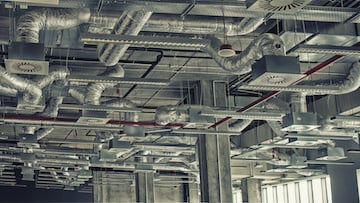
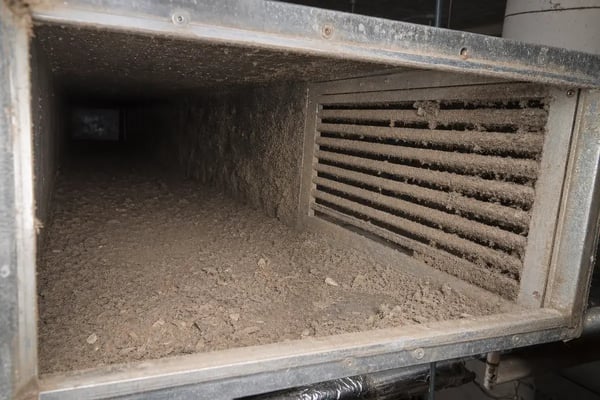
Complete cleaning of your HVAC system is an important aspect of keeping the system operating at peak efficiency. The National Air Duct Cleaners Association (NADCA) sets the industry standard for HVAC cleaning, and when done correctly, HVAC cleaning can have many benefits, including:
Read More – Why Commercial HVAC and Air Duct Cleaning is a Great Investment
Ready to get a quote? Service-Tech provides free estimates for commercial duct and HVAC cleaning at facilities nationwide. Request a free estimate or call 866.215.7150.
Air ducts, like any other HVAC system, require frequent cleaning to ensure maximum efficiency. NADCA recommends air duct cleaning every three to five years.
In some settings, however, the need for air duct cleaning is more immediate. Food manufacturers, for instance, require duct cleaning services on a quarterly, semi-annual and annual basis due to the food particulate they get in their system, leading to mold and pest concerns. The same goes for manufacturing operations that create combustible dust hazards.
Hospitals also need HVAC duct cleaning services on a much more regular basis because they’re concerned about any kind of particulate posing a risk to patients.
The EPA's guidance on residential duct cleaning frequency is far more conservative than any of this, since a typical home never sees the occupancy, system runtime, or industry-specific contamination that drives commercial cleaning schedules.
The air duct cleaning for a small home will often start at $400 while commercial air duct cleaning starts at $1,000 to $2,000 and above.
Depending on the size and scope of your facility, it can take anywhere from one day to a weekend to three or four weeks. A reasonably small office can be cleaned in less than a week or over a weekend.
There are several factors, however, that affect cost and time estimates, such as:
Longer heating and cooling cycles, uneven temperatures between rooms, dust settling faster than usual, and musty odors when the system runs are all common indicators. For a fuller checklist, see 5 warning signs your air ducts need cleaning.
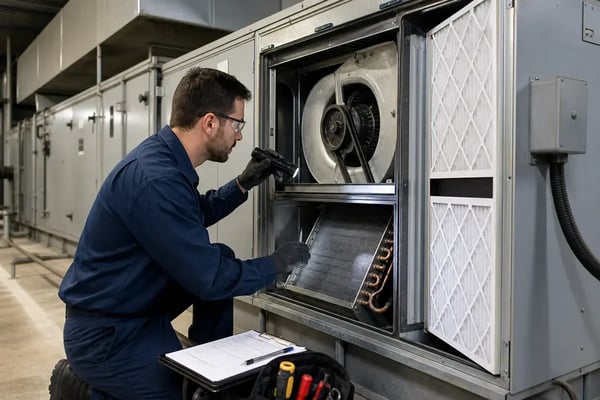
NADCA recommends cleaning the entire HVAC system, including the following components:
NADCA members are accustomed to handling a wide range of projects for commercial and industrial buildings. Because of this, when hiring a NADCA member, a high level of performance should be expected. Not only are technicians required to adhere to industry standards and guidelines, but they’re also expected to inform the client of any obstacles that may prevent them from doing so.
These expectations come directly from NADCA's published standards and publications, which detail the methodology, equipment, and documentation a compliant HVAC cleaning project should follow.
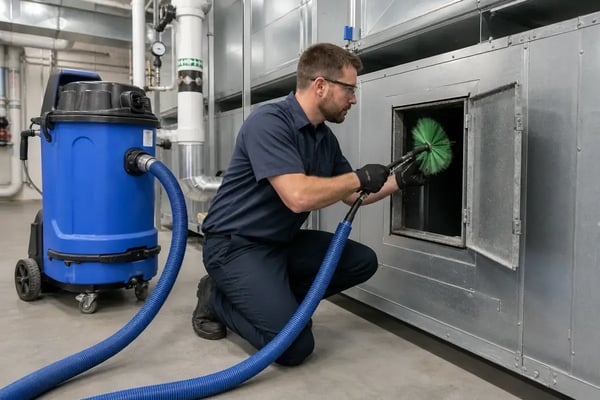
The most effective way to clean air ducts and ventilation systems is to employ source removal methods of cleaning. This requires a contractor to place the HVAC system under negative pressure by using a specialized, powerful vacuum.
While the vacuum draws air through the system, brushes are inserted into the ducts to dislodge dirt and debris that have adhered to interior surfaces. The unstuck dirt and debris travel down the ducts into the vacuum, out of the system and the building.
Cleaning also surfaces problems that go beyond dirt and debris. If a technician finds an air handling unit with worn coils, a failing blower assembly, or corrosion that cleaning alone won't fix, that's a sign it may be time to refurbish or replace an aging air handling unit rather than keep cleaning around the underlying problem.
Use the following checklist as a guide when selecting an HVAC system cleaner:
Ohio facilities can verify a contractor's licensing status directly through the Ohio Construction Industry Licensing Board, and multi-state operators should confirm the equivalent licensing board wherever their facilities are located. Ohio's own Building, Mechanical & Plumbing Code Rules reference these same industry standards when setting HVAC maintenance expectations for commercial structures.
NADCA members sign a code of ethics agreeing to protect the consumer and follow NADCA standards. To be admitted to NADCA, the air duct cleaning company must meet specific stringent requirements, such as employing certified air system cleaning specialists (ASCS).
An ASCS must pass the NADCA certification examination, demonstrating extensive knowledge in HVAC design and cleaning methodologies. They are also required to further their industry education by attending seminars in order to maintain their NADCA certification status. That certification is built around ACR, The NADCA Standard, which spells out exactly how a compliant HVAC cleaning project should be performed and documented.
Minimize machine downtime and maintain a clean and safe environment for your employees with an HVAC system cleaning partner backed by a history built on hard work, integrity, and a commitment to excellent service.
Service-Tech Corporation specializes in complete HVAC and industrial cleaning that reduces safety risks, prolongs equipment life, and improves the indoor air quality of your environment. Contact us today.
Yes. When dust and debris restrict airflow, HVAC equipment has to work harder to heat or cool a space, which drives up energy use. Removing that buildup through commercial duct cleaning lets the system move air the way it was designed to, often lowering utility costs as a result.
In most cases, yes. Projects are typically scheduled around business hours, overnight, or on weekends specifically to avoid disrupting operations — this is one of the first things to discuss with your cleaning provider when scheduling the work.
Duct cleaning addresses the ductwork itself, while full HVAC system cleaning — the NADCA-recommended scope — also covers components like coils, the air plenum, drain pan, registers, and the blower motor and assembly. Cleaning only the ducts can leave contamination in the rest of the system that continues to affect indoor air quality.
There's no single federal law mandating commercial duct cleaning on a set schedule, but OSHA's workplace guidance, industry-specific rules for food and healthcare facilities, and state building codes all reference clean, properly functioning ventilation as part of a safe facility — which in practice makes routine commercial duct cleaning a standard expectation rather than optional maintenance.
Often, yes. Construction generates dust and debris that can settle inside newly installed ductwork before a building is ever occupied. NADCA recommends a post-construction cleaning to remove that debris before the HVAC system starts running regularly.
Minimize machine downtime and maintain a clean and safe environment for your employees with an HVAC system cleaning partner backed by a history built on hard work, integrity and a commitment to excellent service. Let’s talk about a cleaner, healthier environment.
