
800.992.9302

 (Updated August 10, 2026)
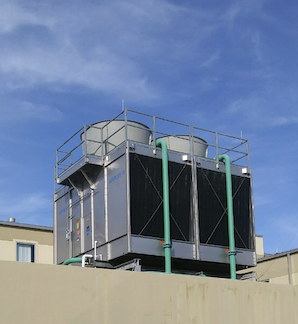
Spring is just around the corner! It’s time to start thinking about cooling tower cleaning. Spring is an ideal time for a thorough cleaning of your cooling tower and air cooling systems to ensure safety, improved indoor air quality (IAQ) and more energy-efficient systems.
Quick Answer: Cooling tower cleaning removes biofilm, scale, sediment and organic matter from the basin, fill media and distribution system, followed by disinfection to control Legionella. OSHA and ASHRAE 188 recommend cleaning a cooling tower at least twice a year — before the cooling season starts and after fall shutdown. Skipping it raises Legionella risk, can cut cooling efficiency by 10–25%, and can lead to costly fill media replacement.
Even though cooling towers are highly efficient at rejecting heat-producing cooling water, they’re not maintenance-free. Over time, nutrients, airborne dirt and debris collect within different components of cooling towers.
If not properly cleaned, these contaminants can cause blockages and corrosion, which impairs the operating efficiency and can lead to significant damage and possibly failure of the system. When a system is neglected or not cleaned properly, motors burn out. Sometimes, the damage is so severe that towers need to be rebuilt.
Another important reason for proper cooling tower cleaning is to prevent the spread of bacteria, including Legionella pneumophila, which can cause Legionnaires’ disease. Legionella, which is found in moist environments and water sources, can spread over a vast area due to drift (aerosols) carrying the bacteria from the tower. For a closer look at containment and disinfection protocols, see our guide to preventing the spread of bacteria in cooling towers.
Before powering on your air cooling systems, be sure to have them properly cleaned. While some cooling towers require more frequent cleaning due to continual operation throughout the year, OSHA (the Occupational Safety and Health Administration) recommends cooling towers be thoroughly cleaned and disinfected at least twice a year.
Cooling tower cleaning should be performed before the start of the cooling season and after shutdown in the fall. Systems with heavy biofouling or high levels of Legionella may require additional cleaning.
Any system that has been out of service for an extended period should be cleaned and disinfected. New systems require cleaning and disinfecting because construction material residue can contribute to Legionella growth.
| Trigger | Why It Matters |
| Visible biofilm, algae or scale | Once biofilm has formed on fill or basin surfaces, water treatment chemistry alone can no longer reach it. |
| Drop in cooling or chiller efficiency | A noticeable dip in approach temperature or chiller performance is a direct sign of scale and biofilm buildup. |
| Extended shutdown or idle period | Stagnant water during downtime creates ideal conditions for bacterial growth before restart. |
| New system startup | Construction residue in new towers can contribute to early Legionella growth if not cleaned before commissioning. |
| A positive water sample result | Results above your water management plan's action level call for immediate cleaning and disinfection, not just a chemistry adjustment. |
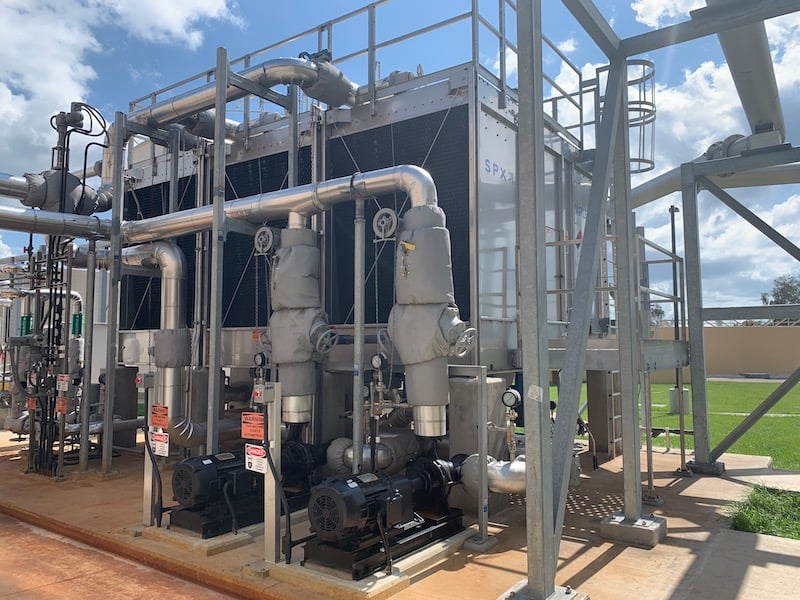
Here are some of the fundamental steps to properly clean cooling towers:
Fill-Media-Safe Cleaning: Aggressive methods — high-pressure water direct on the fill, caustic solvents, or wire-brush scraping — can crack or degrade PVC fill media and force an unplanned replacement.
A properly sequenced clean reaches the biofilm shielding Legionella from disinfectant while leaving the fill intact.
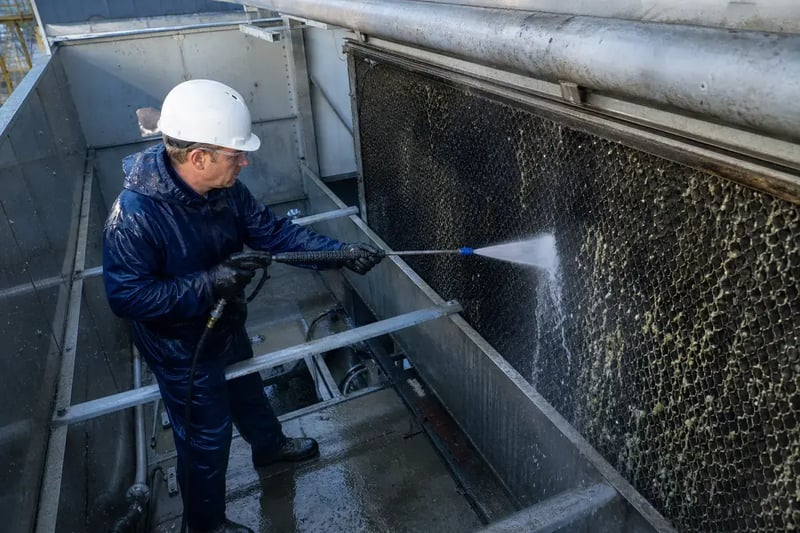
Deferred cleaning doesn’t just shorten the life of the tower — it creates risks that are far more expensive than the cleaning itself. Cooling towers are the leading source of Legionnaires’ disease outbreaks tied to building water systems, and unmanaged biofilm shields the bacteria from routine water treatment chemistry. Ohio facility managers can review the Ohio Department of Health's guidance on Legionella prevention in the building environment for local reporting expectations. Scale and biofilm buildup can also raise chiller-plant energy draw by 10–25% for the same cooling load, and in severe cases, deferred cleaning across multiple seasons can lead to structural fill failure during operation. The financial impact isn’t limited to towers, either — one Service-Tech customer avoided a $30,000 HVAC cooling coil replacement simply by having the buildup professionally cleaned before it caused permanent damage.
Worth Knowing: A well-known 2015 Legionnaires’ disease outbreak traced to cooling towers resulted in 138 confirmed cases and 16 deaths — a reminder that water treatment chemistry alone isn’t a substitute for scheduled physical cleaning and disinfection.
Cooling tower cleaning is typically priced by scope rather than a flat rate, since cost depends on several site-specific factors: tower tonnage and cell count, fill media condition, basin access and confined-space requirements, disinfection depth, and whether Legionella sampling is part of the engagement. Seasonal spring start-up and fall shutdown windows also tend to book up several weeks in advance, so cost and scheduling are best confirmed with a site walk rather than a general estimate.
Ready to get a quote? Service-Tech provides free estimates for cooling tower cleaning at commercial and industrial facilities nationwide. Request a free estimate or call us.
Service-Tech Corporation has provided ASHRAE 188-aligned cooling tower cleaning service for nearly 60 years. Our technicians are fully trained and experienced in OSHA protocols (e.g., lock out/tag out, containment, proper use of recommended equipment, respiratory protection, personal protective equipment (PPE) and other safety measures).
Cooling tower cleaning processes include, but are not limited to:
Our capabilities include servicing different components throughout the systems, from the rooftop fan housing down to the sump pit. Project leaders assess how to best serve the needs of each system and assemble the right team for the project.
With proper cooling tower cleaning, you can extend the life of your cooling towers. We’ve saved numerous customers from having to replace their systems by applying several different cleaning techniques for the different components in a system, including fans, spray nozzles, basins and fill and drift eliminators.
If you want to learn more about our cooling tower services or schedule an appointment, feel free to contact us.
At minimum, twice a year — before the cooling season starts and after fall shutdown — per OSHA and ASHRAE 188 guidance. Towers with heavy biofouling, high Legionella levels, or continuous year-round operation may need more frequent cleaning.
Cost varies by tower size, cell count, fill condition and disinfection scope, so cooling tower cleaning is typically priced after a site walk rather than as a flat rate. Request a free estimate for a fixed-price quote specific to your system.
Unmanaged biofilm and scale raise Legionella risk, can cut chiller efficiency by 10–25%, and in severe cases lead to motor burnout or structural fill failure that takes the tower offline.
Yes — but it requires a controlled process. Over-aggressive pressure washing, caustic solvents, or wire-brush scraping are common causes of fill damage that forces an unplanned replacement. A properly sequenced cooling tower cleaning removes biofilm while preserving the fill.
Requirements vary by jurisdiction, but ASHRAE 188 and several state and municipal programs require documented cleaning and an active water management plan for cooling towers, particularly for hospitals and other high-risk facilities.
Continue exploring cooling tower and HVAC cleaning topics from Service-Tech:
Minimize machine downtime and maintain a clean and safe environment for your employees with an HVAC system cleaning partner backed by a history built on hard work, integrity and a commitment to excellent service. Let’s talk about a cleaner, healthier environment.
