800.992.9302

(Updated July 16, 2026)
Hot water pressure washing is one of the most effective ways to away dirt and grease from the filters of a restaurant’s kitchen hood. Restaurants and cooking operations are required to follow specific processes and protocols established by the National Fire Protection Agency (NFPA) in maintaining their kitchen exhaust systems. Dirty filters impair air flow and can damage other components in the hood and the exhaust fan – all of which can increase chances of a grease fire.
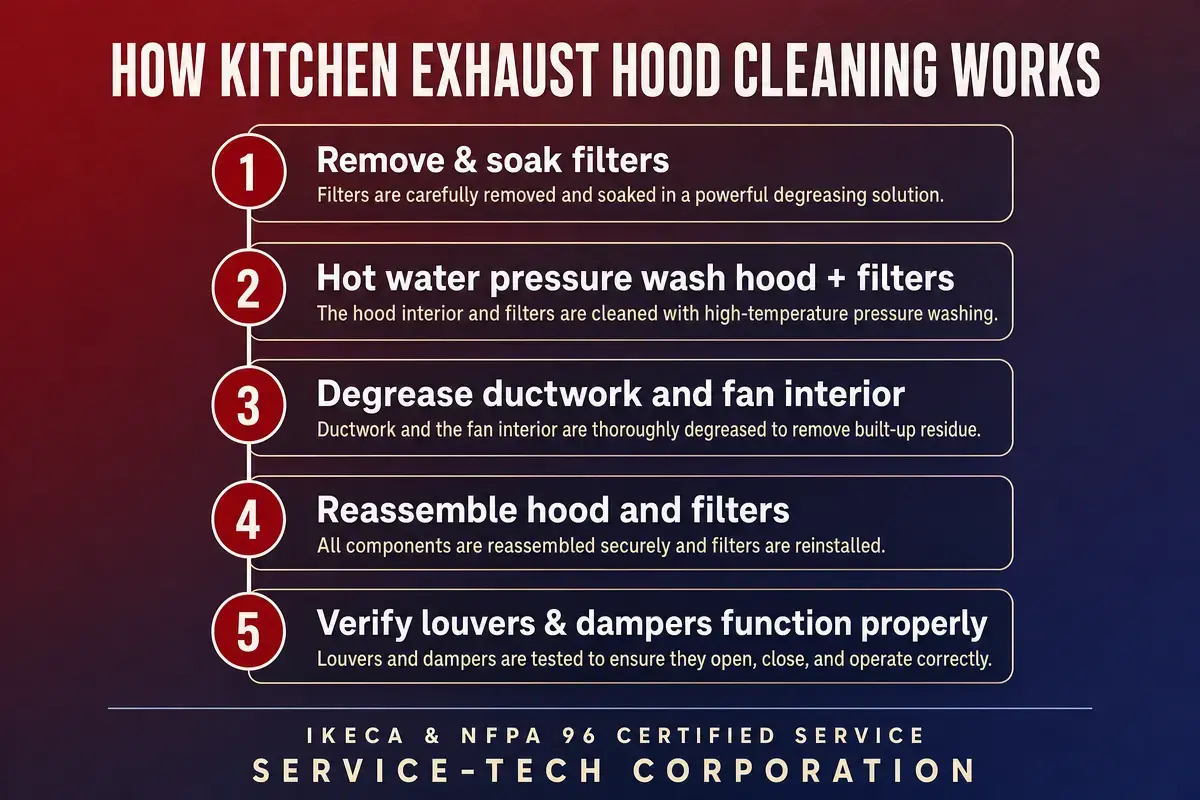
Quick Answer: Professional kitchen exhaust hood cleaning uses hot water pressure washing to strip grease from filters, hood surfaces, ductwork, and the exhaust fan — the same process shown in the video above. IKECA-certified technicians remove and soak filters, degrease the hood interior and ductwork, then reassemble and verify louvers and dampers function properly before signing off.
For a full breakdown of what NFPA 96 requires and what a complete service covers, see our kitchen exhaust hood cleaning compliance guide.
Service-Tech technicians are trained to comply with NFPA standards and are certified by the International Kitchen Exhaust Cleaning Association (IKECA) to inspect and clean all components and ductwork in kitchen exhaust systems including the interior surfaces of the hood, filters, ducts and exhaust fans. During our service of kitchen exhaust systems, we also check for possible blockages and verify louvers and dampers are functioning properly.
A complete cleaning follows the same sequence in every service, whether it's a single-hood restaurant kitchen or a multi-line institutional facility:
| Step | What Happens | Why It Matters |
| 1 | Remove & soak filters | Loosens baked-on grease before pressure washing so filters clean fully instead of just on the surface. |
| 2 | Hot water pressure wash hood & filters | Hot water breaks down grease far more effectively than cold water or degreaser alone — the process shown in the video above. |
| 3 | Degrease ductwork & fan interior | This is where grease poses the greatest fire risk, and where discount services often skip entirely. |
| 4 | Reassemble hood & filters | Filters are returned to their original position so airflow performs as designed. |
| 5 | Verify louvers & dampers | Confirms the system is functioning properly and ready for inspection, not just visibly clean. |
Cold water and chemical-only methods can loosen light residue, but they don't fully break down the baked-on grease that accumulates inside a working kitchen exhaust system. Hot water pressure washing melts grease at a molecular level, allowing it to be flushed out of filters, hood surfaces, and ductwork rather than smeared around or partially dissolved.
This is also where corners get cut. Some lower-cost providers rely on cold-water rinses or vacuum-only methods that clean what's visible but leave grease behind in the ductwork and fan housing. Service-Tech's IKECA-certified kitchen exhaust hood cleaning service uses hot water pressure washing on every component of the system, not just the parts that are easy to reach.
Between scheduled services, watch for these warning signs that grease buildup is affecting your system:
Any of these can point to airflow problems building up inside the system, which get worse — and more expensive to fix — the longer they're left unaddressed.
Ready to get a quote? Service-Tech provides free estimates for kitchen exhaust hood cleaning at commercial and industrial facilities nationwide. Request a free estimate or call 866.682.7727.
Most single-hood restaurant kitchens take a few hours for a complete cleaning, including filter removal, hot water pressure washing, ductwork degreasing, and reassembly. Larger systems with multiple hoods or longer duct runs take longer.
Not necessarily. Most kitchen exhaust hood cleaning can be scheduled around off-hours or between meal services so your kitchen stays operational. Talk to your provider about timing that fits your service schedule.
Filter cleaning only addresses the removable baffle filters. A full kitchen exhaust hood cleaning covers the filters plus the hood interior, ductwork, and exhaust fan — the areas where grease buildup poses the greatest fire risk.
Yes. Hot water pressure washing is the standard method for cleaning stainless steel hood surfaces and filters without damaging the finish, and it removes grease more completely than cold water or chemical-only cleaning.
Surface-only services skip this step, but a complete, code-compliant kitchen exhaust hood cleaning requires removing access panels to reach and degrease the ductwork — not just the visible hood and filters.
Minimize machine downtime and maintain a clean and safe environment for your employees with an HVAC system cleaning partner backed by a history built on hard work, integrity and a commitment to excellent service. Let’s talk about a cleaner, healthier environment.
