800.992.9302

 (Updated July 6, 2026)
You’ve probably read about the unfortunate crisis at Jeni’s Splendid Ice Cream. After listeria bacteria was found in a pint of Jeni’s Dark Chocolate ice cream, the company shut down operations for several weeks, costing it hundreds of thousands of dollars.
Quick Answer: The Jeni’s Splendid Ice Cream shutdown is one of the clearest real-world examples of what happens when food plant sanitation breaks down. FDA inspectors traced the listeria outbreak to gaps most facilities can avoid — missing sanitizer stations and dirty air ducts above prep areas — and the case still holds lessons for any food plant today.
According to an article in The Columbus Dispatch, FDA inspections discovered 11 issues at Jeni’s Michigan Avenue plant, including: lack of floor sanitizer; no sanitation stations at kitchen access points; and dirt, dust or other substances on fixtures and air ducts above or near food-prep areas. Fortunately for ice-cream fanatics and Jeni’s fans, Jeni’s has resumed production and reopened its stores after promptly and responsibly addressing the problems at the plant — but at great cost.
Jeni’s is not the only company to be unaware of proper cleaning and sanitation procedures. Sadly, this is not all that uncommon. Jeni’s can be an important lesson: Don’t let dirt and debris contaminate your facilities and disrupt operations. Be sure to have your facilities properly cleaned according to government regulations.
Alan Sutton
President
866.464.2135

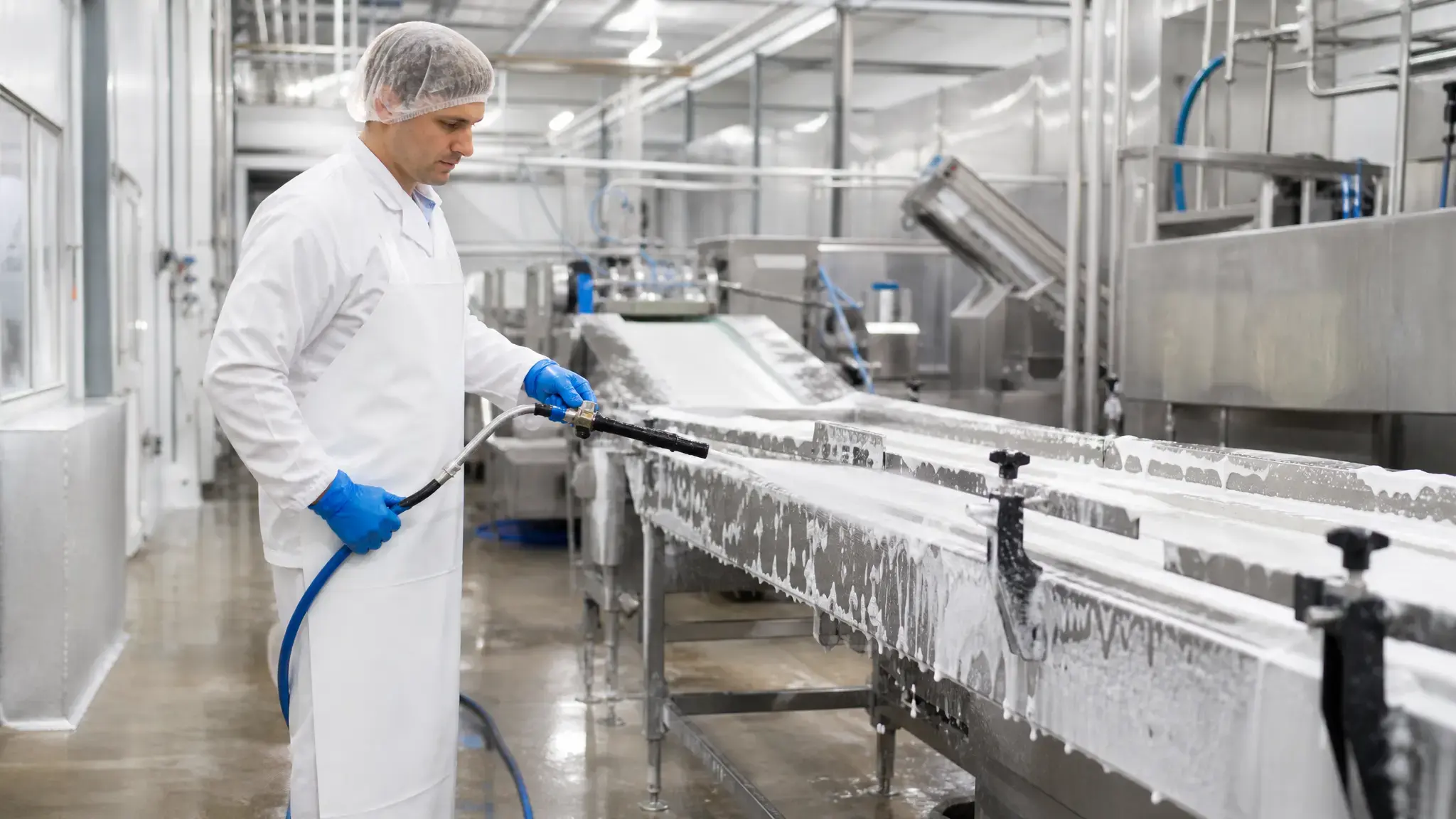
Two of the FDA's findings at Jeni's — no floor sanitizer and no sanitation stations at kitchen access points — point to a distinction that trips up a lot of food plants: cleaning and sanitizing are not the same step, and skipping either one leaves a facility exposed.
| Step | What It Does | Typical Method |
| Cleaning | Removes visible soil, food residue, grease, and debris from a surface | Detergent wash, scrubbing, rinsing |
| Sanitizing | Reduces microorganisms on an already-cleaned surface to a safe level | Chemical sanitizer, heat, or steam treatment |
A missing floor sanitizer means the cleaning step wasn't followed through to sanitizing. A missing sanitation station means employees had no way to sanitize on the way into a prep area at all. Neither is a dramatic failure on its own — which is exactly why both went unnoticed until an inspector found them.
The dust and debris the FDA found on fixtures and air ducts near food-prep areas didn't appear overnight. That kind of buildup is usually a sign that a few specific pieces of a sanitation program weren't in place:
Sanitation Standard Operating Procedures (SSOPs): Written instructions for how, when, and with what each surface gets cleaned. Without them, "clean the air ducts" isn't assigned to anyone on a schedule.
Master sanitation schedule: A documented calendar covering every zone — not just food-contact surfaces, but the floors, fixtures, and air handling systems that Jeni's inspection flagged.
Verification: A way to confirm sanitation actually happened, rather than assuming it did.
Pest control: Ongoing monitoring, since the same dust and debris that drew FDA attention also attracts pests.
Worth Knowing: This isn't optional housekeeping — it's a federal requirement. The FDA's Current Good Manufacturing Practice regulations require documented sanitation controls for facilities producing human food.
Pro Tip: Air ducts and HVAC systems are cleaned far less often than food-contact surfaces, which is exactly why they were the blind spot in Jeni's case.
Service-Tech's food plant sanitation services include air duct and HVAC cleaning specifically designed to close this kind of gap before it shows up on an inspection report.

Part of what makes the Jeni's case instructive is that none of the 11 issues required exotic equipment or a big budget to prevent — they required a schedule that assigned the right frequency to the right zone, and a way to verify it was followed.
| Zone / Surface | Recommended Frequency |
| Food-contact surfaces & utensils | Every 4 hours or between product changeovers |
| Floors & drains | Daily, end of shift |
| Walls & fixtures | Weekly to monthly |
| Air ducts & HVAC systems | Quarterly to annually, or per manufacturer/regulatory guidance |
| Exterior & grounds | Monthly |
The other half of the equation is proof. Following the FDA's HACCP principles — identifying where contamination risk is highest, controlling it, and keeping records — is what lets a facility show an inspector it's compliant every day, not just the day of the visit. And the risk isn't limited to air and food-contact surfaces: cooling towers and water systems can harbor Legionella just as easily as air ducts harbor Listeria, so the same review should extend to every water and air system in the facility.
Ready to get a quote? Service-Tech provides free estimates for food plant sanitation at commercial and industrial facilities nationwide. Request a free estimate today.
Inspectors cited 11 issues at Jeni's Michigan Avenue plant, including a lack of floor sanitizer, no sanitation stations at kitchen access points, and dirt, dust, and debris on fixtures and air ducts near food-prep areas.
Cleaning removes visible soil, grease, and food residue from a surface. Sanitizing is a separate step that treats an already-cleaned surface to reduce microorganisms to a safe level — food plant sanitation requires both, in that order.
Air ducts and HVAC systems typically need attention on a quarterly-to-annual basis, though the right frequency depends on facility size, product type, and manufacturer or regulatory guidance — waiting too long is what caught up with Jeni's.
Yes. Dust, debris, and biological growth inside ductwork above prep areas can settle directly onto food and equipment — this was one of the FDA's specific findings during the Jeni's Splendid Ice Cream listeria investigation.
The food manufacturer is ultimately responsible, even when sanitation work is contracted out. Most facilities designate a sanitation manager or PCQI (Preventive Controls Qualified Individual) to own the program and maintain records.
Minimize machine downtime and maintain a clean and safe environment for your employees with an HVAC system cleaning partner backed by a history built on hard work, integrity and a commitment to excellent service. Let’s talk about a cleaner, healthier environment.
