800.992.9302

(Updated June 2, 2026)
Whether you run a restaurant, hospital, school, nursing home or any place with a commercial kitchen or other ventilation needs, hood cleaning is a crucial component of facility health, maintenance, and compliance.
Quick Answer: Kitchen exhaust hood cleaning is the process of removing grease buildup from the complete exhaust path — from hood canopy and filters through the ductwork to the rooftop fan — to prevent fires and maintain NFPA 96 compliance. NFPA 96 requires commercial kitchen hoods to be inspected and cleaned anywhere from monthly to annually, depending on your cooking volume and fuel type. IKECA-certified technicians, like those at Service-Tech Corporation, are trained to clean the full system to code — not just the visible surfaces.
Hood cleaning is cleaning and maintaining a kitchen exhaust or ventilation system to comply with the NFPA (National Fire Protection Association) and your local AHJ (Authorities Having Jurisdiction).
Complete hood cleaning includes maintenance of (but is not limited to) the following:
Depending on how often and to what intensity your hoods are used, cleaning maintenance of your hoods will vary. To best maintain your commercial and industrial equipment, you’ll need to be mindful of three primary factors:
A full kitchen exhaust hood cleaning covers the entire system from cooking surface to rooftop — not just the visible surfaces. Many lower-cost services only clean what they can reach without removing panels. This leaves grease in the ductwork where it poses the greatest fire risk and fails to meet NFPA 96 requirements.
Here is what a complete, NFPA 96-compliant hood cleaning service should cover:
| Component | What Gets Cleaned |
| Hood Canopy | Interior surfaces, underside, and all grease-contact areas of the hood |
| Filters / Baffle Filters | Removed, scraped, and washed; replaced in original position |
| Plenum | The air-collection chamber between filters and ductwork; fully degreased |
| Horizontal Ductwork | Scraped and washed; access panels opened for deep interior cleaning |
| Vertical Ductwork | Full interior cleaning to rooftop; manual entry for hard-to-reach sections |
| Exhaust Fan & Housing | Fan blades, interior and exterior housing, and drip pans hot-washed |
| Rooftop Grease Path | Fan housing exterior, curb, and any rooftop containment area |
| Louvers & Dampers | Cleaned and checked for proper operation |
Service-Tech Difference: Our technicians use manual entry to reach areas inside ducts that vacuum-only services cannot access — the same standard used to service facilities like NASA, Cleveland Clinic, and GE. Every visit is documented with before-and-after photos and an IKECA Proof-of-Performance decal for your fire marshal, insurance carrier, and inspection records.
The National Fire Protection Association (NFPA) is an international safety advisory organization that develops codes and best practices for fire prevention. In the US, they regulate commercial and industrial facilities through codes employed by various authorities.
The NFPA 96 is the “Standard for Ventilation Control and Fire Protection of Commercial Cooking Operations.”
The NFPA 96 regulates how grease and hood filters should be installed and maintained for cleaning.

 According to NFPA 96, your hoods should be inspected (not necessarily cleaned) anywhere from every month to every year, depending on the frequency of use.
For example, a restaurant or manufacturing plant will likely need their hoods inspected every 1-3 months, while a nursing home or church may only have to have their hoods inspected every six months or even just once a year.
But NFPA 96 guidelines aren’t the only factor. You may notice grease buildup on your hood filters and determine they need to be cleaned sooner than expected.
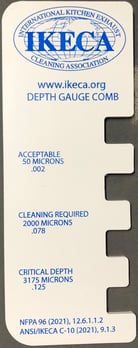
To determine if your hoods have become too greasy, you may use a grease gauge (example pictured, used with permission from IKECA) to determine if your buildup is within the acceptable microns level.
Additionally, depending on your city or county, additional local regulations may require more frequent cleaning than the NFPA 96 mandates.
Remember: The NFPA 96 is the minimum requirement, not necessarily the only requirement.
| Type/Volume of Cooking | Inspection Frequency |
|
Systems serving solid fuel cooking operations |
Monthly |
| Systems serving high-volume cooking operations, such as 24-hour cooking, charbroiling, or wok cooking |
Quarterly |
| Systems serving moderate-volume cooking operations |
Semi-Annually |
| Systems Serving low-volume cooking operations, such as churches, day camps, seasonal businesses, or senior centers | Annually |
The price of hood cleaning depends on the size and complexity of your ventilation system. For a single kitchen hood, you can expect hood cleaning services to cost at least $400-$600 for a complete cleaning that follows NFPA 96. Service-Tech's minimum engagement is $599.
You may be able to find cleaning for even less. However, it is important to note that you get what you pay for with hood cleaning.
Discount hood cleaning is often performed by a service company that isn’t certified by the International Kitchen Exhaust Cleaning Association (IKECA) to perform NFPA 96 inspections. What’s more, these discount cleaning services have a reputation for cutting corners by only cleaning visible areas instead of removing panels to clean in unseen places.
Several factors affect the total cost of a kitchen exhaust hood cleaning service:
| Cost Factor | Impact on Price |
| Number of hoods | Each additional hood adds to the total; multi-hood facilities often qualify for bundled pricing |
| System size and duct length | Longer or more complex duct runs require more labor and cleaning time |
| Grease load / time since last cleaning | Heavy or overdue systems require more intensive work and may cost more |
| Access panel installation | First-time clients may need access panels cut for proper duct entry — a one-time additional cost |
| Facility type | Institutional kitchens (hospitals, universities) with multiple cooking lines have higher complexity |
| Service frequency | Clients on a recurring monthly or quarterly schedule receive a lower per-visit rate |
Worth Knowing: Skipping regular hood cleaning doesn't save money — it costs more. A single grease fire can cause tens of thousands of dollars in equipment damage, business interruption, and insurance complications. Deferred cleaning can also result in $50,000–$200,000 in premature roof-membrane replacement from unchecked rooftop grease leakage. Facilities on a certified cleaning schedule also tend to pay lower insurance premiums and pass fire inspections without costly re-inspections.
Ready to get a quote? Service-Tech provides free estimates for kitchen exhaust hood cleaning at commercial and industrial facilities nationwide. Request a free estimate today.
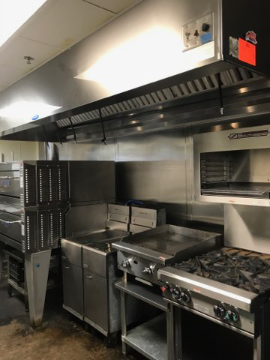
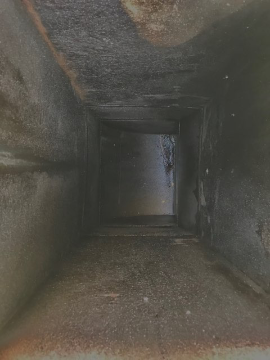
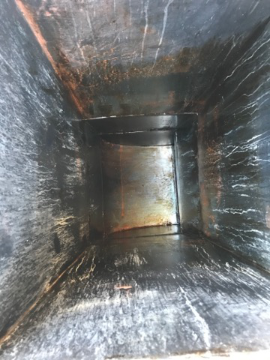
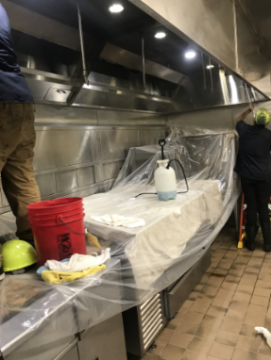
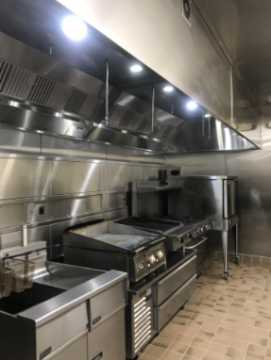
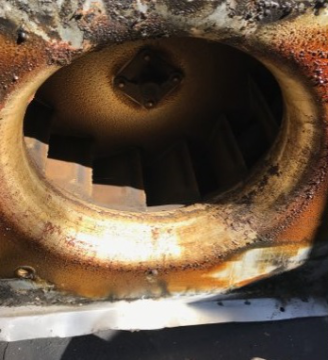
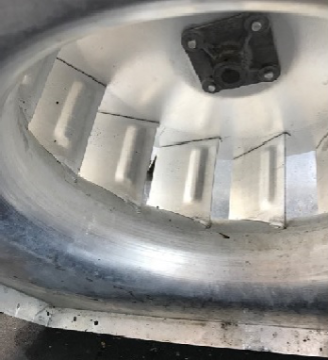
Failure to keep up with regular cleaning is a risk to compliance – which can result in costly fines and closures – and also a danger to your property, equipment, and personnel.
The primary risk is fire. Grease is a flammable substance. As it builds up, the chance of a grease fire intensifies.
Next is equipment damage. As the filter traps more grease, it does its job less effectively. The more grease in your filter, the more grease in the air collecting on machinery and equipment. As this grease builds up, your equipment has to work harder, causing machinery components to wear out quicker.
Finally, is the health factor. With dirty hoods comes poor indoor air quality. This, in turn, affects employee health, leading to more sick days and less efficient labor. Additionally, your food products become contaminated, leading to a loss in quality. Kitchen exhaust hood cleaning is just one part of a complete ventilation maintenance program - dryer exhaust systems carry the same fire risk and require the same attention.
Not all hood cleaning services are equal — and when NFPA 96 compliance, insurance coverage, and fire safety are on the line, the difference matters. Here's what to verify before hiring:
NFPA 96 applies to any facility with a commercial cooking operation — not just restaurants. If there is a commercial kitchen in your building, you are required to maintain a compliant cleaning schedule. Facilities commonly serviced by Service-Tech include:
| Facility Type | Why Regular Cleaning Matters |
| Restaurants & Food Service | High-volume cooking creates heavy grease loads requiring quarterly or more frequent service |
| Hospitals & Healthcare Facilities | Patient safety and Joint Commission compliance make clean exhaust systems non-negotiable |
| Universities & K–12 Schools | High-volume cafeteria kitchens serving hundreds of meals daily need consistent compliance documentation |
| Government & Military Facilities | GSA contract requirements and federal standards mandate certified service providers |
| Manufacturing Plants with Cafeterias | OSHA and NFPA 96 compliance both apply; grease fires in industrial settings pose greater risk |
| Hotels & Hospitality Venues | Multiple kitchen lines require coordinated scheduling and thorough documentation |
| Food Processing Facilities | FDA and food safety regulations compound NFPA 96 requirements for clean exhaust systems |
Service-Tech provides kitchen exhaust hood cleaning at commercial and industrial facilities nationwide, with offices in Cleveland, Columbus, and Dayton, Ohio; Tampa and Tallahassee, Florida; and Pine Bluff, Arkansas.
Whether you need your regular NFPA 96 inspection, someone to help you determine if it’s time for a clean, or you’re ready to have all your vents and hoods thoroughly cleaned, Service-Tech is here for you.
We’re IKECA-certified to perform NFPA 96 inspections and service all your airflow systems. When you have your vents cleaned by Service-Tech, you get the same team that helps NASA, Nestle, GE, and many US government agencies keep their air clean and regulated.
Ready to partner with a proven and trusted commercial and industrial air quality expert? Request a free estimate today.

NFPA 96 requires kitchen exhaust hood cleaning anywhere from monthly to annually depending on cooking volume and fuel type. High-volume or solid-fuel operations — charbroiling, wok cooking, 24-hour kitchens — require monthly inspection. Moderate-volume kitchens clean semi-annually. Low-volume facilities like churches or senior centers may only need annual service. Your local AHJ (Authority Having Jurisdiction) may require more frequent cleaning than the NFPA 96 minimum, so always confirm with your local fire marshal or health authority.
A complete hood cleaning covers the full exhaust path from cooking surface to rooftop: hood canopy and filters, the plenum (air collection chamber), all horizontal and vertical ductwork including hard-to-reach internal sections, exhaust fans and fan housing, and the rooftop grease containment area. IKECA-certified providers like Service-Tech use manual entry into ductwork to clean areas that vacuum-only services miss entirely. After every service, we provide before-and-after photos and an IKECA Proof-of-Performance decal for your fire marshal and insurance records.
A single commercial kitchen hood cleaning typically starts at $599 for a complete NFPA 96-compliant service. Costs increase for larger systems, more complex ductwork, heavier grease loads, or facilities with multiple hoods. Discount services below this range often skip manual duct entry and only clean visible surfaces — which fails NFPA 96 standards and can void your insurance coverage in the event of a fire. Contact Service-Tech for a free estimate tailored to your specific facility.
Look for IKECA (International Kitchen Exhaust Cleaning Association) certification, which qualifies technicians to perform NFPA 96 inspections and full-system cleaning. IKECA-certified companies are trained to clean the complete exhaust system including internal ductwork panels, not just surface-visible areas. Service-Tech is IKECA-certified and also holds NADCA certification for air duct systems, plus a GSA contract qualifying it to serve US government facilities.
A failed hood inspection can trigger fines from local fire marshals or the AHJ, mandatory operational shutdowns until compliance is restored, and in some cases, loss of insurance coverage or increased premiums. NFPA 96 places legal responsibility for compliance on the facility owner unless that responsibility has been transferred in writing to a management company. Staying ahead of the inspection schedule with a certified provider is always less costly than responding after a violation — and Service-Tech's IKECA Proof-of-Performance decal ensures you have the documentation to prove compliance at every inspection.
Minimize machine downtime and maintain a clean and safe environment for your employees with an HVAC system cleaning partner backed by a history built on hard work, integrity and a commitment to excellent service. Let’s talk about a cleaner, healthier environment.
