Quick Answer: Kitchen exhaust hood cleaning removes grease, lint, and debris from the ductwork and fan system so air can move freely through your kitchen's ventilation. When hoods go uncleaned, blockages build up and cause airflow imbalances, higher fire risk, and NFPA 96 compliance violations. Most commercial kitchens need professional cleaning every 1–6 months depending on cooking volume and fuel type.
Kitchen exhaust hood cleaning is the process of removing grease, lint, dust, and other airborne debris from a commercial kitchen's ventilation system — the hood, ductwork, fans, and rooftop exhaust fan housing that pull smoke, heat, and grease-laden vapor out of the cooking area. Unlike a quick filter wipe-down, a full cleaning service reaches deep into the ductwork itself, where grease vapor condenses and accumulates over time.
Every commercial kitchen exhaust system depends on unobstructed airflow to work. When grease and debris build up along the duct walls, the system has to work harder to move the same amount of air — and eventually, it can't keep up.
Grease-laden vapor is the main culprit. As hot air carries cooking grease up through the hood and into the ductwork, it cools and condenses on the interior duct walls — the same way steam fogs a cold window. Over weeks and months, that condensed grease hardens into a sticky coating that traps lint, dust, and airborne food particles, narrowing the duct's effective diameter and restricting airflow.
A few factors accelerate the buildup:
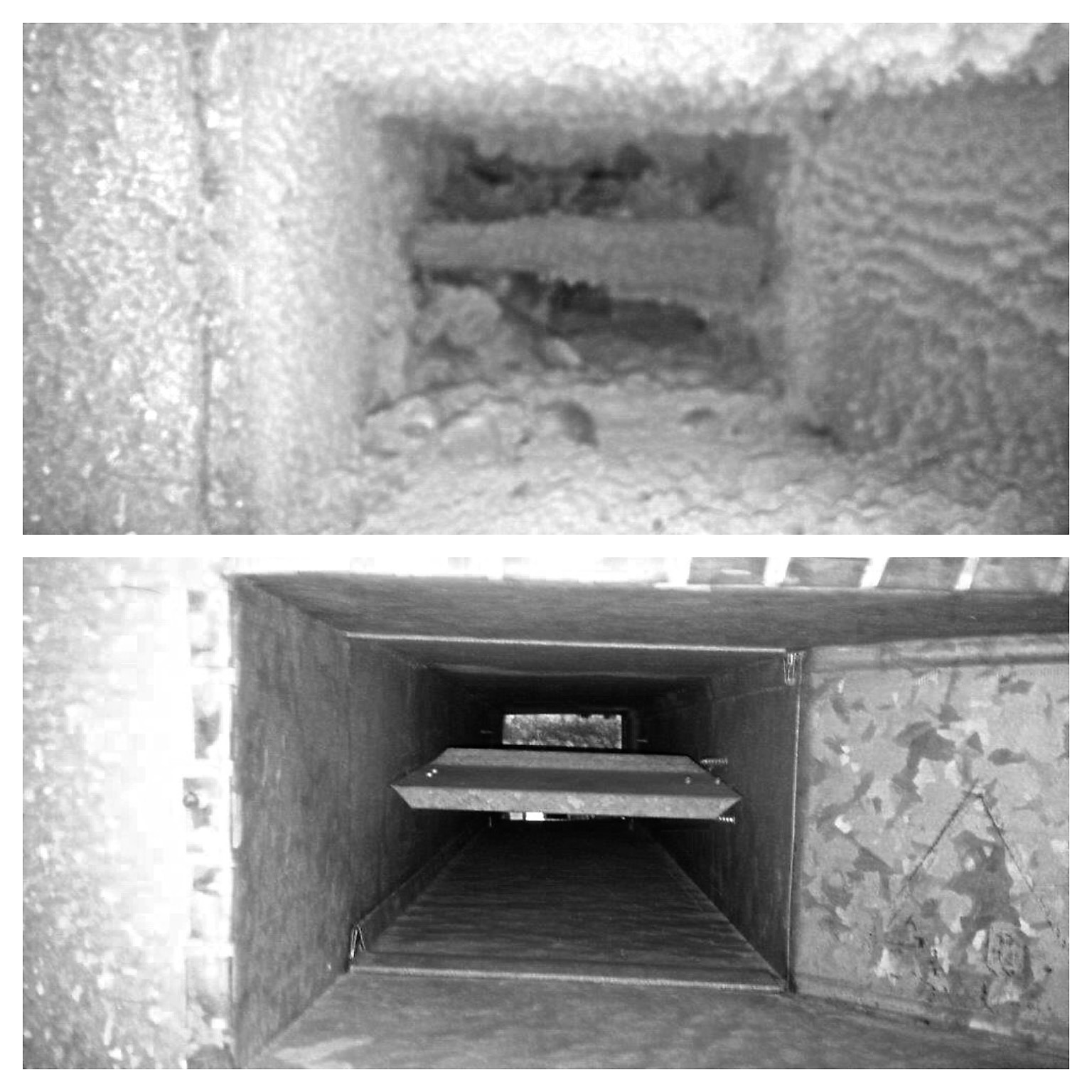
The same basic mechanism — airborne debris collecting inside ductwork until it restricts airflow — shows up across all kinds of exhaust systems, not just kitchens, as the case study below illustrates.
Airflow problems rarely appear overnight. They build gradually, which is exactly why so many kitchens don't catch them until a fire marshal, insurance inspector, or a genuinely bad grease fire forces the issue. Watch for:
Any one of these on its own is worth a look. Two or more together usually means the ductwork — not just the filters — needs professional attention.
The consequences of a neglected exhaust system aren't limited to commercial kitchens — the same buildup-and-blockage pattern plays out in any high-traffic facility with mechanical exhaust, as one of our own service calls shows.
A large Midwest hospital was experiencing air flow imbalances on the floors of its patient rooms but didn’t know why. It wasn’t until a major remodeling project of the patient rooms that the source of the problem was discovered -- the toilet exhaust system had collected a gross amount of debris and contamination. This is not uncommon. Because of the daily linen changes in patient rooms and the amount of activity in a hospital environment, a significant amount of lint and dust collects in toilet exhaust systems overtime and begins to restrict the air flow.
Service-Tech technicians removed the dirt and debris of the hospital’s toilet exhaust system by accessing the ductwork at strategic locations. Utilizing a combination of air pressure, vacuuming and rotary brushes, our crew got the system clean and working efficiently again.
Avoid buildup of contaminants and air flow imbalances in your building or facility by scheduling regular cleaning and service of your exhaust systems - including kitchen exhaust hood cleaning which carries mandatory NFPA 96 compliance requirements for any facility with a commercial kitchen. Give us a call!
Beyond airflow imbalances, poor exhaust maintenance has documented indoor air quality consequences. According to OSHA's guidance on indoor air quality in commercial and institutional buildings, restricted ventilation can allow contaminants to accumulate to levels that affect occupant health and comfort — a concern the National Institute of Environmental Health Sciences also flags as a growing public health issue.
Yes. Commercial kitchen exhaust systems are governed by NFPA 96, the Standard for Ventilation Control and Fire Protection of Commercial Cooking Operations, which sets cleaning frequency, inspection, and documentation requirements enforced by your local fire marshal or authority having jurisdiction (AHJ). Most insurance carriers also require proof of NFPA 96–compliant service to maintain coverage.
OSHA's ventilation standards add another layer of context for facility ventilation generally: 29 CFR 1910.94 covers general industry ventilation requirements, while 29 CFR 1926.57 applies the same principle to construction environments — both reflect the same underlying idea that mechanical exhaust systems have to keep working as designed, not just be installed. On the design side, ASHRAE Standards 62.1 and 62.2 set the broader ventilation and indoor air quality benchmarks that commercial HVAC and exhaust systems are typically engineered against.
Worth Knowing: NFPA 96 compliance isn't optional documentation — it's what a fire marshal checks during inspection, and what your insurer checks after a claim.
For the full breakdown of NFPA 96 cleaning frequencies, IKECA certification, and what a compliant cleaning has to include, see our Kitchen Exhaust Hood Cleaning: NFPA 96 Compliance Guide.
Professional kitchen exhaust hood cleaning reaches the parts of the system a filter swap or a surface wipe-down can't touch. Technicians access the ductwork at strategic points along its run, then use a combination of air pressure, vacuuming, and rotary brushes — the same core methods used across grease, lint, and debris removal in any exhaust system — along with a steam-based degreasing process to break down hardened grease inside the duct itself, not just at the hood opening.
This is a variation on the same engineering-control principle used in other industries with heavy airborne contaminant loads. NIOSH's research on local exhaust ventilation systems in printing operations, for example, documented emission reductions of over 80% once ductwork was properly maintained and airflow restored — the same underlying logic applies to a kitchen exhaust system clogged with grease.
Worth Knowing: Cost depends on hood count, cooking volume, grease load, and duct/roof access — not a flat rate. Our NFPA 96 Compliance Guide breaks down exactly what drives pricing.
Ready to get a quote? Service-Tech provides free estimates for kitchen exhaust hood cleaning at commercial and industrial facilities nationwide. Request a free estimate or call us today.
Wiping down a hood's exterior or hand-washing a grease filter is reasonable routine maintenance between professional services — and it's roughly the extent of what most kitchen staff can safely do. It's a fundamentally different job from cleaning the ductwork itself, which requires roof or duct access, specialized equipment, and NFPA 96–compliant documentation that a facility can present to a fire marshal or insurer.
It's worth noting the EPA draws a similar line for residential systems: its guidance on whether homeowners should have air ducts cleaned notes that duct cleaning is warranted in specific situations — visible mold, pest infestation, heavy debris — rather than as a routine DIY task, and recommends verifying a provider's qualifications before hiring. The same logic scales up considerably for a commercial kitchen system, where the EPA's own HVAC design guidance treats exhaust and ventilation maintenance as a system-level responsibility, not a spot-clean.
In practice: surface cleaning is a DIY-appropriate task between services. Duct, fan, and rooftop cleaning is a job for a certified provider — both because of the equipment involved and because NFPA 96 compliance depends on documented, professional service.
Kitchen Exhaust Hood Cleaning: NFPA 96 Compliance Guide — cleaning frequencies, cost factors, and IKECA certification explained
Industrial Air Duct Cleaning — how STC handles large-scale ductwork beyond the kitchen
Why STC — what sets our crews and certifications apart
Greg Lint
National Sales Manager
866.682.7727
Grease-laden vapor from cooking condenses on the interior duct walls as it cools, gradually hardening into a sticky coating that traps lint, dust, and food particles. Cooking volume, fuel type, and how well grease filters are maintained all affect how fast this buildup happens.
Restricted ductwork causes airflow imbalances, lets smoke and heat linger in the kitchen, raises fire risk significantly, and can trigger a failed fire marshal or insurance inspection. Left long enough, grease buildup can also damage exhaust fans and rooftop equipment.
Weak or uneven airflow, visible grease on the hood or filters, a persistent burning smell, smoke that doesn't vent properly, and a straining or unusually loud exhaust fan are the most common signs. Any of these warrants an inspection.
Surface wiping and filter washing are reasonable DIY tasks between services. Cleaning the ductwork, fans, and rooftop exhaust housing requires specialized equipment, roof/duct access, and NFPA 96–compliant documentation, which is why that part of kitchen exhaust hood cleaning is a job for a certified provider.
They're related but not identical. Kitchen exhaust hood cleaning specifically targets the grease-laden ventilation system above a commercial cookline and falls under NFPA 96. General duct cleaning covers a building's broader HVAC ductwork and isn't subject to the same fire code.